
A Day in the Life of a Woman Who Single-Handedly Saved the World

This short story was written to imitate the style of classic science fiction novels of the late 20th century. It takes place in an alternate reality where people are imbued with powers, but at a cost.
Heroes can only save the world once. That’s the most that their minds, bodies, and abilities can handle. Most of them go out spectacularly, dying by punching a giant meteor out of the sky or performing another heroic act, while others decay slowly. Some of them will save the day and be rendered catatonic forever. The term “Reaching Divinity” was popularized by a philosopher who sought an answer to the question of why no hero has ever saved the world twice.
Heroes don’t have secret identities, as you may have come to expect from popular media. We call them “persons of power” or POPs for short. They’re treated more akin to athletes. Some POPs may have a nickname. Mostly, expect to see a simple headline such as: “James McLorlane, a person of power, holds onto cables to support a collapsing suspension bridge, buying time for commuters to escape to safety.” James exerted himself to the point where he had a massive cerebral hemorrhage and died on the spot. There is not much reason to protect their identity because most POPs only have their powers for a matter of hours.
There are rumors of POPs hiding their powers and living their everyday lives. It is understandably hard to report on which of the eight billion people on the planet are lying about who they are. It is the way of life. If someone has powers, they have to use them. Either become a villain or become the hero that stops them. The world has no room for POPs in the bleachers of life. The balance of the world isn’t a spectator sport for those among us bestowed with the abilities of a god.
Physically, there is nothing remarkable about POPs. Those with super-strength, allowing them to pick up buses easily, have average, sometimes even mediocre muscle structure. Those who can fly seem to do so without any form of propulsion. POPs have come and gone who can shoot fire from the palms of their hands but are not fireproof. A few governments, such as China, would dissect deceased POPs to reverse engineer whatever gave them their powers, potentially.
“Reaching Divinity” describes the event in which a POP achieves their life purpose. They have already been blessed with the abilities of a god by an unknown force, and they reach divinity upon saving humankind. Churches that worship POPs or cults that worship a specific one are increasing in quantity and popularity. The world watches on as the POPs fulfill their destiny, and lose everything. At the same time, we ordinary humans, the unremarkable ones, have to sit by helplessly.
If a POP reaches divinity and “lives,” they receive world-class medical care to live out the remainder of their lives. I run a facility specializing in the “post-divinity care center” of people of power. My name is Scott Crowley, but most call me Dr. Do-Nothing. They call me that because, by all metrics, I’m a failure. Throughout the last seventeen years as the director of the PDC, I have not been able to improve the condition of any of the Post Divinity People of Power (PDPOP) released into my care. Shells of people arrive at my facility, and they stay that way.
The POPs disappear from the public eye, no one knows where they go, but they know they receive exceptional care. Friends and family of the POPs don’t even know where they are. At the first PDC, we allowed the immediate family to visit, but I wasn’t the director of the first PDC. Specific issues arose from allowing visitors, mainly that we couldn’t vet the family to ensure necessary security precautions. One of the POPs at the first PDC had a family member scheduled to visit them. A fanatic of one of the churches kidnapped that family member to find and enter the facility. There was a misconception among members of some fringe churches that coming into contact with a Post Divinity Person of Power would manifest your powers. A villain ran the church in which the fanatic was a parishioner. When he found out one of his followers discovered the location of the PDC, he attacked us.
The attack inflicted substantial damage to the facility and resulted in several casualties. Among the deaths at the first PDC was the director. I was his most senior subordinate, so I inherited the title in the aftermath. I made it my top priority to ensure the safety and security of the second PDC so that my staff could carry out their work without fear of being attacked.
POPs that reach divinity barely survive. I have only a couple dozen in my care that can even walk. Their bodies are primarily functional, but they lack the cognitive capacity to care for themselves. Some of them can speak, to an extent. They have little more than simple responses to specific and straightforward questions. There is no more light in their eyes. They never seem to focus on anything. It is rare to remember their name, and they seldom remember anything else. If they weren’t wearing slippers all day, their shoe-tying skills would worry me, but they don’t need to because more than ninety percent of them cannot even walk.
I treated a man who could run from New York City to Los Angeles in less than three seconds. Now, Cooper Fischmann sits on a couch in the recreation room and drools on himself. A woman in my care once used her telekinetic powers to grab the San Andreas fault line and hold it together. She saved the west coast from a catastrophic earthquake. Now, Sabrina Dellum, on a good day, is lucky to be able to hold a cup of water without dropping it within a moment because she forgot she had it.
I could write on scores of pages detailing the daily woes of the six-hundred and twenty-nine “patients” in my PDC. That is not my goal for this writing. I decided to write today for the first time in a non-professional capacity throughout my time as the director of this facility because I have finally made progress. Well, my staff did. I’m more of an overseer than a physician.
I gave up hope that any PDPOPs would ever see any improvement in their condition. Though I am ashamed to admit it, I did not believe it when one of the department heads called my office. One of our patients had exhibited an increase in cognition and displayed an awareness of her surroundings.
I retrieved the file for Lauren Delaney from a cabinet behind me, the eight-hundred and forty-seventh PDPOP entrusted to our organization. She reached divinity a little more than two years ago. A villain named Irene Gralton launched a device at our sun, which triggered a massive solar flare to erupt towards Earth. Lauren, who had incredible magnetic powers that we still do not comprehend, could deflect the solar flare harmlessly around the planet. If the solar flare hit Earth, it would have crippled most of the developed world. The damage would have cost countless lives and taken decades to rebuild.
Ms. Delaney reached divinity on the eve of her 27th birthday and would promptly lose her powers and forget who she was. She collapsed on the ground, now paralyzed from the waist down. Local police responded to a call from her neighbor, who claimed to hear screaming from the street. Upon looking outside, she saw Lauren in the street, arms outreached to the sky until an aurora filled the sky, and she collapsed.
Upon initial examination by the EMTs, Lauren did not react to any stimuli, be it physical, visual, or auditory. Once she was at the hospital, the FBI’s Regional Person of Power Unit moved in and secured her after being notified by local law enforcement. The FBI then handed her over to the Department of Powered Affairs. Within two days, she was arriving at our PDC.
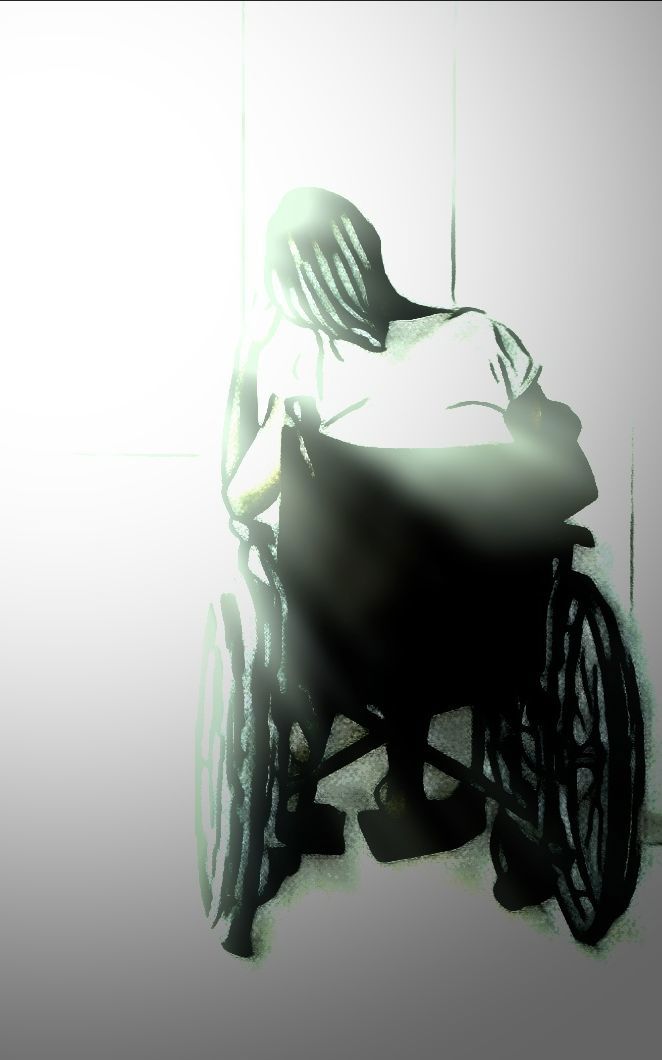
It’s heart-wrenching seeing people who had the power of a god arrive at our facility, wheelchair-bound and usually catatonic. The person who saved an estimated hundreds of millions of people earlier this week is now a frail-looking girl in a wheelchair. A small-framed, pale-skinned girl with auburn hair and dark circles around her eyes was about to undergo exhaustive examinations and tests at the world’s premiere Post-Divinity Care Center.
She was worse off than a lot of PDPOPs were when they arrived. Though her eyes moved, they did not focus, and shining a light in them would not cause any dilation of her irises, which means she probably is blind. Testing her nervous system and observing any of her scarce movements brought us to the conclusion that she is, unfortunately, paralyzed from the waist down.
As for Lauren’s cognitive abilities, we could not determine the level of her literary or mathematical skills. Most PDPOPs are not in a state where we can evaluate such skills. The ones we can determine seldom pass an early elementary-level math test. Following the trend of this facility, scores on these tests never improve over time, even after hours of classroom sessions.
Most PDPOPs have a “trigger-phrase,” which we can say to or around them to prompt a response from them reliably. Asking Lauren verbatim if she knew her name would drive her to say “Lauren” clearly. However, she would not pivot her head or move her eyes in the direction of the staff member who asked her the question. She would only answer if the staff phrased it as “Do you know your name?” Asking Ms. Delaney another variant of this question, such as “What is your name?” or “Who are you?” yields no response from her. Until recently, she has said no word outside of “Lauren.”
She does not blink regularly. The average person blinks approximately fifteen times per minute. However, Lauren only averages one blink every ten minutes. Under examination one time, she did not blink or close her eyes for the duration of three hours. Because of her lack of blinking, our staff has to apply artificial tears to her eyes regularly, or else they will dry out and lead to severe discomfort. We think. We don’t know for sure because Lauren has never communicated pain to us. Our main goal at the PDC is to keep the PDPOPs comfortable. Letting her eyes dry out to the point where just a blink could cause abrasions and redness wouldn’t be keeping her comfortable.
Aside from her eyes, the only body parts that Lauren moves are her lower arms and her fingers. She constantly fidgets. The fidgeting and the eye movement work together to make her look like a young child, nervous and deep in thought. I hope the reflections are entertaining. She has shown no interest in the outside world or communicating with us. I would understand the lack of interaction with the world if she lived happily within her mind. We know she is thinking only because of brainwave spectrography.
When Lauren sleeps, albeit at irregular intervals, often falling asleep while sitting up in her wheelchair, there is evidence of her dreaming. We can pick up intense brain waves through the spectrography, whether asleep or awake. The consistency in her brain activity has led our staff to hypothesize that she is in a perpetual state of dreaming. Her irregular sleeping further leads us to believe that she is blind. People who cannot perceive the day/night cycle often have irregular sleeping patterns. The PDC is wholly subterranean, which means that without windows, we had to devote many resources to developing a lighting system that adequately conveyed a day/night cycle.
Like most of our PDPOPs, we sustain Lauren intravenously because she makes no effort to swallow food or liquid, even when a staff member assists her. This problem isn’t unique to her either. In the first years of the PDC, we needed to develop a solution that provides enough nutrition intravenously. Most of our patients cannot consume food or drink through traditional means. Eventually, we found that ordinary honey, with minimal processing, yielded the most efficient means of feeding the PDPOPs. The patients who can eat by themselves will usually consume anything put in front of them that smells like food, including plastic utensils.
Nobody’s condition improves once they come here. We’re essentially a long-term care facility for those who lost everything while saving humanity. We do it, happily repaying the debt humanity owes them for our continued existence. However, we just keep them comfortable until they die. Though I’m nowhere near as close to the patients as I was a decade ago, it still bothers me when one of them passes. We had two deaths earlier this week. As tragic as this place can be, two deaths in one week is above our average of roughly one every two months.
The call I received from the head of the evaluations department has ignited a spark of hope inside of me. Maybe we aren’t just waiting for the POPs to die. I have to get to the evaluations wing.
I looked over Lauren’s file as a refresher as I walked briskly through the hallways. I have over six hundred PDPOPs in my care; I can’t remember everything about all of them. I pass by dozens of patients being wheeled through the halls, looking up from the file in my hand to respond to the warm greetings of my staff. I’m easy to spot. I’m the man in a suit, speed-walking through a hallway full of medical professionals. Today I feel sincere when I smile and say, “good, how are you?” to the orderlies. As confusing as it is, it seems this news has caused some form of elation.
I arrived at the office of Dr. Jennifer Woltser, the head of the Evaluations Department, and knocked briefly before entering. Dr. Woltser is one of the few colleagues who has been with me since I became the director of the PDC. She looked up from the video feed at her computer terminal, stood up immediately, and told me to follow her to the observation room. During the walk, she filled me in on the situation.
“During our routine evaluation of Ms. Lauren Delaney, we repeated her trigger phrase: ‘Do you know what your name is?’ Every time we ask her that question, she has replied by simply stating her first name.” Dr. Woltser stated.
“Did she not reply to the trigger phrase?” I asked, thoroughly intrigued.
“No, she answered normally, she said her first name ‘Lauren,’ but then her eyes looked at the evaluator, and she said plainly, ‘I saved the world.’”
“She showed improvement?” I asked, stunned.
Dr. Woltser looked at me and nodded “yes.”
“She’s the first one that has ever improved. The first one out of almost a thousand! We finally have some kind of progress after seventeen years!” The excitement made me practically shout.
Dr. Woltser told me to calm down, informing me that they have not replicated the results since that first instance. They are currently doing a complete evaluation of Ms. Delaney.
Still with excitement in my voice, but at an average volume, I say, “Patients deteriorate all the time, die even, but we have never seen one improve.”
We arrive at the room where Lauren’s evaluation is taking place, and Dr. Woltser looks at me before opening the door.
“I’m going to try to draw out a reaction from her, other than her normal response. I called you down here because if I succeed, it means that what happened earlier wasn’t a fluke, and I wanted you to be here for that moment.”
I meet eyes with her and say, “let’s do this.”
Dr. Woltser opens the door, and both of us step inside. We tell Dr. Jones, who is sitting across the table from Ms. Delaney, is asked to leave by Dr. Woltser so we can take the lead in this evaluation. Dr. Jones nods and exits the room. Lauren didn’t react at all to this exchange.
Jen takes the seat at the table across from Lauren, and I stand in the corner of the room, watching intently as Jen quickly reads over Dr. Jones’ notes. He had been unsuccessful in recreating the earlier anomaly. After conveying this to me, she looks at Lauren and says her trigger phrase.
“Do you know what your name is?”
“Lauren,” she says raspily, her vocal cords suffering atrophy from the last two years of disuse. She then continues in her normal state of being.
Jen goes to the next question on the list. “Do you know what your last name is?”
No response.
Next question. “How old are you, Lauren?”
No response.
Next question. “Do you know where you are?”
No response.
Next question. “Do you know why you are here?”
It was subtle. The corner of Lauren’s mouth twitched. Her eyes focused for a second, but then she retreated into her normal state.
“You know why you are here?” Dr. Woltser repeats the question. This time Lauren’s eyes focus directly on Jen.
“I… uh…” Ms. Delaney retreats into her normal state.
Further questions produced no response from Lauren. We had to take a twenty-minute break so that Lauren’s orderly could perform her routine care. During this time, Jen and I talked about our stalling progress. The joy of the progress seemed to be overshadowed by the gloom of its ceasing.
We went back into the room, and Dr. Woltser started the questions again. But when she said the trigger phrase, Lauren did not respond. Another fifteen minutes went by, and I excused myself from the room, telling Jen to keep me in the loop with any updates, that I expected the news to come straight to me.
I returned to my office, mulling over the significance of Lauren Delaney. The eight-hundred and forty-seventh post divinity person of power to ever come to the PDC, fifteen years after our organization started, is the first to ever improve in condition.
I picked up the phone on my desk, a secure and direct line straight to my overseer, the Secretary of Powered Affairs, the head of the POP Bureau, with her fancy office deep in the pentagon over two-hundred and fifty miles away. I wish a president would appoint someone to the position that cared about the PDC. I had only one opportunity to speak with this most recently appointed “Madam Director” when she came to the PDC for a “routine facilities inspection.”
As the director, I have never picked this phone up. What used to be weekly reports, which turned into monthly reports and eventually quarterly reports, were all submitted via a portal on the PDC’s intranet. Unfortunately, there has never been any progress to report. So I just begrudgingly wrote the reports, had my chief of staff proofread them, and then hit send after I made the necessary revisions.
With the secure phone in my hand, I pick up the slip of paper from the left-hand side drawer of my desk, buried under sticks of gum and loose change from my visits to the vending machine. I pressed the call button to activate the phone, and upon being prompted by a machine voice, I typed in the codes that brought me swiftly to the director’s line. It rang, and rang, and rang more. After a couple of minutes, my arm got tired, and I put the phone down and turned on the speaker, awaiting an answer.
I turned my attention back to the papers on my desk, budget reports, documents detailing the deteriorating condition of several PDPOPs in our facility. On top of a pile, there is a newspaper article from yesterday’s edition about a man in Kansas City who jumped up and caught a nuclear missile and flew it into outer space. Nasa, working some magic, determined that the POP made it to the asteroid belt before the payload detonated. So it seems that I will not be taking care of that poor bastard for the remainder of his life.
Four hours later, after lights out, while I was lounging on the couch in my office, the phone finally stopped ringing. A woman’s voice came on the line, but it wasn’t the director’s voice. I asked her to identify herself, to which she replied that she was the assistant director of the POP bureau. I informed her that she wasn’t the next step in my chain of command, and I asked if I could speak to the director, and she told me that she was unavailable. I said it was crucial because I needed to report something to her. The Assistant Director said to me that the director would reach out. When I tried to ask when I could expect the Director to reach out, the phone fell silent. Another fine example of the department working as intended.
I turned off the phone and set it back on the corner of my desk, where it will no doubt gather dust. While I’m at my desk, I figure I should check my email. JWoltser@pdc.gov is at the top of my inbox. The subject line is “No new progress.” It seems that Lauren Delaney’s early exhibition of improvement was a fluke after all. She became utterly unresponsive, ceasing her normal eye movement and fidgeting altogether. Jen placed Lauren under observation for tonight to watch her sleep and see if anything abnormal.
Today’s events may have finally killed the optimist in me. We are indeed a trash can for the people that gave up everything short of their life to save countless people. The registry in my office details innumerable times vegetables of my compost-bin saved humanity from annihilation. Despite everything we strive to do here, nothing has yielded positive results. All the experimental and pseudo-scientific treatments and drugs are for naught. We even have an alternative medicine department. Staff in that department try to sing PDPOPs back to normal, teach them yoga, or even try acupuncture on the more docile ones.
The closest thing we had to a breakthrough in the last seventeen years was a patient showing a slight increase in cognition. The PDC’s non-existent progress presents a problem. If a PDPOP magically recovers and reaches a state where they could live a typical life, we don’t have a protocol in place to release them. Could we allow them to leave? Even if we could, I doubt anyone is ever going to reach that point.
I open the right-hand drawer to my desk and take out the flask that sits just inside. I take three large sips from it and stand up. I’m going for a walk.
Walking down the hall from my office, I take the first left, going towards the patient rooms. After passing through a large corridor, I turn right and reach the first patient room. Unless one of the PDPOPs needs care, these hallways stay dim, with the rooms dark and the patients sleeping peacefully inside. Of all the symptoms they display, at least they’re quiet, which is good because some of our patients have quite an aversion to loud noises.
A security guard passes me from behind, saying “good evening” in a hushed voice. I start walking past the rooms. These rooms hold the people responsible for continuing humanity, the ones responsible for averting our extinction. The first room belongs to “Saint Klara.” She is a Swede who saved Stockholm from a plague by kissing the foreheads of those infirmed in the quarantined area. A large percentage of the healed from that event would tattoo a kiss on the center of their forehead. Most of these people would go on to worship in “The Cult of the Kissed,” a remarkably benign group that believes in carrying on Klara’s legacy by helping the sick. Klara has been here for nigh on five years now. Her days of doing anything, much less working miracles, are over. She lays catatonic on her bed, like so many other patients.
The next room belongs to an Italian boy that came to us just last week. Marco Abbatini, a boy of twelve years of age, prevented a villainous POP from sinking the entire country of Italy and causing massive tsunamis in the coastal territories of the Mediterranean Sea. Marco did so by beating the powered terrorist to death with his bicycle. He performed a tremendous service to millions of people, and now he may never move on his own ever again, though to an extent he can still speak.
Being a man of science for most of my life, I never thought of anything these people have done as possible. We've been running the PDC for seventeen years, and POPs were only around for a few years before that. It’s out of my field altogether, but we still have no idea how POPs get their powers. We don’t know how they know where to be at just the right time to stop significant catastrophes and extinction events. A prime example is that man from Kansas City in yesterday’s newspaper. From the account his friends gave, they were all walking down the street, and suddenly, he took off into the sky, without even saying goodbye. This very phenomenon has made me reconsider religion. There truly is a force for good outside of our observation and understanding that wants nothing more than sacrificing a select few, using them as tools to save the many.
The next room on my tour down the hallway belongs to an elderly man, Archie Stinson. He was sitting on a bench at a playground, watching his three grandchildren. A passenger jet was flying low overhead, on a crash trajectory that would have placed it near the town center. Archie, never exhibiting powers before, was seemingly possessed by the omnipotent force for good. He reached out a hand and telekinetically grabbed the jet, bringing it to a stop that was a little too quick for the comfort of the passengers. However, it was much better than the alternative. Archie slowly lowered the jet into the field adjacent to the playground. All passengers and crew survived, and Archie avoided the potential damage to the town. He saved thousands of lives but burst several blood vessels in his brain. We anticipated his stay here at the PDC to be a short one, but a year has passed, and he is still in the same condition he was in when he arrived.
I’ve seen enough of them tonight. It is severely disheartening to watch these saviors sit and wither.
I go back to my office and lay on the couch, which has been my bed for most of my nights throughout the last seventeen years. I always request the extra-wide sofas, which take up a little of the allotment for the PDC’s furniture budget. However, I only have to replace them once every couple of years. I almost have this new couch broken in.
I put Steely Dan on the speaker on the coffee table, kick off my shoes, and pull the quilt I have adorning the back of the couch over myself. This six hours of sleep I’m about to have in the early days would be impossible. In just six years as director, I was able to get this place running like a well-oiled machine. I carefully divided the various responsibilities and essential operations between departments and incentivized all staff to perform higher quality work. Though they were not a concern at the first PDC, I decided to vet the staff more rigorously.
After the first PDC, I wanted the facility to have people coming and going as little as possible. One of the ways to reduce traffic was to impose long-term tours of duty among the general staff. Each staff member works and rooms here for six months, and then the next team comes in for the next six months. Department heads are the exceptions. Of course, I am another exception, but this place would never work as well as it does today without me. However, I could never have accomplished this efficiency level without my department heads.
5:00 AM, my alarm goes off, and I sit up on the couch and put my shoes on. I go about my usual morning routine, freshening up in the bathroom down the hall, visiting the cafeteria for a fruit cup and some hot coffee. Returning to my desk with the remnants of my coffee, I ring the 6:00 AM bell, which only goes off in the staff rooms. Patients’ day doesn’t start until about eight o’clock.
I check my email inbox—three new messages. The first is from the POP Department, telling me that the director has declined to reciprocate communications with me at this point because of an ongoing event. The second is notes from the last residential staff meeting; I flag that to read later. The third email is from Jen Woltser, informing me that Lauren Delaney will undergo testing again today. I reply to her not to spend all day on it, the old saying of beating a dead horse and all. I put the morning news on my TV. The world is still spinning, it seems.
The day was largely uneventful until about three in the afternoon, when my pager chimed, calling me down to evaluations. I started in such a rush that I got halfway to evaluations before I realized that I had forgotten my jacket in my office. My tie was hanging across the front of my shirt. I looked like a man who had spent the night in his office, which is not a state I like for my staff to see me in.
This time, Jen is already in the hallway waiting for me. She motions for me to follow her and starts walking down the hall without saying anything to me. After a briskly paced walk, we arrived at our destination. Jen looks me in the eyes and tells me that Lauren exhibited awareness of her surroundings for three minutes uninterrupted when she paged me. I asked her if she was still aware, still conscious.
“Last I checked on the feed before leaving my office, she was”
We walk into the room; Dr. Jones is mid-laugh, and across the table from him is a very aware-looking, smiling Lauren Delaney.
Thank goodness that Dr. Jones was there to break the ice because when Lauren looked at us, Dr. Woltser and I froze up. But Dr. Jones just waved at us and said, “I’d like you to meet my supervisor, Doctor Jennifer Woltser, and the Director of the PDC, Scott Crowley.”
“Hi,” Lauren said shyly.
Jen spoke up first. “Hey, Lauren, how are you doing?”
While Jen was greeting Lauren, I just politely waved.
“I’m… confused, but all right, I guess,” said Lauren, eyes turning down towards the table.
“Maybe we can help clear up the confusion,” Jen said as she sat down at the table, Dr. Jones excused himself, wishing Lauren luck. I walk out to speak with Jones before he gets too far away.
“Thaddeus, one quick thing before you leave.”
“Yes, Dr. Crowley?”
“If you tell anyone else in this facility about Ms. Delaney before I give the OK, I won’t fire you. However, I will make you one of the yoga instructors and pay you the same as one. If you tell anyone outside of this facility, I’ll have you brought up on espionage charges, understand?” I say firmly.
“Yes, Dr. Crowley, my lips are sealed. I didn’t even work in evaluations today.”
“Good man. Relax for the rest of the shift.” I say, dismissing him.
Upon stepping back into the room, I take a seat in the corner and observe. How is this even possible? Yesterday I thought it was extraordinary that she moved her eyes and said a couple of words. Now, today she’s acting as though she hasn't been unresponsive and in a wheelchair for the last two years.
Dr. Woltser begins with the new evaluation, which we never expected to use. She starts the camera and then begins the questions.
“Can you state your full name for the record?”
“Lauren Alexia Delaney”
“Date of birth?”
“April 5th, 2003.”
“Do you know what today’s date is?”
“No, sorry,” Lauren said apologetically.
“It’s fine. We didn’t expect you to know. Just so it can help you readjust, today is the 12th of December, 2032.”
Lauren was taken aback by the news that she had been offline for nearly three years now.
“Do you know where you are?” Jen continues with the questions.
“I think Dr. Jones said I was at some kind of a long-term care facility for people of power that saved the world.”
“That’s right, you saved the world, and since then, you have been in the post-divinity care center, which we endearingly refer to as the PDC.”
I chime in, “we’ve been taking care of you as a way of repaying you and the others that have saved humanity from various calamities.”
“I don’t remember saving the world,” Lauren says, looking down again.
“What is the last thing that you do remember, Lauren?” Jen asks.
“I remember sitting on the couch in my living room, watching a movie, and then having these bizarre dreams, and now I’m here. If it weren’t for Dr. Jones repeatedly saying that this isn’t a dream, I don’t know if I would be able to tell.”
“I’ll reaffirm that for you; this is not a dream. We’re going to send you for a full medical evaluation, and we will have you meet with the therapists afterward, ok?”
“Ok,” Lauren says, her eyes dropping towards the floor once again.
I stand up from my chair. “Any questions you have for us before we turn you over?”
“Um… yeah, do I still have my powers?”
“You remember having powers?” Jen asks quickly.
“Yeah, I had them for a couple of years. I just never told anyone about them.”
“We don’t know if you do. Our equipment here has never been able to pick up anyone’s powers, and you’ve never used them. None of our patients have exhibited extra-human abilities. Hence, as a rule of thumb, we say POPs lose their powers after they reach divinity.” I say, which causes Lauren to look even more downtrodden.
Jen tries to reassure her. “We can have you try to test them out in the gym tomorrow if you’d like?”
“Your powers were magnetic in nature, right? I interject.
“Yes.” Ms. Delaney answers.
“Well, go ahead and try to take the paperclip out of the file on the table.”
Lauren stares at the paperclip and waves her hand in response to this. Nothing happens; she tries again. Again nothing happens, and I can see her get frustrated. Jen tells her to stop, saying there would be plenty of time to try later.
Jen and I leave the room, and she asks me why I let Lauren try to use her powers. I explained that I figured if she could wake up from whatever every other PDPOP seems to be in, that maybe she’s special enough to have kept her powers too.
“I want you to oversee her, personally. You’re the only person I trust with this. When you run her tests and examinations, see if you can figure out something that sets her apart from the other six hundred patients. See if you can find anything that could explain why she is the only one who has snapped out of whatever limbo these people are in.”
Jen nods and tells me that she’ll update me at every step. I tell her that I expect nothing less.
Exiting the evaluation threshold into a lobby, I tell the security not to let anyone through unless they have clearance for the department. We can’t afford any wanderers today. The security nods and closes the automatic doors usually left open.
Returning to my office, I go through dialing the secured line to the Department of Powered Affairs for the second time in as many days. This time I didn't wait for hours, only about forty-five minutes, which I spent starting to write this manuscript.
The director herself was on the other side of the line this time, which is the way it is supposed to be. I give her a full report on what’s happening. However, she isn’t very well-versed in post-divinity care, so I tried my best to convey the weight of the situation. We might recreate it in the other patients if we can find out why Lauren Delaney is suddenly approaching normal. The director promises to send a liaison out, expecting a full report.
Overall the phone call was more complicated than needed. I can’t blame the higher-ups for not caring about the PDC. We haven’t had a single breakthrough since our inception. Nonetheless, the government throws unlimited money at us because of the moral implications of our mission.
Later, after exhaustive testing on Ms. Delaney, every single test our facility is capable of running, which will take days, potentially weeks, to read the results. I have to speak over the intercom, mainly telling the staff about Laurens condition, that we finally had a patient seemingly on the road to recovery.
As I turned off the intercom, I could already feel a shift in the facility's energy. It felt positive like there was a new vigor in the staff that radiates throughout the subterranean corridors and rooms of the PDC.
Two days passed before the Liaison from the director would show up and assess Ms. Delaney’s condition. He was a little upset when we informed him that some test results would take four days to examine. Another two days after would be necessary to write a comprehensive report.
He said that the director had given him a secondary objective for his visit in the meantime. She wants him to do a full report on the facility's operations. On his first day of poking around, two of my personnel would end their life. When I confronted the liaison, I demanded what he found was worth two vacancies in this facility. He refused to answer, saying I was below him in the chain of command. I tried to tell him that he was under my control for as long as he was in my facility, or I would remove him. I tried to cite maritime law, claiming I was the captain of this vessel. He called my bluff, and I received no answers from him.
On the second day of the liaison’s visit, Lauren would make her first documented attempt of using her powers. She told us that she could manipulate magnetic objects, which resulted in her fastening ferrous material to many of her everyday household items, like the tv remote. Ms. Delaney started exclusively buying chip clips that could move using her powers. In addition to simple manipulation of magnetic fields, she could also interfere with wi-fi, and other electronic waves, such as those used by cell phones and radios.
It was strange to hear tales of a POP who simply used their powers to bypass certain mundanities of life. I guess there is no need to get up to get something from across the room when you can merely defy the laws of reality.
Unfortunately, every time Lauren attempted to use her powers, it was a fruitless effort. We concluded that she could no longer manipulate magnetic fields by our trials. She couldn’t even distort the picture on a TV from the late 90’s that we found in a janitor’s closet. It’s a bit of a shame; her powers to move things from across the room would be helpful for someone who will never walk again.
Ms. Delaney asked if the absence of her powers meant she was no longer considered a POP. Technically, she is still considered a PDPOP. We have never seen anyone post-divinity use their superhuman abilities, so powers are not actually in the criteria for being a PDPOP. Lauren had to spend a couple of hours with a counselor after confirming her suspicion that she no longer had powers.
After a week of the liaison’s presence, we determined that we had no way to define the reason behind Lauren’s sudden revival. There was no disparity in the tests we performed this week to any of the ones from within the last two years. We were at a loss. Nobody in this facility, including Lauren Delaney herself, had any explanation as to why she was the only one to make strives to be better.
I wish we could pinpoint what made Lauren special. We can’t identify any difference between who she is today and who she was last week. We can’t determine why she woke up, much less why everyone else has not awakened in the previous two decades has not awakened. We cannot determine why she is awake while everyone else still sleeps. If we could reverse engineer it, we could potentially recreate the process in all of the other POPs at the PDC.
Even when scientists outside the PDC reviewed the finalized results, there were no abnormalities compared to the other POPs. We had nothing to distinguish Ms. Delaney from the other six hundred patients in the PDC.
After maybe two months, I had fallen into a sorry state; I was no longer the director that the PDC needed. Nothing I had spent the last two decades of my life meant anything. All I did was just prolong the inevitable perishing of the PDPOPs.
Whatever entity, gods, or even goddesses wanted these people to throw these lives away got what they wanted. I wasn’t a religious man twenty years ago, but science cannot explain what these people have gone through. Sometimes, even for just a day, these people were the most powerful beings of all the world, and then they were nothing, barely human.
Today, I wheel Lauren Alexia Delaney out of the PDC. Tomorrow, I tender my resignation. There is no scientific explanation for why the POPs exist or why they break down after saving all of us. Reaching divinity isn’t something that science can quantify.
I wish I could do something to help the vegetables in my compost bin, but after twenty years and even a breakthrough, I cannot help them. Whatever deity chose them in the first place to sacrifice themselves will be the only one that determines which of them will finally be able to return to a “normal” life. I have no say in it; I haven’t had a say in it for two decades.
Lauren Delaney will be released into the care of her family today. She will have a new identity; nobody will know that she saved their life two years ago. What Lauren does from now on will be of her choosing; I just hope it's enjoyable.
The United Nations’ Treasury, in conjunction with the World Trade Organization, amended the global POP fund. Now Any PDPOPs that recover will be entitled to the same benefits. So far, Lauren is the only person who gets to enjoy the luxury of having her life bankrolled by a coalition of the world’s wealthiest countries. She will never have to worry about healthcare, monthly bills, a mortgage for a house up to $300,000 US, even education if she chooses to pursue it.
I recommend Dr. Jennifer Woltser to take my position as head of the PDC. If anybody is qualified to run this place without me, Jen is. I am no longer fit, for I can no longer see reason, only dogma.
So today, I give Lauren over to her parents, and I retire to a cabin in Alaska. I wish I could have determined why the first vegetable escaped my compost bin. However, in reality, we are only pawns of the divine. With people like Lauren in the world, maybe I won’t have to use the bullet that I have sitting chambered in the handgun on the table next to my rocking chair. I’m not leaving it to chance, though, since we cannot comprehend how the divine works. What’s to stop the universe from deciding it won’t save us one day and condemn us all to a slow, horrifying death?
Ashamedly, I was sad to see Lauren leave. Not because I was bothered by the idea of her living a happy life, but because I selfishly wanted to be the one responsible for life. I’m not responsible for it. Something outside of understanding was responsible for curing Dr. Do-nothing’s only patient to recover.
I wish anybody who reads this all the best, and I urge you to reconsider whatever stance you take on divinity. Whatever divinity is, I am the person closest to it outside of the POPs themselves, and I have no rational explanation for it. I wasted twenty years of my life thinking that I could help these people who gave everything to everyone else. My wife left me soon after I became the director of the PDC. I didn’t get to see my children grow up, one of them didn’t, and I didn’t even find out until fifteen years after the fact.
I ignored my family. I neglected my blood trying to solve a problem outside my power. We are just toys to whatever is out there. It is not too simple to say that the divine is a five-year-old boy smashing action figures together on the living room floor. Whatever watches over us seems to care to an extent. But what happens if they get bored of us, maybe? Maybe they already have. Perhaps these powers, these severe disasters, and villains could just be the divine hitting on nineteen, trying to raise the stakes, so they don’t lose interest altogether.
Two decades I wasted attempting to fathom the unfathomable. Don’t make my mistakes. Keep the POPs alive, keep them comfortable, but know their fates are woven in a cosmic tapestry, and we are not tailors. It’s out of our hands.
No one should ever hear from me after this. If I am never forgotten, it will be too soon. Hopefully, the divine forgets about me too,
Dr. Scott Crowley
Former Director
Post Divinity Care Center
That is the end of A Day in the Life of a Woman Who Single-Handedly Saved the World. Thanks for reading.
Get the app for the rest of Ethan McGrane's writing, and everything else on Novellea.
Open in Novellea