
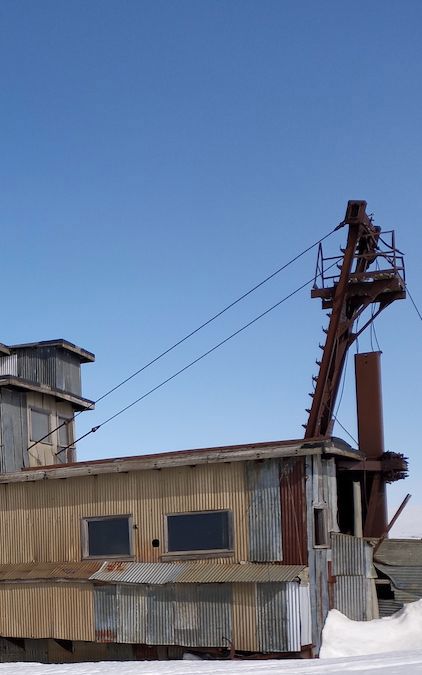
A Dinner of the Hours

An old man, whose best days are behind him, gets a letter in his own handwriting, inviting him to dinner on a remote ruin...
On a bright specious day in October, I received a letter slid under my door. It was in a battered envelope, grey and crusted around the edges. It bore no stamp but instead was sealed with bright green wax: the kind of seal I hadn’t seen since my youth. I thought this odd. However, opening the letter and pulling out the paper inside gave me an even greater surprise: The letter was in my own handwriting. I had never seen this thing before in my life.
Trembling a bit, I examined the paper more closely and read the words:
If you remember our old haunt and the place where our work began,
meet me there for dinner tonight. You may not remember me,
but we were best of friends when we first moved to Alaska and worked
In Nome together on the Bering Sea. I know you never left Nome, and I would like to see you
again. I know you would like to see me. Please come to our old workplace, even though it is high and dry now, at 7:00 this evening. I will give you a feast of wealth and variety you won’t soon forget.
The letter was unsigned, but it did have some sort of mark at the bottom. I pulled out my glasses to examine it, but it seemed like nonsense: just a scribble. I had no idea who the note was from, but it made sense that someone I couldn’t remember wanted to see me so badly.
When I came up to the town of Nome, sixty-seven years ago, to work on one of the first gold mining dredges in the North, I was the best worker they had and the most popular kid in town to boot. Even when I was just a tender, they needed me like they didn’t need any other man. When they wanted an extra miner to work overtime, I was the one. If there was ever turbulence on the sea, they turned to me for comfort and to steer them home. Off the dredge, the girls in town would line up in Front Street just to see me go by. I would only pick the prettiest.
My company doubled its profits when I joined, and many assured me that it was due to my hard work and insight. My life was glorious in Nome sixty-seven years ago. It’s no wonder someone wanted to see me again after all these years. The similarity in handwriting was a coincidence.
At the appointed time I pulled up to my old dredge. It was no longer on the ocean anymore, of course, after decades, but grounded in a pond on the tundra, off the Nome-Teller highway. The dirt road that led up to it was blocked off with a “no trespassing” sign. Nobody went near it anymore except those heading to practice at the gun range, and of course, kids who would trespass anywhere they were told not to. It seemed quite deserted when I got out of my car and walked down the trail towards it.
It was proper Nome October weather: clear but cold, 43 degrees or so. The tundra was all withered to brown. I wasn’t young anymore, and this cold was starting to chill my blood. I shivered with some irritation. If this person wanted to impress me, he could have treated me to a dinner at the Polar Cafe, or taken me to the BOT.
As I walked up the path under the bright Polar Sun, a song kept running through my head. Something classical and elegant that I must have used to lull myself to sleep one night (there never was much point to classical music other than to put you to sleep). I couldn’t remember what it was though. It was odd that that nameless tune came to my head so urgently at that moment.
I finally reached the dredge. There was somebody there. His back was turned from me and his hair was long and fair. He looked far too young to have worked with me on the dredge, sixty-seven years ago. But, he had put out a strong plank of wood to make it easy for me to cross the moat, and I knew I was welcome.
So I straightened up, rubbed my hands together, and decided to give this fellow a chance. I crossed the moat and cleared my throat to let the stranger know he could begin to serve me his feast. He’d better be quick about it, I was thinking, because I didn’t see a feast in sight and I don’t think too kindly of people who make empty boasts and can’t keep their promises.
And then all thoughts fled from my head. The stranger turned around. His face was familiar to me from thousands of old pictures and older memories.
He was me.
I didn’t have a son. Not a son that I knew of. None of those women would stick around long enough. And no son ever looked so much like his father as that fair young man looked like me from the past. Every feature was mine; his build, his hair, even his smile, as he extended his hand and walked towards me, was mine. This was me when I came to Nome sixty-seven years ago.
“I’ve been expecting you,” he said in my voice. “For many many years.”
At moments like these, I tend to make a joke, always carefully calculated to make everyone’s day and set the topic onto a different path.
“But I only got your letter this morning,” I said.
The young man did not laugh. Instead, he looked straight at me like he knew what I was thinking before I thought it, and he said.
“But we made our choice to meet again, sixty-seven years ago.”
Something about his tone, as it echoed in all that bright sunlight, made me uneasy. At his invitation, I walked onto the dredge and moved to the back part where there was indeed a long, low table, laid out with silver place settings. But the place settings were so many I couldn’t count them. And the table was so long that, the more I looked at it, the more it seemed to stretch beyond the walls of the dredge itself and fade into the mountains.
“What is this?” I said. That weird old song was playing in my head, all out of nowhere, once again. “What are you doing? This is some kind of trick! Is this supposed to impress me?”
“Impress?” said the man like the word had a different meaning. His voice whistled off into the cold tundra wind. “Yes, it is supposed to impress you.”
He gestured me to sit down, at the place of honour I assumed it was, and so I did. The wind didn’t seem so cold at the table, and the song in my head grew so loud, as I sat, that I wondered if the man beside me could hear it too.
“We’ll feast soon.” He said, never once changing his tone. “But we must wait for the others.”
“The others?” I asked.
He gave me an odd look.
“Yes, of course, the others.” He said. “You didn’t think it would just be me did you?”
I said nothing but pressed my hands up against my stomach. I didn’t wish to wait for dinner.
The man moved away from the table, and that’s when I saw it. He had on his finger my old ring. The ring that I thought was gone. I stirred, memories long suppressed flooding into my mind:
The ring should have been mine originally, but it wasn’t. Sixty-seven years ago, when I had only started work I had come up with a friend. Well, a protegee might have been a better word for our relationship. He was younger than me and adored me. When I started reading about Alaska and dreamed of going there to find gold, he followed suit because he always did everything I did.
He and my sister fancied themselves in love, and she cried for days when he decided to go away. She claimed that ‘I’d stolen him away from her’ but she was too young and too sheltered to know what was good for her. It was a good thing I’d intervened.
So he’d come with me to Alaska and wrote to my sister every day against my express wishes. And, only a few days after coming, he found a priceless ring that washed up on the beach. Nobody could claim it, but one of the gold buyers said it was worth tens of thousands of dollars, and that he’d give us even more for it. My foolish young friend refused to sell it. He said it was for her.
I hated that. I hated him for costing us so much money. I used every bit of power I had over him to convince him to give me the ring for safekeeping until such a time as he should make his fortune and go back to my sister. Slowly I made a plan to sell it when he was least expecting it.
That was so much harder than I had thought. We worked the same shifts, and every day when we came back he would take it from the place I kept it to look at it and think of my sister.
I despaired of what to do until, one day, all my problems were solved.
He had bought himself a sailing boat and used to go out onto the sea, One day, an October day like this, he sailed out under a clear blue sky, and a sudden storm came up. Only I had known he was out there, so no distress signal was sent. The authorities finally figured out he’d drowned after he didn’t come to work the next day and never did again.
With the money, I was able to buy the finest house in Nome.
The man moved down to the seat beside me. Soundlessly. He sat erect like he didn’t need the chair to keep him in place.
“What others?” I asked again, rather peevishly. “Why must we wait? How many others”
The man gave me a sidelong, amused glance that made my blood run cold.
“Many others.” He said, drumming the ring on the table with a great clang. “But they will come by and by.” He reached over and began to put food onto my plate. Not his at all. Just mine. I stared in a bit of awe at the food. It looked rich and varied, and not at all like the kind you usually find in town. Now this was the way it was supposed to be!’ I thought. “If you are going to drag me out into the tundra, this was the hospitality you were supposed to show!” I smiled expansively and started to eat all that wonderful food. The others would have to wait.
Halfway into a bite of the most delicious lobster dish I’ve ever had, I got distracted. Another man had come up. I nearly choked, even though it shouldn’t have been so much of a surprise this time. This man too looked exactly like me.
He was older. Just a little bit older than the first man, and he carried himself with more confidence. I remembered holding my head up like that after I bought my house and began to court the wealthiest in Nome. Gravely, he shook my hand.
“I’ve waited long to see you.” He said in my voice.
“What can you mean, how would you know?” I said, beginning to get rather angry. “I don’t know you people at all.
“I know you.” He said as if that was all that mattered. Then he relapsed into silence and walked to a further chair to sit down. My gaze couldn’t help but slide down to his feet.
Yes, they were there. Just like I didn’t want them to be: those beautiful beaded, lavishly furred boots.
She’d made them for me. It would have been decades ago, but those decades just slid away all when I saw them again.
Her name was Agnakluwak or something like that. I always just called her Becca. She’d fallen in love with me. I found her gorgeous, so I made sure she stuck around. It was annoying, though, the way she wished to be with me all the time and talk to me, but oh! Those piercing black eyes, long hair, and beautiful figure! She wasn’t going anywhere.
She made me those boots, or mukluks she called them, the way she’d been taught by her people. She made them as a gift when our love was newest and strongest. She’d come to my house, under cover of night during the darkest part of the winter. The whole town thought we were going to get married, but they never knew about those night visits.
She was a village girl. She’d come up from her village for some short errand but stayed when she met me. We carried on for a while until I grew tired of her. I paid her off, but by that time it was too late. It was clear what she had done and everyone knew. I’ll never forget the burned-up look in her eyes when her aunts carried her away as the whole street howled.
She went back to her village, and I never heard from her again.
Her family wanted to kill me. I wasn’t afraid of them though. And in time they realized they couldn’t intimidate me, and just grew sullen throughout the years.
I looked at the man who had sat down at the table again. He carried himself the way I fancied I carried myself back then: strong, full of confidence. The way a man should when he owns the finest house in town and has all people of influence courting him. He had a coldness in his eyes, though, that I didn’t recognize. Surely my eyes never looked so hard back then.
The next guest came up from behind me. I didn’t even start this time to see the same fair hair and enviable features all over again. This time, he looked a little bit older, more in manner than anything else. This one barely gave me a curt nod (but it was a nod with such a piercing glance, as if he too was saying he waited a long time for this). When he sat down, he pulled out a notebook and devoted the rest of the dinner to writing in it.
I remembered that notebook well. I had gotten it at the shops for a dollar. It was a good cheap time to be alive. Or at least, it was, if you had your wits about you. Men owed me money by the time I had amassed my empire, and I was the sort of man who would collect. I’d keep careful count in that notebook of who was short, whose interest was amassing, and who needed an eviction notice. I’m sure there was some grumbling about me among the inebriates and the like, but I didn’t grow poorer. I was popular among the folk in town who mattered. The more I collected, the more they would court me and come to my parties.
As I thought these thoughts, the guests at this strange dinner party started coming so thick and fast to take seats around the table. Over and over again, it was variations of the same man. . . and I was the oldest variation of the lot. Some of the guests came older, grimmer. They looked like they’d been through a hard time, poor chap. Some were younger, and had that air of reckless abandonment that I so admired in myself sixty-seven years ago.
But they, one and all, made me uneasy. Without fail, each version of myself brought up memories that I’d learned to suppress; memories that would have spoiled my gain if I had dwelt on them for more than an instant. With a surge of anger, I realized what was going on.
“This is an ambush!” I cried, springing up with a bottle in my hand. I don’t know who was behind this or how much money they paid to assault me so, but I wasn’t having it anymore.
The instant I stood up, every single one of them stood as well. Down that long long table, fading out into the tundra, every single pair of blue eyes looked at me: not angry, not happy. . .just an empty, hollow, searching stare.
For a second I was breathless: caught and pinned down by all those airy blue nails. But then my better judgement, which never failed me for long, returned. I backed away from that table, waving my ridiculous bottle.
“I’ll have you thrown in prison, any man who dares come near me, hear? Cited and thrown in prison! Damn your tricks! Damn your lies! Damnation to all of you!” My words faded on the tundra wind as if there was nobody to hear them.
That song! That song again! Before it was just a tune, now it was a whole orchestra, blaring in my ears, with sepulchral voices singing words I suddenly understand.
“Don Giovanni! A cenar teco. . . ”
I knew the words, I knew the context, and I knew what came next.
“No!” I shouted, my voice young and virile as ever. “No! Never! Fuck you! Fuck you all!”
Those eyes, those rows and rows of dead blue eyes, they weren’t looking at me, they were looking behind me. I turned around.
There was one more copy of me. He was old. He seemed so much bigger, but in truth he was shrunken. His eyes had lost all light. His skin was grey. His breath was stopped. He was dead!
“Fuck you all!” I screamed again. I broke out into a run, intending to leap over the side of the dredge and return to my car. But the rows and rows of blue eyes were walking now, and they clustered around me. . . .
*********************************************
As the sun set that night, a group of kids, the kinds who were always climbing and exploring where they shouldn’t, came back to town quite shaken. Old Man Simons was dead, they said. His body was out on the old dredge, which was random, they said. And. . . . he had the most horrible expression on his face.
Everyone in Nome drew a collective sigh of relief. It was high time the old bastard was dead, they all said to each other. It was high time he met his maker. . . .
That is the end of A Dinner of the Hours. Thanks for reading.
Get the app for the rest of Miriam Trujillo's writing, and everything else on Novellea.
Open in Novellea