
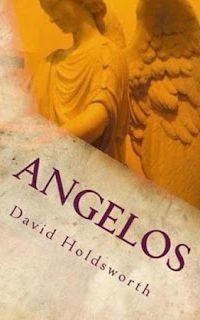
Angelos
In dirt and blood, the soldiers waded on...I stood holding a gun, pointing it at the lad who had once been my best friend. He was dressed in the red coat of a government soldier; I was not!
By David Holdsworth
"This short story will help us to engage with our own inner voice and to find the courage to find expression for our convictions. I thoroughly enjoyed it and was left with much to ponder. Do actions really speak louder than fine sounding words?" (MH)
Angelos opens on the field of Culloden, Scotland, as the legendary battle of 1746 has ended and the wounded Jacobites are being shot or clubbed to death. Davy MacLeod holds a gun to the head of his former friend, Paul Cope, his hands shaking, ready to pull the trigger on this man who betrayed him and delivered his family to death. This man who took even his beloved from him. Revenge seems a foregone conclusion. The trouble is that Davy is a radical, one who does not believe in violence and who has eschewed any form of warfare in the name of God, man, or society. In a Europe torn by religious wars, he identifies with the Anabaptists, the Radical Reformation, people whose teachings spread through ratty pamphlets and stands taken for love and allegiance to the Prince of Peace...
You may not see me, but I am near.
Travel through time.
Travel through space.
Travel through eternity.
Some have entertained me, but were not aware.
The infants, ill, and dying see me most, as I bless them with the heavenly hosts.
You are not alone, we are around you, just as we stand before his throne.
I repeat, you are not alone.
Messengers of love and truth walk among mortal men.
You are not alone as we guide you home.
1
Culloden, Scotland, April 1746
All around was the awful sound of moaning. It was not just mournful, but the sound of immense suffering, the cries of dying men. The battle had waged on, and the day was far spent. In dirt and blood, the soldiers waded on. Horizontal rain, snow, and wind made the normal battle conditions much worse.
Near the edge of the field I stood holding a gun, pointing it at the lad who had once been my best friend. He was dressed in the red coat of a government soldier; I was not.
“You won’t do it!” he yelled.
“What makes you so sure?”
“You don’t believe in violence.”
I felt the anger rising within me. “How could you?”
“It was orders. I had no choice.”
“So that makes it all right? We took you in, and you betrayed us!”
“I didn’t know what the redcoats were planning. I swear I didn’t.”
“They are not liberators as they claim. They attacked our village and killed everyone!”
With a growl my friend retorted, “We need to stop the rebels at any cost!”
“No remorse! You think they can police the world by force, that might is somehow right? You claim God is on your side. Don’t you think he knows what you have done? Did he tell you to help those who killed my family and friends? We aren’t even part of the rebellion!”
The images of my whole family flashed before me as the words burst from my mouth. I recalled Mother helping me up after I had fallen down when I was a little boy, playing in the trees with the other village children; Father showing me how to ride a horse for the first time; the kind pastor who had taught me many Bible stories—and my beloved.
“I didn’t know this would happen . . . I’m sorry. Please . . . put the gun away and we can talk. Please!” he cried as I advanced with the gun still pointed at him.
“I’m through talking!”
“Please . . .”
“Get on your knees!”
Trembling, he dropped to his knees.
“Please . . .”
“It doesn’t feel, good does it? No power. Helplessness.”
“No!” he began to cry.
“Close your eyes and pray for forgiveness.”
Still shaking all over, he closed his eyes and began to mumble.
“I can’t hear you!”
“Father, forgive . . .”
“Good-bye!”
I paused. Could I do it? This was another child of God, no matter how far he had fallen. Who had made me judge, jury, and executioner? Suddenly, I joined the chorus of crying. I couldn’t do it. He looked so cold and helpless kneeling in the dirt like a sinner such as he was, and such as I was. His hands were clasped tight; his fingers had turned red, and his lips were curved with fear and dread. What good would it do to kill him? Across the fields, the howling continued as the slaughter of the wounded commenced.
“You were right, I can’t do it. I, unlike you, have a conscience!”
I threw the gun away in utter disgust that I had come so close to using it, and then I fell to my knees and embraced my prodigal friend.
“I’m sorry,” he whimpered.
“I know . . . as am I.”
As the severe weather beat against us, we continued to cry, holding each other.
2
My story begins in the Highlands, a place of immense beauty. Much like the garden of Eden before the fall, my homeland witnesses powerfully to God’s love and creativity. Across the Highlands and Islands should be the words Ceud Mile Failte, which in Gaelic means “A hundred thousand welcomes.” Not because the people are welcoming, though many are, but because God’s creation welcomes and even beckons you to come and see the glories of his handiwork.
This is the land of the deer, the golden eagle, Shetland ponies, sheep, Highland cattle, seals, otters, and—once upon a time—wolves. It is the land of great mountains, cliffs, and woodlands.
Inverness is the gateway to these beautiful Highlands. Along the river that flows through the town is the great Loch Ness. Where, according to legend, Saint Columba sent a monster back into the sea, praying it would never return.
At the other end of Inverness lay a small, little-known village in a glen, near the famous river Nairn. On one side of the river was Nairnshire and the famous Cawdor Castle, whilst on the other was Inverness-shire and beautiful Kilravock Castle, seat of power for the diplomatic Clan Rose. It was on Kilravock’s side of the river that we had our dwelling. Our village was between the Kilravock estate and the village of Culloden. It consisted of a few thatched-roofed black houses, some crofts, and the ruin of an old broch, a circular Iron-Age building of dry stone.
Legend has it that while on his way to help found a church at Kilravock, Saint Columba passed through Inverness and Nairnshire in the sixth century and introduced the people to the Christian faith. Before, they had gathered in places like Clava Cairns near Culloden to practice traditional ancestor worship. As this Celtic missionary from Ireland journeyed through Scotland settling churches, starting with one on the Isle of Iona, the gospel spread and many became followers of Jesus. Our wealthy neighbour’s estate was named Kilravock, or “Church on the Rock,” for Saint Columba had planted a church there long ago.
It was in this deeply spiritual landscape that I sat on a rock watching over my Father’s sheep on a calm day in the spring of 1740. Many lambs gambolled before me, and the nearby fields of gold blew gently in the breeze.
All of a sudden, a great mist came down. I began to shiver, and I wrapped myself in my coat of sheep wool and covered my legs a little better with my tartan kilt. A lone, dark figure caught my eye as it emerged from the mist. At first I was unsure what it was—until I realised it was Condon the recluse, clutching his Tyndale Bible and with a sense of determination walking toward me. I wondered what he wanted as he sat down beside me on the rock.
“Do you know who I am?” he asked.
“Why, yes sir, I do.”
“I’m Condon. Do not be afraid.” He was a tall thin man with a long black robe, much like a priest, and he had no hair on his head, but a long grey beard on his face.
“I’m not afraid, sir. I know that the villagers like to gossip. I reckon, if you don’t mind me saying, that you are a kind old man, really.” Because of his radical views, some had begun to say he was a witch or even worse. To me he was just a kind man who had gone about doing good until his radical faith in Jesus led him into conflict with most of the established churches. The inevitable fallout drove him to avoid crowded places and eventually turned him into a recluse. Still, some of his strange teachings reached us in whispers. He advocated that all who follow Jesus are priests, not just the official clergy. Much of what he said made sense, as did his kind manner. But why was he here now? Had this persecuted recluse emerged just to speak to me?
“Your name is Davy, isn’t it?”
“Yes.”
“It is a nice name, from the Hebrew, meaning beloved. Do you know the story of David from the Scriptures?”
“Yes, sir. I love it.”
“Jesus is a descendant of David, the beloved of God. Jesus is the only begotten Son of God who was born into this world and died and rose again. Saint John calls him the Word and the Light. When he died, he did so as atonement for our sins, and when he rose, he did so to defeat the power and curse of death and hell on this once-holy world. Do you believe in him?”
My heart warmed as I heard these truths afresh, as did my wonder at his boldness in coming out of hiding just to share the good news with me. “I do, and have done a few years now. I found a tract blowing in the wind once. It was a translation of an article by someone called Menno Simons.”
The old man looked as if he were about to cry, but he held it back.
“I want to tell you something, Davy. You will see many horrors in your life, of that I am sure. But I want to encourage you that God loves you and will never forsake you. He is not the author of war and division. He did not send his Son as one to steal, kill, or destroy. He sent him to give, to raise up, and to restore.”
I sat holding one of the lambs still in wonder at this man’s boldness and authority in the way he spoke of things of God. I had never heard anyone speak in this manner before.
He smiled a broad smile, and his eyes lit up with joy. “How fitting that God chooses a shepherd boy for this task . . .”
“What task?” I said, frowning.
“You are to be a light against the evils of war. In great troubles God can bring to you great joy, just as he did for Saint Paul and Silas when they were in jail for the faith. You know that story?”
“Aye, is that the one where the early Christians got arrested and then started singing in the prison, and God opened the doors? Then the guard was about to kill himself, fearing the harsh punishment if his prisoners had escaped, but Paul stopped him and then the guard joined the Christians?”
“Yes, it is.”
Condon smiled to himself, no doubt at the fact that I was fairly well educated for a farm boy. I had always loved to learn, and when a missionary taught me to read, there was no stopping me. Sometimes a travelling family, known to us only as the pedlars, persecuted by many but loved by my people, came to visit and sold books to my Father for me to read. I loved the books, and judging by the variety they carried, it was clear my travelling friends had either been far or had the means to acquire these lovely editions from those who had. Where these wandering strangers had come from or even where they went to was a great mystery and a topic of lively debate at mealtimes. Some suggested they were angels, which at the time I laughed at, preferring the notion that they might be itinerant ministers from further north or across the Irish Sea. They certainly didn’t have a local accent, that was for sure.
Condon fixed his eyes on me, and his voice lowered as though what he was about to say was especially important. “Davy, I knew the exact time of your birth and what you would look like when the time was at hand, for I dream dreams. Now is the time. A great evil is brewing in the land that will turn the nation against itself. But you must make a stand for what is right. Be strong, young man, be strong.”
“I don’t understand . . .”
“You will.”
With that, he stood and walked back into the mist. Once he had gone the mist began to disappear, and Condon was seen no more.
3
Around about the same time as my visit from Condon, some unfortunate events were unravelling elsewhere in the world. My future wife’s father, Victor Ó Muireagáin, was making the mistake of his life—a mistake that would not only cost him, but others also. He had been posted at one of the many outposts the British were setting up in the British Isles and beyond. It seemed sensible to the rulers to set up forts and garrisons across the lands, particularly in Scotland to subdue “the unruly Scots.”
It had been a miserable, cold, and damp day, and he had already made sure several deserters were shot.
Sitting at a table in a dungeon facing a young man was a small man with rounded features. He was dressed in the red coat of a government soldier. “My son, will you not reconsider?”
Young Matthew Campbell had already been visited by a clergyman who had tried to make him reconsider, and the attempt had only made him sure of his choice to refuse the draft. He found it ironic that he had been told to renounce nonviolence in the name of Christ, which in his eyes effectively meant he was being asked in the name of Christ to deny Christ.
“My decision is final, Father.”
With tears in his eyes, Draco Campbell said, “My son, they will kill you.”
The brave young man turned his head away so he would not cry. “Blessed are the peacemakers, blessed are the persecuted,” he muttered.
His father was no longer able to hold back his tears. Matthew’s decision had been the result of tragic events. Initially he had agreed to the draft, even though he had been press-ganged into the army. It seemed such an adventure at the start, and he wasn’t bothered at all about it, but the more he read the Sermon on the Mount in his little Tyndale New Testament, the more he found he could not abide cruelty to other humans. Then something awful occurred that he could not process in either his heart or mind.
An army medic told him to write down what had happened in the hope that writing would give him some relief. So he wrote:
To the Ground
He falls to the ground.
Hands over his eyes, he weeps bitter tears of great pain.
How had things come to this?
Wiping the blood and tears from his face, he does something he hasn’t done for a long time—he prays.
With his rifle finally laid to rest, the young soldier looks to the heavens and then across a field of corpses.
Among the dead he sees a child he killed in the heat of battle.
The soldier’s words echo in the valley of death, “God forgive us.”
Forgive us all, sweet Jesus, forgive us.
To the ground the soldier falls.
The medic looked over this piece of writing and thought the young soldier’s feelings were fairly normal. It was the second two pieces of writing that got Matthew into big trouble:
Collateral Damage
You are someone’s baby, someone’s child;
But they call you collateral damage.
You are someone’s son, someone’s daughter;
But they call you collateral damage.
You are someone’s brother, someone’s sister;
But they call you collateral damage.
You are someone’s father, someone’s mother;
But they call you collateral damage.
They call you collateral damage—
For they know not what spirit they are of.
They Lie
They send us off to die.
Blood and tears we cry.
In the heat of battle we live.
Our sweat and life we give.
Bang beats the drum.
A war never won.
Vanity and pride.
The leaders hide.
Why should this be?
In the name of the free?
No, not in my name.
This is not a game.
They send us off to die, we shall not go
For they lie!
When he was taken to the authorities for this expression of conviction, in the heat of argument he declared he would no longer fight. Now he was on trial.
“Father, do not weep for me. If they decide to kill me I will simply go to heaven and inspire others to make a stand for love and peace.”
Crying, Draco said, “Son, you are a hopeless idealist! In all of this I can’t see how you can believe in God and still believe in nonviolence. My son, how will your death serve the people? How will it serve the coming empire, the new world order? The kingdom of the future?”
“Father, I serve the Messiah, the Christ. Not any Caesar. His kingdom is not of this world, and no man need fight for it. All empires will pass away, but Christ lives. He is love and peace, and his kingdom will last forever.”
Draco’s expression changed from one of compassion to one of rage. “What foolishness, what treason is this?”
“Calm yourself, Father. I’ll be gone soon.”
His short time in the prison had given Matthew time to think, and one thing was clear to him: he must not compromise. Having seen various criminals coming and going in this awful place, he had also begun to see that these thieves and murderers did not see what they did as wrong. He had also seen soldiers coming and going and wealthy people making a profit on other people’s suffering, all bragging about what they had achieved. What was boasting in wealth but theft from the poor, and what were nationalism and war but murder and denial of the human family?
There was a knock on the heavy metal doors that kept the dungeon shut, and Draco went to the door. Two soldiers, muscular and tall, stood without. He muttered with them, out of hearing distance from Matthew. The soldiers suddenly pushed past Draco and headed straight for Matthew. They grabbed him and took him away.
The soldiers marched Matthew to another room in the dungeons where a superior officer waited. This man was to be Matthew’s judge and jury. Sitting at a table with two armed guards by his sides, Jenny’s father, Victor, sat with a disinterested face and a dominating figure.
“Do you wish to die, young man?”
“No.”
“As I suspected. Then you must cooperate and agree to the draft. The army needs young men like you.”
“I cannot.”
“And why is that?”
“I am a Christian, and I do not believe in violence.”
An amused expression crossed his face. “Come now, young man, there are plenty of Christians in this military.”
“I must protest, sir. Any allegiance between Christians and murder is a compromise too far.”
“What foolishness is this?” Victor whispered to one of his soldiers. Then he paused and said, “Never mind, his father is here.”
Draco entered and looked at Matthew before stepping forward.
Lieutenant Commander Ó Muireagáin spoke to him. “You must instruct your son; he is refusing to do his duty.”
“I refuse to kill,” Matthew interrupted.
“Please instruct him.”
Draco, unsure of what to say, looked at Matthew and said in a cold tone, “He is of age.”
Everyone in the room knew what such a statement implied: Draco had washed his hands of his own son. However, Matthew seemed to have been empowered with a new boldness, and he rose to his feet in defiance.
Victor looked at him sternly. “Very, well, young man. You will die if you don’t obey.”
“So be it.”
“Such a waste . . . but as you wish. As of this hour you are a condemned man. God save the king!” Victor roared.
In response, Matthew said, “Hail to the Prince of Peace, Jesus the Messiah.”
This enraged Victor all the more. “Get him out of my sight!”
The soldiers grabbed Matthew’s arms once more, but Draco suddenly lurched forward, his face showing a sudden surge of compassion. “Wait, son, please.”
Victor addressed Draco. “Make it quick, old man. I’ve got more scum to deal with, executions to arrange, wars to plan. I haven’t got all day!”
“Son, please, recant and hope they forgive you. They are going to kill you.”
Matthew looked at his father, hugged him, and said, “God be praised!”
Victor rose to his feet and thumped his fist on the table. “What sin do your fellow Christians commit by being in this army?”
Matthew looked him directly in the eyes. “You know what they do.”
“Take him away,” Victor roared.
Matthew’s punishment was arranged for sunrise on the next day. He was returned to a solitary cell. The prison window overlooked an execution ground.
To Matthew’s surprise, the guards seemed to have forgotten all about him the next morning after a night of heavy drinking. The time for his execution came and went, and they left him alone. This delay in affairs did not bring the relief that Matthew would have hoped for—instead he saw a friend who had helped many to run away from the army face execution.
Matthew was slumped against the wall when he heard the guards ask, “Are you ready to die?”
He jumped up and ran to the window to see what was happening. A beautiful young girl was bound against a wall, and the soldiers were making ready to execute her by firing squad. She wore a beautiful purple dress that only a young lady of nobility could afford. Matthew knew her at once.
Looking up and seeing Matthew’s face in the prison bars, the young girl smiled and said, “Yes.”
The guard was taken aback. “Are you sure?”
“Yes.”
“So be it.”
The firing squad made ready, aimed, and then fired. In the brief minute before the word “fire,” she closed her eyes and spoke in Irish Gaelic a prayer of praise while gazing up at a Celtic cross that stood just behind where the firing squad had lined up to take her life:
Tall, dark, towering, decorated with curves and angles.
Sign of the people, the passion, and the place.
The circle of life and resurrection.
Hands once held there, feet once nailed.
The inscription “King of the Jews”
The reality “King of all kings.”
The King of the Celts died here.
Slain to reconcile man to God.
Art and heritage combine.
The story unfolds as it is retold.
God of our fathers bless us.
Bless us in the shadow of thy cross.
BANG!
She fell forward, but the shots hadn’t killed her instantly. She choked and spluttered in the dirt. Matthew’s only comfort was the word he heard her cry out on her last breath—“Hallelujah!”
Then all was still.
The next morning as the sun began to rise, Matthew lay curled in the foetal position. He felt broken inside, and the doubts so many people of faith have from time to time began to surface. The young girl’s death had been horrible. Was he doing the right thing? Had he acted rashly?
“I’m so alone,” he moaned.
He looked toward the prison window as a beam of light broke through the bars. At first it seemed normal, like a beam of sunlight. However, the light burst through the bars with such an impact that the entire room was filled with light. This was not just sunlight, nor the light of a candle.
“Matthew,” a voice said.
Matthew rose to his feet in surprise. “Who’s there?” he said, shielding his eyes.
He began to see the faint image of what at first appeared to be a human. The light gradually faded a little, and before him stood a beautiful angel. She was radiant, dressed in white with the wings of a dove. The angel held a shield with the word PAX on it and cradled a dove in her other hand. Matthew fell to his knees.
“Rise. I am only a messenger of truth.”
Gently, she helped him to his feet and led him to the window. “Child of God, you are not alone. Look, and behold the light among the people.”
Pointing out, the angel directed Matthew’s eyes to the execution ground below. The blood stained ground doubled as a marketplace during the day. It was busy, as people were selling various produce from local farms and craft shops. However, now he didn’t just see the troubled prisoners and the soldiers walking and marching to and fro, nor did he simply see people buying and selling on bloodied ground—he also saw the spirit realm, and beside every human was at least one angel.
“Behold God’s compassion.”
Matthew’s attention was drawn to a young lady carrying her baby. Beside her was an angel, and around the baby were baby-sized angels playing and singing together.
“Since you were small, God and his angels have looked after you in both the good and bad times. The choice before you now will be costly if you continue to choose grace, but be of good courage. God and his angels will give you strength to love.”
His lips began to tremble. “I’m afraid.”
“Child of God, fear not. Your elder brother, Jesus, has made a place for you in his house of many mansions. His kingdom come!”
“What about those I leave behind? What about all these people? My father . . . my friends?”
“If you choose this costly path of love, your witness will be a light to fallen hearts.”
“What about God’s kingdom?” Matthew asked. “Will it really make a difference?”
Then the angel said, “Even a drop of love can change many hearts, and I sense that you have much love. Be not afraid. You will have strength to bless those who curse you, to love those who hate you, and to pray for those who persecute you. Be not afraid, fear not.” The angel’s voice and visible presence slowly faded away.
When she was gone, Matthew was left in awe. Calmly he pondered the events of his life and especially of the last few days. A person would hardly kill and torture a neighbour just because a man in a suit told him to do so—so why should he go far from home to do it? Were the faraway not also neighbours? He began to write on the floor with a piece of stone that had broken off the window ledge:
Hope in Jesus
What happens when I die?
The voice of angels that do not cry.
Ladder to heaven.
Death has won?
Nay, Life has won.
Death: where is her sting, where is her victory?
No shame in dying, no shame in living.
Crushed to earth, but rising again.
In Christ alone my hope is found.
What happens when you die?
The voice of angels that do not cry?
He put the stone down, and thinking of the angel, felt a comforting presence he had never felt so strongly before. Then he thought again of his Saviour, Jesus Christ, and wrote one last piece.
It Is finished!
Finished
Bloody Palms
Bloody Crown
Bloody Ground
Bloody Nails
Radiant Light
Third Day Rising
Finished, but Just Begun
He lay down his primitive writing tool. He had run out of space to write, and besides, he was ready to die for his beliefs now.
4
The impact of what Victor did to Matthew would not become clear for some time. In the meanwhile, things continued as usual. Children were educated, adults farmed the land and looked after young and old, and of course, some young people fell in love. In this last point I was no exception.
Lying in a field of snowdrops and bluebells, Jenny and I held hands and kissed each other gently on the lips. It had been a beautiful spring day, a Sunday, and the night was finally drawing in. After church we had obtained permission to go out, both making up a story to get out of spending time at home. We spent the day walking and talking together along Nairn beach before finally heading back into Inverness. We had a plan, and it was a good one!
Heaven knew we needed one, for ours was no simple case. She was of noble birth, and I was of mixed heritage. My father was a MacLeod, but only distantly related to the MacLeods of Dunvegan and therefore not nobility; my mother was what Father called his “Gypsy Princess.” She was part Jew, and some said she was also related in some way to my travelling friends who had given me books and in so doing furthered my education considerably. At times, her heritage had caused us difficulties growing up. In England the infamous “bloody code” had already started, and there were many crimes punishable by death. One of those was “being in the company of Gypsies for one month.” As we were subjects to British rule, this cruel and bizarre law was also, in theory, in force in Scotland. No distinction was made between Romani, Irish, or Scots travellers—all were subject to persecution from state and people alike. As for her Jewish heritage, some mocked, “You crucified Christ.” The Roman Empire was never mentioned in these jibes, nor the sins of the world. However, only a few got to know of our heritage, and even those who did limited their persecution to verbal abuse. This mercy we continually thanked God for, as many others had not been so fortunate.
Our love was a forbidden love, and well we knew it, but we lingered as long as we could together as the stars began appearing in the sky. Finally we parted with a kiss and a long hug.
“I love you, Jenny.”
She had the kindest smile, the kind that would light up a room. Her bright blue eyes were like the depth of the ocean, eyes that had seen things, bad things, yet reflected a soul of wisdom, a compassionate heart. She was internally aged before her time, yet she carried herself gracefully in walk and in manner. Her skin was gentle and soft, with rose-blossom cheeks and tender hands of affection. “I love you too, Davy.”
We left one another with our plan burning in our hearts. The next Sunday in the dead of night we would borrow a horse from a friend at the Kilravock Castle stables, and go to the chapel at the grey friars’ graveyard. Usually I walked everywhere, but it was a long journey on foot, so a borrowed horse would be much appreciated. I often went to this chapel when I had leave to go into town. It was my place to go when I needed to think. A week hence, we would marry there. We would sneak out in the dead of night and be united as husband and wife beneath the stars and before our God.
It was my propensity to go the graveyard that had led to the plan. One evening, sitting in the graveyard on a tombstone table, feeling the breeze I wrapped myself up tight in my sheepskins and rubbed my hands together for warmth. I was about to get up and go home, but then I saw the door of the small chapel open. It was then, for the first time, that I saw the kind hearted old monk who lived there. He wore a brown habit tied with a cord at the waist, and a simple wooden cross hung from his neck. It seemed odd, but he appeared to be deep in quiet conversation with a cat he was letting inside the chapel and a pigeon sitting on a nearby headstone. He threw a bread crumb toward the bird, and it took it up onto the roof of the chapel where a nest sat. I coughed a little, and the monk noticed me.
“I have seen you here often,” he said, “but only tonight do I dare disturb your thoughts. You must come inside with me into the warmth.”
“Are you sure?”
“Of course. Come in, my friend.”
“I’m not Catholic . . .”
He laughed. “A Protestant who likes to spend time in my yard—that’s a first.”
“Actually, I’m not Protestant.”
“Now I have heard everything,” he said, leading me into the chapel. “Take a seat, my friend.” He pulled up two wooden chairs next to the fire.
“Thank you,” I said, smiling and taking a seat. They weren’t exactly comfortable, but looking around I admired the simplicity of this place, simple much like the gospel. There were no pews, just a few wooden chairs, the cross on the simple wooden altar, some communion cups and plates made of wood, and a small bed in the far corner of the room.
“So,” he said, “what are you?”
I wasn’t sure it was safe to talk so openly about faith with this man—until he saw my hesitation and explained that he was of the Franciscan order and tended toward peace and harmony with all living creatures. I reflected for a moment as he asked the question again, then I answered, “I truly trust in Jesus as my personal Saviour, and I believe that salvation is by grace alone through faith alone in Christ alone, but that this grace should lead a person to bear fruit. I feel uncomfortable in these times of conflict. I can’t see how killing in the name of reform or in the name of a church can possibly fit with what Jesus taught.”
The old monk held up the wooden cross that was hanging around his neck. “I admire your words. I met a fellow Franciscan monk when I was on pilgrimage to Iona who said something similar. He gave me an article by a wise man called George Fox, who founded a Society of Friends in England during the 1600s. It is one of my only possessions.”
He showed me the article, which was written on a ratty pamphlet and probably printed in an underground printing press, much like many of the books I had read. It was a beautiful copy none the less, and I read how a people called the Quakers or Friends had made a stand against the violence of all fighters in the world. The message had been boldly sent to King Charles and was signed by George Fox and eleven other Friends. This bit stood out to me:
“All bloody principles and practices we do utterly deny, with all outward wars, and strife, and fightings with outward weapons, for any end, or under any pretence whatsoever, and this is our testimony to the whole world. That spirit of Christ by which we are guided is not changeable, so as once to command us from a thing as evil and again to move unto it; and we do certainly know, and so testify to the world, that the spirit of Christ, which leads us into all Truth, will never move us to fight and war against any man with outward weapons, neither for the kingdom of Christ, nor for the kingdoms of this world.”
The monk smiled at the look of awe on my face as I looked up from the strong words of these persecuted people.
“The problem with churches of all sorts,” he continued, “is that so often they ignore the key teachings of the Sermon on the Mount, like the doctrine of love. So often we ask God to be on our side instead of asking that we be blessed enough to be on his. That said, the wheat and the tares must grow up together, and in the days of harvest they will be separated properly.”
“Wise words, Brother . . .”
“Please, call me Peter.”
I smiled. “Peter. I’m Davy.”
“Well, it is nice to finally put a name to a face. I couldn’t help notice that today you seemed deep in thought, more than usual. It may be none of my business, but perhaps I can help? You’re in love, aren’t you?”
I blinked in surprise. “How did you guess? “
“Let’s just say I wasn’t always a monk,” he said with a grin. We both laughed. But my heart was too troubled to laugh for long. I leaned forward, intense.
“It is love, Peter. Of that I am certain. But the girl I love is of noble birth and the daughter of a prominent redcoat, whilst I am clearly not.”
“You love her?”
“More than life itself.”
“Do you feel passionate toward her?”
“Yes.”
“Have you thought of marriage?”
“But it is impossible! I wish . . .”
“Well, why not? You love her, and I presume she loves you?”
“We mean the world to each other. I would die for her if I had to.”
He grinned from ear to ear and gave a hearty chuckle of approval “That is true love. Don’t run from it, embrace it.”
“How?”
“Ask her to be your wife. If she says yes, come. We can arrange to have you married in this chapel.”
Although I knew this monk was of an unusual leaning in these war-ridden times, I still couldn’t at that moment get past the fact that he was a Catholic who by all accounts should be considered my enemy. “But why would you do this for us? And how will it be possible when our families are natural rivals?”
“I would do this for you because I was once in love, but I never asked her. She was a foreigner with dark skin. She was a slave until I bought her freedom. Her beauty was amazing, but I didn’t do anything about my love, and now here I am, old and alone in a graveyard. As for the problem of rivalry, ignore it. I didn’t, and it was a great mistake. I was scared of what people thought. Now all I have is regret.” The old monk turned his head away to hide his tears.
“Do you know what happened to her?”
“She went on to marry another, or so I heard. And then I became a monk.”
“I want to marry Jenny so badly. She is so beautiful—in looks, character, faith, hope, and love. I will ask her.”
I was true to my word. That lovely spring day in the garden that was bursting into life, I asked her on bended knee, and she said yes.
The night we made our plan, I hardly slept. A week later, we went out to meet each other in the middle of the night. Jenny climbed out of her window on the second floor of the manor house in Nairn and down the branches growing on the wall of the house. She was wearing a lovely dress, and I waited for her at the bottom astonished at the ease and beautiful composure with which she scaled the wall. It was clear she had done this before. Landing, she straightened her long, black, flowing hair. Then she grabbed a Prince’s Flower from the garden and put it in her hair. Taking my hand, she ran with me through the woods of her ancestral estate to the stables at the castle, where we met our friend with a horse.
We reached town and stood among the headstones, beneath the stars as we had planned, and as we held hands, the monk prayed:
God of Love,
Thank you that you are love itself.
We praise you that it was for love that your Son Jesus was born.
We praise you that it was for love that your Son Jesus lived a perfect and holy life.
We praise you that it was for love that your Son Jesus taught us to love.
We praise you that it was for love that your Son Jesus taught us to love God.
We praise you that it was for love that your Son Jesus taught us to love each other.
We praise you that it was for love that your Son Jesus taught us to love even our enemies.
We praise you that it was for love that your Son Jesus died for us.
We praise you that it was for love that your Son Jesus took the punishment for all our sins.
We praise you that it was for love that your Son Jesus defeated death and rose again.
We praise you that it was for love that your Son Jesus set us free.
We praise you that Love Incarnate will come again, and we thank you that you are love itself.
In the name of the Son of Love,
Amen.
Then he blessed our union. Once the ceremony was complete, we kissed, and the monk, with tears in his eyes, hugged us both. He certainly was a little unorthodox.
“Live a long and happy life together. Do not waste it; instead, truly live. Be blessed.”
5
It was not until later that I learned his name was Paul, but he was having a bad day; of that I was sure. I spotted him as I walked with my sheep on a hill above.
“It’s a lovely day,” he declared as he stepped out of the caravan that he appeared to be living in into the heavy horizontal rain. “Welcome to the Highlands, go to the Highlands, they said; great prospects.”
He stepped out of the wagon into a massive puddle with ducks swimming in it, then turned and realised that the entire caravan was stuck in a muddy pond. He encouraged his horse to move, but before he knew what was happening, the animal had broken free. The horse galloped off into the heavy rain.
“Stupid cart!” he raged, and picking up a stick, began to hit the caravan. “You stupid thing! This is your fault! Now the horse has run off!”
Placing his shoulder against one corner of the wagon, he began to push, complaining all the while. Finally it was free from the mud, but he was on a slope, and the caravan picked up speed as it hit the rockier ground and in moments became a runaway. He pursued it as fast as he could.
“Stop! Stop!”
It went straight down the hill and into a tree. By now rage was written in every inch of his posture. He began to mock, “Pray, they say, well, here goes. O Lord, thanks for such a wonderful day—could you possibly make it any worse?”
His blasphemy was instantly rebuked as the wagon completely collapsed into lots of pieces.
He began to cry.
It was at this point I reached him, having started down the slope the moment I realized the caravan was stuck. I had seen what was going on in the distance whilst tending the sheep.
Paul Cope was a drifter. His past was hardly worth remembering, or at least that is what he told me when I invited him to come live with us in our village. He claimed to have been evicted from his father’s land after his parents died during a cholera outbreak. He had no way on his own of keeping up payments, and it was certainly not unheard-of for lairds to clear their land of people to make way for more productive industries. Little did I know much of his story was exaggerated, and he was in point of fact a spy who had been paid by the redcoats to find out if our village was a haven for Jacobite rebels, as some had rumoured. What neither he nor the redcoats had expected was that my family would be so welcoming.
Paul was meant to turn us all in if there was even a single sign of Jacobite leanings, and as it happened, there were one or two in the village who were sympathetic to that cause. But he could not do his job. Not only were most of the villagers neutral when it came to the war, but in fact he liked most of the people in the village, and they liked him in return. It was for that reason he didn’t report back to his superiors after his month-long infiltration. It was just a matter of time before the redcoats would take alternative action.
About two months after I invited him to live with us, Paul received a letter from his superior that requested he meet in the great woodlands near the village. Knowing that disobeying could cost his life, he complied with this command. Making his excuses, he left and walked to the centre of the forest where an officer was on his horse looking smart in his full red uniform, medals and all. It was none other than Draco Campbell.
Despite Draco’s well-dressed look, a bloodstain—faded but still present—marked his white shirt. He was proud on his white and black horse, its height neutralizing his lack thereof. On his coat was many a medal. His newfound wealth and position were evident by his composure and the manner in which he spoke.
“Today we will bring glory to our cause and our kingdom!”
Draco raised his fist in a signal, and more of his men appeared from within the depth of the woods. What he said sounded so inviting. Missing out the mention of death, maiming, blood, guts, mourning, and depression, he instead spoke of the glory of war. After all, he was an expert. Oblivious to his own cruelty and inhumanity, blinded by supposed duty, he had murdered his own conscience. Just as he had murdered so many others.
Seeing Paul, the young incompetent spy clothed in his working-class tartan kilt, his general smugness changed to a look of disgust.
“Well, if it isn’t the worm that turned.”
“What do you mean?”
“You seem to have feelings for this savage clan. You are in too deep. One could be forgiven for thinking you had turned Jacobite.”
Paul’s face went bright red, and he gulped, sensing the severity and potential implications of such an accusation “What! I will never become a Jacobite!”
“Well, what are you doing then?”
“I just don’t understand why you wish to punish this village for simply having different views from yours. They are not all Jacobites.”
“It’s called WAR! Get used to it!” Draco roared.
“It is sick,” Paul said, tight-lipped. “And cruel.”
“I spoke to my superiors, and they don’t need evidence. They have asked me to lead an offensive on the village—with you by my side.”
“Why?”
“They need to be made an example of, and your loyalty needs to be tested. You will meet me here at first light and join my troops in this great task.”
With that said, they parted. Draco, the hardened soldier, was unaffected by this encounter, but Paul was broken inside. He didn’t return to the village immediately, but wandered through the woods crying and arguing within about what he should do. In the end, his conclusion was to follow the soldiers’ plan. After all, he could do nothing to stop it—and there was no point dying as well as the villagers.
The next day he met the troops as planned and was made to ride on a horse that had a young prisoner walking behind it, a girl who was tied to the back of the saddle by a length of cord. She had dark skin, and he presumed she was a foreigner. He smiled at her, but she kept her head down, staring through hair that hung over her muddy face. Paul leaned toward one of the foot soldiers and quietly enquired what she had done.
The reply troubled him considerably. The girl had been arrested for no charge other than being attractive and speaking neither Gaelic nor English when the soldiers enquired as to who she was. Was she to be an object of pleasure? He knew that in times of war the lines between right and wrong could become blurred. In fact, though he had not admitted it to himself, he knew deep down this war was simply wholesale murder and lawlessness. It made no sense to him that individuals were not allowed to kill, nor were families, but the state was exempt from such a sensible rule. In fact, the way soldiers could kill with not just a lack of remorse but with celebration had always troubled him. He wondered if he should try to free her and pretend the rope had just come loose by itself. However, he pushed such noble thoughts to the back of his mind. It was every man for himself, and he planned to survive this war.
As they advanced, he saw the village and cringed. He knew the army would show no mercy. The scene unfolded before him like a nightmare. With swords and guns they went into the houses and killed without mercy or remorse. Then they set the thatched roofs alight. Hearing the screams, he turned his face away. He had no stomach for this cruelty, but seeing his reaction, Draco turned his face around with his strong hands, forcing him to watch the village of people who had been so kind to him burn to the ground. Paul’s only relief was that there was no one to witness his sin other than those who participated in it—the soldiers, and this foreign girl who was crying quietly to herself and seemed to be praying in an unknown tongue.
All of this I learned later. I was in a faraway field tending my father’s sheep as my home burned. My secret wife, whom I planned to finally introduce as such to my family that evening, was heading for the village. She had stopped to pick some flowers on a hillside and only missed being caught up in the slaughter by a couple of minutes. She heard the awful screams and hid behind a rock, watching in horror. She was powerless to do anything.
“That snivelling little coward,” she mumbled with tears in her eyes as she caught sight of Paul. Then, to her surprise, she watched as Paul untied the foreign girl, who was by now frozen with fear. Paul proceeded to try to get away also and started to run away. The poor girl just stood there. She seemed to instinctively know that running was futile. Draco was sat on his horse overseeing the bloodbath. He turned and stared at her, then smiled.
“Smart girl . . . stupid boy. Seize him!” he ordered.
Within seconds, Paul had been dragged from the horse he was trying to get away on and taken to Draco. Draco stared at him in such a stern manner that he would have normally looked away—but he didn’t. He stared him down.
The soldiers began to open fire in his direction, laughing and playing with him. “I thought war had rules!” Paul blurted, fearing he might be shot.
“Ha! You stupid boy! We can do whatever we like; we are the law now!” Draco laughed manically, followed by a chorus of laughs from some of his hardest troops. Paul raised his hands in surrender.
“Since you have been of use to us thus far, I shall show mercy. You have the choice of being a prisoner . . . and I think you know what that means. Alternatively, you can come quietly and be one of my soldiers.”
Jenny wondered if I had fallen in the massacre or if I was in the fields still. It suddenly dawned on her that she needed to warn me. Without thought for her own safety, she stood up and began to run. This immediately caught the attention of the redcoats, who in an instant had her apprehended.
Any claim to be of noble birth and of a family with redcoat leanings would not save her, for Draco had immediately recognised her as the daughter of the man who had his son killed. Without mercy, he ordered her dress torn from her, removing any mark of her position in society. Standing helpless in her underskirt in the midst of violent men, she suddenly realised how vulnerable she was and began to scream.
Although they quickly shoved a gag in her mouth, her scream echoed across the countryside, and I heard it. I had been walking back to the village when I heard the scream—if only I had started home from the hills an hour earlier, I might have been able to do something to help the villagers, although I am not sure what one young man could do. Without a moment’s hesitation, I picked up my pace and ran to her aid. The smells of smoke and blood in the air told me something was terribly wrong.
When I reached the village, I was horrified to see it still on fire, and no sign of Jenny. I fell to the ground and began to cry deep and painful tears from the heart. Father, my wee brother, and all the others were dead. I didn’t care that my crying was echoing through the valley; I didn’t care about myself anymore. Then, unexpectedly, I became calm again, and a sense of determination came over me.
6
I had to save her. I had no idea where they had taken Jenny, so I went to the only person I knew might be able to help. I went to Brother Peter. He was on his knees before the altar when I came in. His attitude toward the religious wars and the Jacobite wars, toward the whole rotten affair, had gone from distaste to out-and-out disgust. When I came in he was in the middle of praying, and his face was streaked with dried tears.
Your Grace is sufficient.
Your Sacrifice our hope.
We are broken.
You are broken—broken for us.
We are beautiful.
You are beautiful—beauty for us.
You hear our cry.
You heal our hearts.
Blessed be your name.
In the shadow of the cross,
On blood stained ground,
Even in the depths of hell—there
You are with me.
My rod, my staff, my comfort.
Hallelujah!
Paradise lost.
Fallen, broken, hurting.
Beauty swallowed by pride.
Forgive us, Lord, restore us.
Free us from ourselves.
Guide us home to thee.
Paradise found.
The furnace is ready.
Through the fire glorify thy name.
May we never deny thee.
Be with us in the flames.
I coughed a little to clear my throat, and he finally realised I was in the chapel with him. In a moment both of us were on our knees, humbled before God.
“Did you hear what happened?”
“Yes, and I have taken action. The only thing left to do is pray.”
Brother Peter had already asked a few trustworthy people if they had seen where the soldiers had taken the young captive. When they all said no, he asked them to ask others who could be trusted in the Catholic and the Protestant communities. There was no news yet, and he was right—we had to pray. In despair we both cried out to God.
We prayed for an hour solid. In mid flow, a young boy suddenly interrupted one of the prayers. “Come quick! I know where they took her!”
Without a second’s hesitation we both followed the boy, who was running fast toward an old bell tower in the centre of Inverness. There, a dark-skinned woman argued with the jailer.
“You must release her at once!”
Brother Peter stopped in his tracks. She turned her head slowly, and as she did so, the light of recognition flared in his eyes. Though she was a woman of some age, she was beautiful, both in appearance and spirit. I knew without question that he had found his beloved.
“My love.”
“Peter!”
They embraced each other, and then she pulled away and began to tell her story.
As she spoke, she told me more about the story of my own wife. There was some information I had not yet discovered about her: she was in fact a modest hero. The girl who was being held in the tower was not just Jenny my beloved, but Jenny the abolitionist. She had been working fearlessly to abolish all kinds of slavery, and she feared plans of future empire expansion would further ignore her ethical view of the world. This was how she had met Rose, the freed slave whom Brother Peter had once courted.
Once I heard all this, I became impatient with the whole mess and simply pushed my way past the angry jailer, shaking on the bars and looking around the walls to see if there was an easy way in. The guard approached to throw me out of the entrance, but Peter and Rose began to argue with him, distracting him from the task. Rose began to insist that I had the right to see Jenny and that he should respect young love.
“Were you not young once?”
It took some time, but he finally agreed to let me in.
I was made to wait in a tiny entrance hall, with an artist’s depiction of the passion of the Christ hanging in a gilt frame. It was an extremely bloody depiction of the death of Christ, and I had no stomach for it. I had seen enough bloodshed to last a lifetime. But the blood was not all that offended me. The thing that annoyed me most was that Christ who had died to set people free was hanging on the wall in a place of captivity.
After some time staring at the picture, I was led in to see Jenny. She was chained next to the young, dark-skinned girl who had been captured before the massacre of my village. It was a small cell; the other prisoners were men and boys and were crammed into another cell. We hugged and cried together. When it was time to go, I whispered promises that I would free her—not knowing how I could.
When I came out, I was surprised to see Peter and Rose holding hands. It seemed he had been wrong about her marrying.
“This time I will marry you, my sweet Rose,” he said as I approached.
“But, my love, what about being a monk?”
“I have been planning to give it up. I am not strong enough to make reforms from within the Catholic Church, and thus I am joining the Anabaptists.”
As we went back to the chapel to try to hatch a plan to save Jenny and the other young girl, Peter began to tell a story he had read in an illegal Anabaptist pamphlet. He told of how a man in 1569, called Dirk Willems, an Anabaptist whose doctrine was Jesus, peace, and baptism, saved his enemy’s life even though he knew he would be burned to death afterwards. To burning he was taken, all in the name of love. As he was burning, he said seventy times, “O my Lord; my God,” and other things like it. Peter retold a short piece he had written about this moving story:
Day of the Martyrs
Gathering of light.
Sacred assembly of love.
Age of war, hate, and strife.
The day of the martyrs has just begun.
Blood stained standing stones.
Anabaptists’ tears, angels’ song.
The day of the martyrs has just begun.
Ice cracks, foe falls.
Pilgrim saves.
To burning he must go.
Stands fast, dies slow, proclaims love for all to know.
The day of the martyrs has just begun.
The planning went on late into the night, and finally it became clear that it was virtually impossible for us to free the prisoners without risking our very lives. This became even more abundantly clear when the messenger boy who had announced where Jenny was came with the sad announcement that the other young girl had been killed for trying to escape. We all sat in shock for some time, and the messenger boy joined us. Rose had travelled in America and England, and in her travels had met John Woolman, an itinerant Quaker preacher who openly opposed slavery and war. She suggested we adopt his practice of worship and sit in silence to see if the Lord would minister to us there. Our first plan was to break Jenny from prison non-violently if we could, but by force if we had to. But in the still small voice that came in the silence, we all began to sense that this was not the way.
“I don’t have all the answers,” I said at last into the quiet, “and I do have questions. I cannot be proud in this matter, but I feel I have a solution to our problem. Violence should be seen as the last resort, not the first. As for risking all of our lives further, I do not see how this could be a good thing.”
I had an idea, one that would take some time to convince the others to accept. The cost would be high, but not too high to pay. I could not tolerate cruelty to animals, never mind humans, so I was hardly going to let anyone be cruel to my beloved, to kill her in cold blood for no real crime. It was time for action.
7
Suddenly Peter stood up and removed his priestly robes, stripping down to undergarments. Picking up a towel and taking a bowl of water he had initially put out for washing in the morning, he began to wash our feet. Rose began to speak in an unknown tongue, and the messenger boy started to cry. We then took communion together as more of Peter’s followers began to gather in the small chapel. Some stood, some sat, and some knelt, and a few even lay face down on the ground in prayer.
Peter then stood up and began to preach:
Love will win.
No matter what happens
Love will win in the end.
We all need compassion.
We all need hope.
This is it:
That love will win.
We have a duty to make this a better world.
No, it’s more than a duty.
It’s destiny.
Embrace your destiny.
Sons of Adam and daughters of Eve.
We are one family
We are one world.
Love will win in the end, dear friends.
Love will win.
There are whispers of a word.
Amidst the chaos and confusion of a dark and angry world, it echoes through the mist.
My heart heard this misunderstood little word.
It heard and was blessed.
The word ‘love’ caused my heart to skip a beat and my soul to become merry.
Could it be that even in man’s darkest hours, love still lives?
Indeed it lives and breaths all things pure.
But what is the meaning of such a word?
Could it be the joy of babes playing a merry little din?
Is it the splendour of a spring morning?
Or the beauty of a maiden’s face basked in sunlight?
Or perhaps it’s just a word we use in season to gain something in return?
Maybe it’s just a word the poets like to write?
Nay, it is more.
Surely true love is self-sacrifice.
It’s the laying down of one’s life for a friend.
Even an enemy.
It’s the will to bless those who curse us
To love our haters
To forgive our debtors as Jesus forgives his.
Love is not some superficial myth, but a dream of things better.
It was love that allowed God’s own Son to give himself into man’s angry hands.
It was love that sent him beyond this realm to prepare a peaceful place for us.
Our Promised Land, our Paradise.
Yes, behold, it is love that is the greatest thing!
I sat in awe, knowing the power of God was at work in this place. There was hardly a dry eye in the chapel. Yet, I could feel a fresh anger arise within me as one of the friends began to explain what Paul had done. That night he was meant to be visiting Kilravock Castle. So I decided to go and surprise him. Deep down in my conscience I knew this was a bad idea. A storm was starting to brew inside. This coward had cost the life of my family and friends.
That night, I approached the castle and noticed on the wall of the west wing the Rose Clan family crest. It was a boar’s head with three symbols that looked like music notes and the words “Constant and True.” I pondered this phrase, and it got me thinking about my own clan’s motto. The MacLeod crest is a bull’s head and the words “Hold Fast.” Both these phrases seemed sound advice given the time of crisis now upon me. But the phrase that influenced me most in this time of need was another that I saw on the west wing. It was the words “Non est salus nisi in Christo. Soli Deo Gloria.” This stone had originally been part of a bridge across the river Nairn, but one of the barons had moved it, fearing it would be destroyed in a storm along with the bridge. It now stood boldly as part of the castle wall. The translation of these Latin words is, “There is no salvation except in Christ. To God alone be the glory.”
As I pondered these things, I was welcomed into the castle by a kind servant who showed me through to the drawing room where a party was going to be held. It was such a lovely room, with a large window facing west, and there were a few people already gathered. I did not see Paul. There was a little debate among the guests as to when the musicians would arrive, and then they mentioned in hushed tones that the one known as Bonnie Prince Charlie was going to come to the castle that night.
It was at that moment I desired to leave—this man had brought a war to our region. Whatever the rights or wrongs of the Jacobite rebellion or those who wished to crush it, I had decided to have nothing to do with either. I couldn’t see Paul anywhere anyway, so I politely made my excuses and left the castle. As I was coming out the west driveway, I met a man on a horse who looked at me thoughtfully while caressing a dagger.
“Not for you then, these Jacobites?”
Unsure if he was for or against, I gave him the honest answer, “No.”
“Not for me either. Cumberland shall hear of this. I am going to see him this minute at the Rose’s Townhouse. How strange that they should support the rebels in a castle and at the same time Cumberland and his government troops in a house?”
I looked at him confusedly, so he explained, “It would appear that the Rose Clan have not taken a side. They have a rebel in one home and my lord the duke in another.”
I was worried for the safety of this diplomatic family, so I retorted, “Baron Rose told me he did not have an army to withstand the prince’s visit, and furthermore, they are a hospitable people who are seeking peace in a country at war.”
“Prince? He is no prince! Be gone with you, peasant!” The man spat.
“Gladly,” I said, walking away from this unpleasant stranger.
I stayed at an inn in Culloden the night before the battle, but on hearing the suggestion that the English troops opposed to the Jacobites planned to use this inn after the fight, I left early. But in my grief and anger, as I walked out I saw Paul. My conscience said Forgive him as Christ forgives you. However, at that moment a louder, primitive rage within was saying Avenge your beloved. He had to pay—he had to suffer for all he had done.
I headed for the battlefield, following him discreetly as he followed the government troops. But even as I walked, I began to argue within myself about what I planned to do. Paul had not only handed the village and my family over to the redcoats, but he was now heading out to fight on their behalf! I could not abide it any longer. He had to die. As I disputed within myself, I lost sight of Paul.
From a distance I observed the Battle of Culloden in all its brutality begin, and I decided that if Paul survived the battle, I would take his life. And so I found him alive near the edge of the field as the wounded were being slaughtered. I found myself at the end of the battle, holding a gun to my friend’s head and trembling with the conflict that warred within me. But I couldn’t do it. How could I kill him? It would be inconsistent with my love and inconsistent with my beliefs. As I knelt hugging Paul, I thought about everything that had happened. I remembered the words of Condon, the story I had heard of Matthew Campbell being martyred, my marriage to Jenny, how I had met Paul, how my family was now dead and my beloved in prison. I had a choice of how to react: choose despair and revenge or choose hope and redemption.
Getting up, Paul threw off his red coat and charged toward the British soldiers whose task it was to kill the wounded. The scream of a young boy being given some final death blows punctuated Paul’s steps. I understood in an instant: in his grief and regret, he was throwing himself into the Jacobite cause. He had seen and heard enough, he was becoming a deserter and an advocate for the dying men of this field of blood. I protested, calling after him, insisting that this was not real repentance. But I do not know if he heard my words. He was instantly shot by a soldier who, seeing me, charged toward me also.
I managed to flee the bloody battlefield, traumatised.
As I fled, a Jacobite who thought I was a deserter unfaithful to the rebellion attacked me. I managed to defend myself by using my arm as a shield. I so much wanted to fight back, but if I did my entire belief system would be useless.
Then suddenly I cried out:
“I am not a Jacobite or a redcoat! I am a follower of the peaceable kingdom.”
This outburst at first seemed to have little impact, but when I said it a second time, adding the words “Father, forgive,” the man stopped his attack and helped me off the ground. He muttered, “It is a difficult day in which to remain neutral.”
“Oh, I am not neutral. I am just not wrestling against flesh and blood.”
8
A few hours passed by while I grieved and prayed, and I began to walk back from Culloden into the town. The redcoats were already marching into town, and they probably only had more suffering to give to the people of this land.
I was interrupted in my thoughts by the messenger boy. “Sir, they are going to kill Jenny, you must hurry. They are going to kill her outside the Gaelic church.”
The boy was distraught. In answer, I ran faster than I ever had run. I ran so fast that the boy was soon a speck behind me. The boy had managed to shout to me as I ran that Brother Peter and Jenny were trying to convince Draco and his firing squad to have mercy.
As I reached the old Gaelic church I saw soldiers huddled together, smoking and joking together. Among them was Draco, who was to lead the execution. The Jacobite rebels and other prisoners were bound and blindfolded, and some seemed to be trembling due to both fear and the cold.
Peter was still shouting at the defiant Draco: “Stop! The girl is innocent!”
“I don’t want to hear it!” Draco barked, the words spitting from his mouth. His eyes were full of hate.
But Peter would not give up without a fight. He truly believed in the power of words and logic.
“You would kill this girl and these young men for a kingdom that will not last forever. Vanity, vanity!”
“Shut up, you old fool!”
By now, a number of the soldiers who had been chatting among themselves were watching the show, wide-eyed with surprise at the boldness of this former monk. Townspeople, too, were drifting into the scene.
“The kingdoms and empires of this world are led by Caesars who are deluded about themselves. They have no sense of the human family. In fact, the word allegiance comes from the word Lord. So to serve them is to serve ones who are saying they are lord, when Christ alone is Lord! The kingdom of Christ is one of love. It is a kingdom not of this world!”
Draco was going red with rage, but he knew that Peter was well respected among the troops and the people who had begun to gather.
“May I say a few words to your troops and to you?”
“Fine,” Draco replied, but his tone implied he regretted it.
Peter began to speak boldly:
Hiding the poor,
Killing the prophets,
Generation of vipers,
Trees that bear no fruit.
The grass withers and the leaf fadeth.
A puff of smoke, a vapour
All empires crumble and fall.
One thing remains.
His name is LOVE.
A couple of the soldiers with softened hearts hesitantly said amen, but others remained silent.
“Enough,” Draco snapped. “Let’s get on with our duty.”
I ran forward. Peter had bought us time with his arguments and short-lived speech, enough that I could get into the crowd without being noticed until I wanted to be—and enough that others could get in place also.
“I must speak with the man in charge!” I shouted.
The bewildered soldiers looked at me with surprise. Draco’s face reddened, and he was about to reply when a horse galloped up. Seated on its back was a soldier, and the messenger boy who had finally caught up with me.
“A message for you, sir!” the boy said, sliding off the horse and addressing Draco. “You’re to report to your superior immediately!”
“Can’t it wait?” Draco snapped, his eyes darting to Jenny and his revenge.
“No, sir, they insisted immediately. You are to give your duties to the next in command and come at once.”
Draco’s commander was even more cruel and corrupt than he was. Quickly he handed over command to a younger soldier and was on his way. Our plan had begun to fall into place.
This young soldier had never seen war until recently. He had little stomach for it. Seeing Draco was out of sight, I ran up to him and pleaded with him not to allow Jenny to die.
“I must perform my duty.”
“Yes, but no one will know if you don’t kill her.”
“They will—the number to be executed is recounted when disposing of the bodies.”
The words sent a chill down my spine. These people, including young men, boys, and my still-beautiful Jenny were soon to simply be corpses. Suddenly my face lit up, and I knew it was time to part with the plan we had agreed upon at the chapel and go to my last resort instead. I had told no one of my thoughts—they would have tried to stop me from going through with it.
“What if I take her place?”
Jenny was crying softly as I spoke the words. I heard others gasp and protest in surprise. But the young soldier in command seemed glad to hear them.
“Very well, I have no stomach for killing girls anyway. You are either brave or stupid, though.”
“May I speak with her before I die?”
“Aye, but make it quick.”
In a moment of great love, I walked up to Jenny, untied her, and then removed her blindfold. Gazing into her bright blue eyes, I kissed her.
“You don’t have to do this, Davy,” she sobbed.
“I do. It was for this reason I was born.”
“I think I am with child, Davy.”
“Today I save both your lives.”
Crying, she embraced me and whispered in my ear, “How will I raise the child on my own in such a world?”
I turned to Peter and Rose. “This is your family now.” They were holding each other in tears.
“Such a strange gift . . .” she said with half a smile.
“Good-bye, Jenny,” I said, giving a nod to Peter. He seemed to instinctively know he had to take her to stand with them so I could perform my calling. As he was taking her away, she suddenly broke free from his gentle arm and ran back to me.
Kissing me, she said, “I love you.”
Then a slightly irritated young soldier pulled her away, and she went and stood beside her new family. Without being blindfolded or bound, I stood still as the words sounded: “Ready, aim . . .”
Just as the word “fire” was being shouted, I saw an angel standing by my tearful, pregnant wife and the new family God had provided for her.
“Hallelujah,” I whispered, and then fell to the ground covered in blood with the other prisoners.
Jenny took me in her arms as it began to snow, even though it was April. “Merry Christmas,” I said with a smile. Then I used every bit of life and energy I had left to say as loudly as a dying man possibly could, “Soli Deo Gloria!”
With that, I departed from this world and awoke in heaven.
At my funeral, Jenny had a little girl from Peter’s congregation light a candle that she placed on the river Ness. Peter gave a short word before more candles were lit by others and placed on the water:
Alone it floats on the water, lit by a child, a call for peace amidst the wars.
It’s a sign to beckon the weary to come.
Slowly more candles are lit,
More people come.
They come, not to curse the darkness.
They simply come to light a candle.
Soon the water reflects so much light.
Broken and surrendered they come.
Softly without words or song they minister.
In prayer and stillness they gather.
The ever-growing, universal vigil for peace has begun.
So what’s it like, here where I am? Hopefully you will find out when you get here. As for Jenny, she forgave her father, Victor, for inadvertently condemning her and causing my death. Thinking she was dead, and finding out that the rebellion, which he had secretly supported, had failed, Victor shot himself. Draco went with a ship to see the New World, thinking his revenge was complete. He was killed when his boat blew up after taking on board a supply of arms he intended to deal.
Peter and Rose were married and moved in with Jenny on her estate, and together they raised our son—Davy. They established a small community of radicals who believed in love and redemption and set about trying to reform both church and society through simple acts of love.
The End
Lay down together, friends.
Roar lion, roar!
Silent lamb to slaughter.
A child will lead them.
Lay down together, friends.
Speak and nations bow.
Swords to ploughs.
The harvest is plenty.
Lay down together, friends.
Prince of peace.
Hallelujah, angels sing.
Saints awake.
Lay down together, friends.
Lay down on holy ground.
Lay down your weapons.
Lay down your burdens.
Lay down together, friends.
This is the end.
That is the end of Angelos. Thanks for reading.
Get the app for the rest of David Holdsworth's writing, and everything else on Novellea.
Open in Novellea