
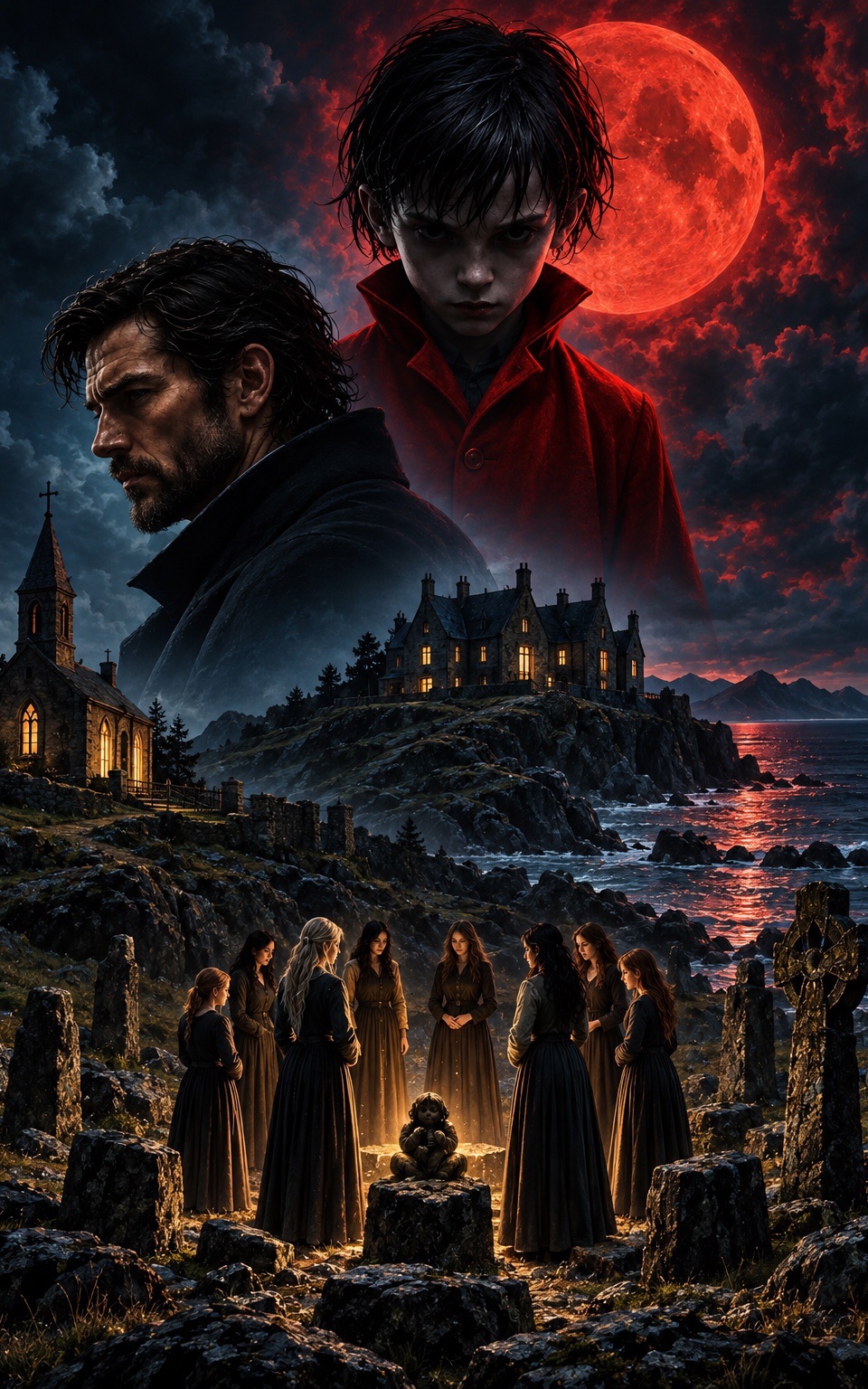
Carranmore II

In 1710 Ireland, a skeptical former soldier investigating accusations of witchcraft discovers that eight condemned women are the only thing keeping an ancient evil buried.
Chapter Two
Father Declan Byrne did not believe Mairead Corvin.
He believed that she believed herself.
There was a difference.
He sat across from her in the small front room of Carranmore House while rain struck the windows. Mairead had not changed from the previous evening. Her gray hair had been tied behind her head without care, and dark circles surrounded her eyes.
On the table between them rested six small stones.
Father Byrne picked one up.
“And you say this came through the window?”
“No.”
“You said something struck the window.”
“It did.”
“But the window did not break.”
“No.”
“And then the stone appeared inside?”
“Yes.”
Father Byrne examined it.
It was an ordinary river stone.
“Perhaps it was already in the room.”
Mairead stared at him.
“Father.”
“Mairead.”
“I have lived in this house for thirty-seven years.”
“I know.”
“I do not keep stones on my sitting room floor.”
“I did not suggest you did.”
“You were about to.”
Father Byrne returned the stone to the table.
He was fifty-one and had served Carranmore for nearly fourteen years. In that time he had learned that grief could make people hear voices, loneliness could make people see faces, and fear could turn a loose shutter into the hand of Satan.
He had also learned never to tell frightened people they were foolish.
It rarely helped.
“Show me the cellar.”
Mairead stood immediately.
Father Byrne followed her through the kitchen.
“Where is your maid?”
“With her sister.”
“You sent her away?”
“I told her to leave.”
“Why?”
“Because I am not certain what is in this house.”
Father Byrne stopped.
Mairead looked back at him.
“You may think me an old fool if you wish. I would rather be an old fool with a living maid.”
“I do not think you are a fool.”
“You think I imagined it.”
“I think you experienced something.”
“Priests have become very careful with words.”
“We had to. People kept listening to us.”
Mairead almost smiled.
Almost.
She opened the cellar door.
The darkness below seemed heavier than Father Byrne expected.
He took a lantern from the wall.
“You said the workers discovered a chamber?”
“Yesterday.”
“And the figure?”
“Inside it.”
“What figure?”
Mairead stopped.
“The iron child.”
“You didn’t mention an iron child.”
“I am mentioning it now.”
Father Byrne looked at her.
“What iron child?”
“A small statue. A boy with his hands over his face.”
“And where is it?”
“Gone.”
“Where did it go?”
“If I knew that, Father, I would have told you.”
He sighed.
“Of course.”
They descended.
The cellar smelled of damp earth and old stone.
The opening in the eastern wall was exactly as Mairead had described it.
Father Byrne raised the lantern.
“That was sealed?”
“Yes.”
“For how long?”
“No one knows.”
He entered.
Mairead followed.
The chamber was smaller than he expected.
The crosses caught his attention first.
Father Byrne approached one.
He touched the carved lines.
“These are old.”
“Catholic?”
He glanced at her.
“Very funny.”
“You laughed at the laborer when he said it.”
“I wasn’t there.”
“I laughed for you.”
Father Byrne studied the wall.
The crosses had been cut at different heights. Some were clean and deliberate. Others had been scratched into the stone.
One had been carved upside down.
Father Byrne frowned.
“What?”
“Nothing.”
“Do not begin that.”
“Begin what?”
“Priestly nothing.”
He looked at her.
“An upside-down cross is not necessarily Satanic.”
“I didn’t say it was.”
“You were thinking it.”
“I was thinking you stopped speaking when you saw it.”
Father Byrne moved toward the center of the chamber.
The circular slab remained in place.
The eight stones surrounded it.
He crouched.
Symbols had been carved into each.
“Do you recognize them?” Mairead asked.
“No.”
“Are they religious?”
“Everything is religious if you ask the right person.”
He moved the lantern closer.
One symbol looked vaguely like a cross contained within a circle. Another resembled a series of intersecting lines.
Father Byrne touched the slab.
Cold.
Very cold.
He pulled his hand away.
Mairead noticed.
“What?”
“The stone is cold.”
“It is a cellar.”
“The surrounding floor isn’t.”
He placed his palm against it again.
The cold entered his fingers.
Then came the scratching.
Father Byrne froze.
Scratch.
Scratch.
Scratch.
Mairead said nothing.
The priest stood.
The sound stopped.
“Rat?” she asked.
Father Byrne looked at her.
Mairead raised an eyebrow.
“You were thinking it.”
He walked around the slab.
“Could be.”
“That is a very large rat.”
“There may be several.”
“Organized rats?”
“Mairead.”
“Perhaps they have a committee.”
Father Byrne almost laughed.
Then something knocked beneath the stone.
Once.
Twice.
Three times.
Neither spoke.
Father Byrne slowly stepped backward.
Mairead folded her arms.
“Still rats?”
“No.”
The answer came too quickly.
Father Byrne realized it.
So did Mairead.
A sound came from the passage behind them.
A child’s laugh.
Father Byrne turned.
Nothing was there.
Mairead gripped his sleeve.
“You heard that.”
“Yes.”
“You heard it.”
“Yes.”
The scratching began again.
This time it came from the walls.
Father Byrne raised the lantern.
Scratch.
Scratch.
Scratch.
All around them.
The flame weakened.
“Out,” he said.
Mairead did not argue.
They hurried through the opening.
The lantern went out.
Darkness consumed the cellar.
Mairead stumbled.
Father Byrne caught her.
“Keep moving.”
Something ran behind them.
Small feet slapped against the stone floor.
Father Byrne pushed Mairead toward the stairs.
“Go.”
She climbed.
The footsteps followed.
Father Byrne turned.
He could see nothing.
Then two black eyes opened in the darkness.
They were several feet away.
At the height of a child.
Father Byrne stopped breathing.
A small voice spoke.
“Priest.”
He backed toward the stairs.
The eyes moved closer.
Father Byrne raised the crucifix hanging from his neck.
“In the name of Jesus Christ, I command you to leave this place.”
The eyes stopped.
Silence.
Then the child laughed.
“No.”
Father Byrne ran.
He reached the stairs and climbed quickly.
Mairead pulled him through the doorway.
They slammed it shut.
Something struck the other side.
Once.
Mairead jumped.
Another strike followed.
Father Byrne placed his hand against the door.
“Do not open it.”
“I had no intention.”
The knocking stopped.
They waited.
Nothing happened.
Father Byrne turned the key in the lock.
His hands were shaking.
Mairead saw them.
“So.”
Father Byrne looked at her.
“So?”
“Do you still believe I experienced something?”
He did not answer.
Mairead walked back toward the sitting room.
Father Byrne followed.
Neither spoke until they reached it.
The stones were still on the table.
Except now there were seven.
Father Byrne stopped.
“There were six.”
“I know.”
He approached the table.
The seventh stone was larger than the others.
Wet mud covered it.
Mairead looked toward the windows.
Both were closed.
Father Byrne picked up the stone.
Something had been scratched into its surface.
A single word.
BYRNE.
He dropped it.
Mairead stared at him.
“What does that mean?”
Father Byrne did not answer.
His face had gone pale.
“Father?”
He sat.
Mairead remained standing.
“Declan.”
He looked up.
She rarely used his first name.
“What do you know?”
Father Byrne looked toward the cellar door.
“My predecessor told me something before he died.”
“About this house?”
“No.”
“Then what?”
“About Carranmore.”
Rain struck the windows harder.
Father Byrne rubbed both hands across his face.
“He was eighty-six. His mind was failing. Most days he didn’t know where he was.”
“What did he tell you?”
“He said there had once been another church here.”
Mairead frowned.
“There is only Saint Brigid’s.”
“Now.”
“When?”
“He didn’t know. He said it was before the famine. Perhaps much earlier.”
“And?”
Father Byrne hesitated.
“He said the church was destroyed.”
“By whom?”
“He never told me.”
“Why?”
“He couldn’t remember.”
Mairead sat opposite him.
“What does that have to do with my house?”
Father Byrne looked at the stones.
“He said the old church had kept records.”
“What records?”
“Deaths. Baptisms. Confessions. Things that happened in the village.”
“Churches keep records.”
“Not these.”
Mairead waited.
Father Byrne continued.
“He said there were records that were never sent to the diocese. They were hidden because the priest believed no one outside Carranmore should know what had happened here.”
Mairead’s expression hardened.
“What happened?”
“I thought it was nonsense.”
“You no longer have that luxury.”
Father Byrne looked at the stone bearing his name.
“No.”
He stood.
“We need to go to Saint Brigid’s.”
“Why?”
“There are boxes in the old sacristy. Parish records. Letters. Documents no one has touched in decades.”
“You think there is something about this house?”
“I don’t know.”
A sound came from the hallway.
Both turned.
A wet footprint appeared on the wooden floor.
Then another.
No one stood above them.
A third footprint appeared.
Then a fourth.
They crossed the hallway slowly.
Toward the sitting room.
Mairead rose.
Father Byrne reached for his crucifix.
The footprints stopped at the doorway.
Water gathered upon the floor.
A child’s voice whispered from the empty hall.
“Mairead.”
Her face tightened.
The voice came again.
Closer.
“You found me.”
Father Byrne stepped in front of her.
“Leave her alone.”
A quiet laugh answered.
Then every stone on the table rolled at once.
Seven stones moved across the wood.
They arranged themselves in a circle.
Father Byrne stared.
Mairead moved beside him.
At the center of the circle, words slowly appeared in the wood.
Not scratched.
Not written.
The letters darkened as though they had always existed beneath the polished surface and had finally decided to show themselves.
Mairead read them aloud.
“Eight were buried.”
Father Byrne looked toward the cellar.
There were eight stones around the slab.
Then another line appeared.
“Seven remained.”
Mairead stopped breathing.
Father Byrne whispered the final words as they formed.
“One came out.”
From somewhere beneath Carranmore House, a child began to sing.
That is the end of Carranmore II. Thanks for reading.
Get the app for the rest of Elnos Plautt's writing, and everything else on Novellea.
Open in Novellea