
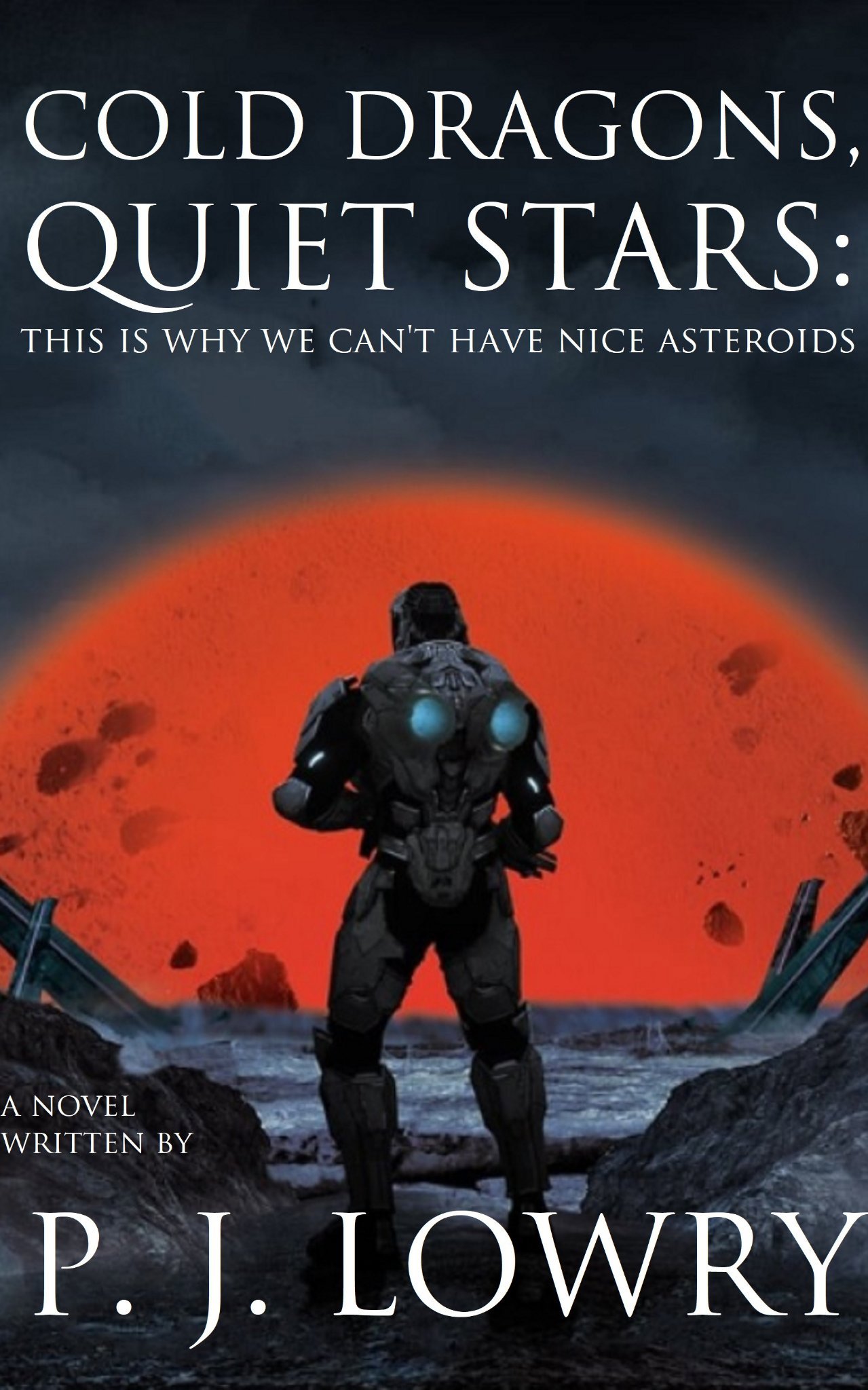
Cold Dragons, Quiet Stars: Why We Can't Have Nice Asteroids

In the distant future humanity goes to the Kuiper Belt to mine quiet, obedient rocks. When a distant asteroid begins behaving in ways it should not, Max investigates and raises unsettling questions.
Chapter 1
CHAPTER 1: ASTEROIDS DON'T BLINK
Maxwell Howard did not grow up dreaming of dragons.
He wasn't born on Earth and spent most of his life being referred to as a child of Luna. Humanity had obviously colonized their own moon first, but once Earthlings started to expand to other planets in the solar system and the moons that orbited them, it just made sense to give their own moon a formal name to avoid confusion. Hence, the moon was formally and officially named Luna, and after time people just got used to it and stop referring to that thing in the night sky as simply the moon. As a young lad, and one of the early children of Luna, Max's childhood fantasies were mostly about gravity. Specifically, having more of it. Luna's children either developed a primary fascination with physics or an early resentment toward their own bones. Max had landed somewhere in the middle, as he was curious, mildly brittle, and very good at asking questions no one else wanted to answer.
Maxwell's parents had been practical people. Both were engineers, which meant dinner conversation revolved around structural tolerances and why cutting corners was how good people died. Max absorbed this worldview early. Systems and stability mattered, and if something appeared calm on the surface, that usually meant the interesting part was happening underneath. His parents were also the kind of people who believed the universe was fundamentally understandable if you stared at it long enough and took careful notes. They had moved to Luna during the Second Expansion Wave, back when humanity still thought spreading into space would somehow make it better at getting along with itself. Earth came later for Max when it was time for university, and he immediately disliked it. The planet was too heavy, too loud and with too many people that were absolutely certain they were standing in the center of the universe. Max had spent most of his first academic year sore, vaguely nauseous, and wondering why anyone would voluntarily live at the bottom of a gravity well.
Academically, he did fine. Socially, not as much. Maxwell also had a complicated relationship with being right. On paper, his credentials were excellent, and annoyingly so. Doctorates from two separate institutions, both of which no longer existed in their original form due to funding reallocation and one memorable political scandal involving a senator and a zero-G wine cellar. Max's education spanned linguistics, cognitive modelling, and what the university brochures optimistically referred to as "Non-Human Intelligence Systems", which was a department founded on the assumption that if aliens ever showed up, someone should probably have done the reading in advance. Max had done the advanced reading, but what he had not done was learn when to stop talking.
The young man also gravitated toward research areas most people avoided: slow systems, emergent intelligence, patterns that unfolded over years or centuries instead of grant cycles. His doctoral thesis titled "Temporal Asymmetry in Distributed Non-Biological Cognition" was described by one examiner as "fascinating," by another as "deeply unsettling," and by the funding board as "not obviously profitable."
This did not bode well, and things got worse.
The incident that permanently branded Max as "difficult" occurred during his first postdoctoral appointment on Europa. At the time, Europa was fashionable: subsurface oceans, exotic chemistry, and the persistent hope that something down there might be alive in a way humans could point to and name. Max had been brought in to analyze anomalous signal noise coming from beneath the ice.
Max had concluded, correctly I might add, that the noise was not communication. He also concluded, less helpfully, that it was not random. His official recommendation had been to stop drilling immediately.
"Because if this is a system," Max had written, "then increasing thermal intrusion may provoke an adaptive response."
Despite his warnings, the drilling continued and three months later, the ice shelf collapsed into the ocean below, taking with it a very expensive probe and one deeply embarrassed research director. The final report blamed "unanticipated structural feedback", and no one ever apologized to Max. They did, however, stop inviting him to future meetings. This became a theme as Max would notice something odd, mention it to the higher ups, and then everyone else would explain why Max was overthinking it. Something expensive would break, and all hell would break loose. In fairness, Max did not help his case by being smug about it afterwards. He was actively working on that, but progress was slow.
His relationships followed a similar trajectory. There had been a long-term partner once, back on Mars with a systems architect named Alyson who appreciated Max's curiosity but not his tendency to prioritize hypothetical intelligence over dinner plans. Alyson eventually pointed out, with admirable patience, that Max seemed more emotionally available to abstract concepts than to people who occupied the same physical space. Max had responded that abstract concepts were statistically less likely to leave, which was clearly not the correct response. They remained on cordial terms, which in Max's experience meant exchanging holiday messages and carefully avoiding conversations about the past, the future, or why Max now lived several billion kilometres away.
The Kuiper Belt, therefore, felt like a reasonable compromise. Out here, Max's social awkwardness blended seamlessly into the background radiation. No one expected charisma in the outer system. They expected competence, silence, and a willingness to work with systems that did not care whether you understood them. Max had learned very early in life that space did not care about things, but what it did do was remain eerily quiet, which was why he preferred life in the Kuiper Belt.
Humanity reached the Kuiper Belt the same way it reached everything else: slowly at first, then all at once, and finally with a surprising amount of paperwork and political red tape. By the time Max arrived, the Belt had been re-branded from a "theoretical region of icy debris" into what classified as a "strategic resource corridor," which was corporate talk for please don't ask too many questions about what we're really doing out here.
The logic was simple enough. The Kuiper Belt was full of frozen volatiles, rare isotopes, and conveniently untouched material. It was all just sitting there, not doing anything useful. Fusion reactors needed fuel and habitats needed mass. Someone always needed something, and space had an annoying habit of being quite large. So, humanity started to bring heaters. The Outposts followed and then the mining platforms. After that there were the research annexes, which existed mostly to reassure everyone that someone, somewhere, was keeping an eye on things. That someone was not supposed to be Max.
Max's official title was Senior Xenolinguistics Analyst, which made people assume he spoke alien languages. This was flattering but grossly incorrect. What Max actually did was study patterns of communication that did not resemble communication at all; slow systems, emergent behaviours, and intelligence that did not feel any particular urgency about replying before the heat death of the universe. Max specialized things like star-scale signalling, distributed cognition, and the uncomfortable idea that higher intelligence didn't want to talk to us. This was merely a few of many reasons Max was deeply unpopular at funding meetings. His presence in the Kuiper Belt was the result of a bureaucratic compromise, which was often a result that nobody liked nor wanted. Someone had decided that if humanity was going to carve up the coldest, darkest part of the solar system, it might be a good idea to have at least one person nearby whose job was to ask, "Are we sure this is dead?"
Max had accepted the position mostly because it was quiet.
The Outer Systems Research Annex was a modest station by interplanetary standards. There was no rotating gravity ring. No luxury modules. Just a collection of pressure-tight corridors, humming servers, and enough insulation to keep the icy fingers of deep space politely on the other side of his walls. For the most part, Max liked it there. One of those reasons was the stars, as they were sharper in the Kuiper Belt. They were less washed out by dust and light pollution, making them a majestic sight to behold. During his off-hours, which he generously defined as any time no one was actively ignoring his warnings, Max would float near the observation blister and watch the slow ballet of distant objects drifting against the dark.
The Belt did not feel empty to him. It merely felt... paused.
This was, incidentally, how Max noticed the first problem.
Asteroids are not supposed to blink.
Max knew this with the calm certainty of a man who had spent fifteen years studying things that did not have eyelids. Asteroids were rocks. Rocks did not blink. Rocks did not move unless acted upon by something else. Rocks especially did not send automated distress pings that began with the phrase: this is probably nothing, but...
Max stared at the message scrolling across his console and took a long sip of his coffee. The coffee was recycled, nutritionally optimized, and tasted like it came from a crime scene. He drank it anyway as caffeine was sometimes the only thing standing between humanity and its own worst decisions.
The alert originated from Kuiper Station K-17, a mid-tier mining platform parked on the edge of nowhere, busy carving rare isotopes out of a perfectly respectable lump of ice and rock. K-17 had been operational for twelve years without incident, which in space qualified it as "boringly successful."
Until three minutes ago.
Max gingerly tapped the console, pulling up the full transmission log. The distress signal was short, jittery, and unmistakably human.
"Control, this is K-17." The message began, "We're seeing movement in the primary mass. Probably sensor drift, but the rock just... uh... well, the rock just moved."
There was a pause after that. Six seconds of silence. Then:
"Correction. It blinked."
That was where the signal ended.
Max leaned back in his chair, which complained quietly because it had also been recycled too many times. Around him, the Outer Systems Research Annex hummed with its usual low-level chaos. Processors whispering, cooling vents sighing, someone down the corridor swearing creatively at a malfunctioning printer. To him this was normal. Comfortingly normal.
But a blinking asteroid was not normal.
Max opened a private channel and pinged the station's AI.
"Tell me that's a metaphor," Max said, praying that's all it was.
The AI, helpful as always, replied, "Clarification requested. Which part?"
"Any part." Max answered.
There was a pause as the AI accessed the data. Max watched the little spinning icon and felt the first prick of something he didn't like. Anticipation, maybe, or the familiar itch of being right when he would very much prefer not to be.
"Sensor data confirms anomalous mass displacement," the AI eventually replied, "Visual feed inconclusive due to particulate interference."
"Of course," Max muttered, letting out a deep, frustrated sigh.
He still pulled the raw footage anyway and took a gander. The video was grainy, low-contrast, and full of static from micro-ice collisions. For several seconds, nothing happened. Just the asteroid, tumbling slowly against a backdrop of stars so distant they might as well have been decorative. Then, unmistakably, the surface shifted.
Not fractured.
Not exploded.
Shifted.
A seam opened along the rock's surface, both smooth and deliberate. A light that was cold, pale, and all levels of wrong... spilled out for a fraction of a second before the seam closed again. Max froze the frame. He zoomed in and enhanced contrast. He sat there and stared at it for what seemed like a very long time.
"Well, fuck me," Max muttered to no one in particular, "That's new."
His console lite up and even chimed as an incoming priority request cut interrupted his concentration. The sender ID read CENTRAL OPERATIONS, which meant someone important had just also noticed the same thing and was already scrambling to prepare a cover up about equipment failure. Max sat there for a few seconds, had a decent swig of his gawd awful coffee, took a very deep breath, and then finally accepted the call.
A woman in a sharply pressed uniform appeared on the screen, her expression appeared set to concerned but not alarmed, the official face of someone who managed crises for a living. Her name was Lieutenant Mara Chen, and Max often interacted with her whenever something like this happened.
"Dr. Howard," Chen started, "Are you're seeing this?"
"I am," Max confirmed as he took another swig of coffee, "And before you ask, no, asteroids aren't supposed to do that."
The lady frowned, which was a bad look for her because Max thought Mara was kind of cute. He had often wished she would smile more often but was smart enough to never actually say it out loud since they only spoke when something was wrong.
"Our analysts suggest a thermal venting event." Chen continued, "Possibly a micro-fissure releasing trapped volatiles."
"Volatiles don't blink," Max retorted, "They hiss or explode. Blinking implies coordination."
Lieutenant Chen appeared surprised. "Are you suggesting..."
"I'm suggesting," Max gently interrupted "That something inside that rock noticed it was being watched."
There was a silence on the line, heavier than the vacuum outside the station.
"That's not funny," Mara replied.
"I know," Max said, giving off another deep sigh. "That's the problem."
Before she could respond to that comment another alert chimed. This one was louder, redder, and less polite: K-17: SIGNAL LOST.
Max closed his eyes as the statement of the signal sank in. Somewhere in the Kuiper Belt, a mining platform had just stopped existing in any meaningful way. That meant whatever had been inside that asteroid, whatever had blinked. was now awake.
He opened his eyes and looked back at the frozen frame on his console: the moment the rock had opened, just enough to see out.
"Congratulations," Max said quietly. "We did it again."
The woman on the screen frowned. "Did what?"
Max took one last sip of his terrible coffee and watched the stars beyond the station drift in perfect, uncaring silence.
"We just found something," Max informed her. "And we poked it."
Outside, far beyond the warmth of engines and human certainty, the Kuiper Belt remained cold, but it was no longer as empty as everyone had originally assumed.
Chapter 2
CHAPTER 2: OBSERVING THE UNOBSERVED
Max floated back into the observation bubble, letting the gentle hum of the annex lull him into what could be a semi-productive focus. Behind him, the console continued to blink insistently red, which was not good. Max could feel the asteroid watching, or at least that’s how it felt to him. It was a personal policy for Max to not trust things that blinked at him without permission. Mara Chen’s face appeared on the screen again, brows drawn tight. She still looked cute when angry, but that feeling dissipated whenever she spoke to him in her usual negative banter.
“Max,” Chen called out, “Status update. Now.”
Max took a long sip his new cup of coffee, which still tasted like recycled disappointment, as he grinned faintly at the screen.
“Well,” Max started, “It’s definitely awake. And it appears… opinionated.”
Mara’s eyes narrowed. “Opinionated?”
“Yes,” Max confirmed, “Consider the evidence, Mara. Three distinct thermal fluctuations in the past twelve minutes, all perfectly localized. As if something, or someone, was pacing inside the asteroid. There’s a very distinct shift in mass distribution too. It’s subtle, but deliberate. One could believe that it’s thinking or at least behaving as if it is.”
Chen pinched the bridge of her nose, a clear sign of her ongoing annoyance.
“Max,” she continued, “You do realize how insane this sounds, right?”
“I do,” Max concurred, giving her a shrug. “I also realized it when I said ‘micro-tectonics’ on Europa and then a probe exploded. History suggests I might be right again, and things would move a lot soother if that was our default position.”
“Exploding probes are not analogous to blinking rocks,” Mara retorted, but her voice held a flat note that suggested she was desperately trying not to roll her eyes.
“Maybe not,” Max admitted, “but blinking rocks are far less convenient than exploding ones. At least the latter leave behind evidence you can point to.”
Chen didn’t answer immediately. Instead, she glanced at some data scrolls he couldn’t see.
“I’m sending a small observation team.” She informed him, “They will dock with you in about four hours.”
“Are you sure that’s necessary?” Max inquired.
“By the book, mister!” Chen reminded him, “You’re on coms. Full procedural oversight. And Max, please don’t give it a name.”
Max leaned back, pretending to consider the request seriously.
“I’m a scientist, Lieutenant.” He reminded her, “Naming things is practically in our job description. If it has patterns, I will not hesitate to name it. It’ll make data analysis more personal. Also, I like saying ‘It blinks’ out loud.”
Mara blinked. “You’re impossible.”
“I prefer the term consistently entertaining,” Max replied, giving her a boyish grin before watching Chen almost grown before turning off her screen. Max knew that his idea of humor was an acquired taste and that most people could only tolerate him in small doses. Rather than take it personally, Max returned to his console and opened up the latest feeds from sensors that were around K-17 but far enough away to not be damaged. The data stream was still chaotic in a subtle way, with mass distribution shifting slightly, surface textures smoothing and contracting like a living thing. Not explosive or catastrophic, but just responsive. Max found this all very fascinating but decided to give it a little more time before pestering Chen again. It was a gesture that didn’t last very long as Max had the patience of a dead horse.
“What is it?” Chen asked as she was already tired of seeing him again.
“Look at this,” Max muttered. “Do you see the seam along the ice ridge?”
Chen leaned closer to her screen, her soft lips pursed. “I see something, but I don’t know what I’m looking at.”
“It’s subtle,” Max said, as he floated closer. “A blink isn’t just visual. It’s structural, thermal, maybe even… communicative.”
“Communicative?” Chen repeated, her voice tight.
“Yes,” Max said, as he thought about it carefully, “Think of it like a cat. Not the domesticated kind, but the smart, judgmental kind. It sees you. It notices patterns. It decides whether to respond. And this one…” Max tapped the console, zooming in on the image of the asteroid’s seam, “…this one is curious. Or annoyed. Possibly both. It’s hard to tell with blinking rocks.”
Chen raised an eyebrow. “Did you just compare our asteroid to a cat?”
Max grinned back at her. “You should see the cats on Europa. Less blinking, more existential disdain.”
Mara sighed, but there was a faint twitch at the corner of her mouth. Max took that as a victory.
“How do you want to proceed?” she asked.
“Cautiously,” Max said. “When the observation team arrives, we should get a full-spectrum observation. Thermal, magnetic, structural. If this blinks again, we need to log the exact parameters. And…” Max stopped for a moment, “if it moves in any coordinated way, I want to talk about calling it something other than ‘asteroid.’”
Mara groaned loudly.
“We had an agreement,” She reminded him, “No names!”
“I made no such pact,” Max said as he held up a finger, “But we at least need a temporary placeholder.”
“Fine,” Chen conceded, “What do you suggest?”
“Let’s call it ‘The Blinker.’” Max suggested, “For internal use only. And yes, I will whisper its name to the console every time it does something clever.”
She rolled her eyes. “I hate you.”
“I know,” Max said, as he loved every chance to quote his favorite sci-fi movie.
“I’ll update you on the observation team when I hear more,” Mara said before turning off her screen again. Max loved their playful banter, but it was clear that Chen wasn’t fond of it, as speaking to him often ruined her calm.
As they continued to monitor the asteroid of the moment, Max suddenly noticed something new. The surface seam that had first blinked at them was now pulsing again, slower this time, as if it was actually breathing. There were tiny plumes of gas venting from precise intervals. This kind of behavior clearly wasn’t random, especially for an asteroid. Max noted that it was patterned, and almost deliberate. Max couldn’t help but bug Chen again when he discovered this.
“Do you see that?” Max called out excitedly, “It’s not just reacting to us… it’s showing off! Like it knows we’re watching and wants our attention!”
“Attention?” Chen repeated, as she leaned back in her seat. “We are not sending it a gift basket.”
“I didn’t say anything about gifts,” Max said, fingers hovering over his controls, “We’re talking about acknowledgement. Respect. You know. Scientific stuff.”
Mara shook her head, but her tone had started to soften.
“You know,” She said, “In another universe, you’d be a charming disaster. Here, you’re… exactly the kind of disaster we need.”
Max smiled faintly, floating near the observation bubble. He took a sip of coffee, eyes glued to the asteroid as it pulsed and shifted.
“You know, Mara,” Max continued, “If it decides to blink again, I’m going to call it Gerald. Or maybe Lucille. Something dignified. Names carry… weight.”
“You’re ridiculous,” Chen said again, though she didn’t sound annoyed this time.
“Thank you,” Max replied, “I try to keep the universe from being boring.”
A small shimmer of movement along the asteroid’s seam drew his attention. This time, it wasn’t subtle. Something inside was aligning, almost as if it were preparing to reveal more. Max’s grin faded into a sharp, focused stare.
“Okay,” Max murmured. “It’s curious. And patient. But not harmless.”
Mara leaned forward, voice clipped. “Do I need to panic?”
“I don’t think so,” Max said, shaking his head. “At least not yet. But let’s keep all escape routes warm and the coffee stronger. I have a feeling if this Blinker decides to teach us something… it won’t be gentle.”
Outside the bubble, the Kuiper Belt remained still, silent, and indifferent. But inside the observation room, Max Howard and Mara Chen were beginning to realize something very important: the asteroid wasn’t just a rock. It was alive… in its own slow, inscrutable, blink-of-an-eye kind of way.
And it had opinions.
Max floated in the observation bubble, his eyes glued to the asteroid’s subtle pulse. The red alert light on his console blinked like an impatient child. Mara Chen’s voice had returned, firm as ever.
“Max,” she called, “I’ve got to expand this conversation. You’re going to have company very soon.”
“Company?” Max repeated, “Do I at least get some names, or is this a surprise cameo?”
“Yes,” Chen confirmed, “Ops is sending three specialists. They’ll want full coms and oversight.”
“Ah, I see.” Max said as he leaned back, waving lazily. “The dream team. Flattering, I’m sure.”
Within minutes, three additional faces popped up on the screen: a systems engineer who looked like he had slept poorly for a decade, a data analyst whose long blonde hair defied gravity more than zero-G ever could, and a logistics officer whose expression suggested he had recently learned the definition of regret. Max floated forward, hands spread like a man introducing a lecture on interstellar etiquette.
“Greetings and salutations!” Max called out, “I am Dr. Maxwell Howard, and I am the company Xenolinguist. A specialist in slow-time and nonhuman cognition. Widely regarded as that guy who thinks space is alive. I study things that don’t speak, don’t blink, and do not particularly care if we exist. Mostly, I’m here to notice improbable patterns and say inconvenient things about them. Coffee critique is optional.”
Mara’s mouth twitched. “You’re impossible.”
“Yes. Thank you,” Max said, taking a half bow. “I try.”
“A pleasure to meet you Dr. Howard.” One of the screens replied, this one the systems engineer in need of a long nap. “My name is Eugene Dawson, but you can call me Gene. So, correct me if I’m wrong, but the asteroid blinked?”
“Yes,” Max confirmed, “That is correct, Gene.”
“Are you suggest that it’s deliberate?” Gene inquired.
Max leaned toward the console, tapping the image of the asteroid’s seam. “I’m afraid so. It’s not a vent or a glitch. Definitely not a meteorological anomaly. The thermal pulses are controlled. The mass shifts in coordination with observation windows and this the pattern repeats. This rock is aware and is responding. That’s not being done by accident.”
“This is Kevin Jones, logistics,” The second man on the screens called out, “So, are you trying to tell us that billions of tons of ice and rock are aware?”
“Aware enough for me to notice, Kevin,” Max replied, polishing off his latest cup of brutal java. “Consider it… opinionated. Slightly judgmental. Maybe even polite in its own unique way.”
“Tricia,” Gene said, referring to the last man to speak, the analyst. “What do you think about all this?”
The analyst rubbed her temples, and her hair seemed to be reacting to her mood just as much as she was.
“Max,” Tricia started, “This is impossible. This is a rock. Rocks are inert.”
“Rocks are usually inert,” Max conceded, “Until they are not. This one isn’t.”
“Max!” Mara called out as she leaned forward, her voice tight. “Please calm down and let them speak.”
“I am calm,” Max retorted. “I’m just… highly observant. I might have a history of noticing improbable things.”
“Yes,” Gene replied, his voice rising. “Like Europa. And Titan. And Mars. I think your definition of improbable is things that explode.”
Max grinned faintly. “Technically, yes. And statistically, it’s inconveniently informative. That’s my specialty.”
“Max,” Mara cut in again, exasperated. “The point is this could be dangerous. K-17 is currently offline. People might be hurt or dead, and you’re floating around calling a rock opinionated.”
“I understand where you’re coming from,” Max said, trying his best to play nice, “But I notice the patterns. The pulsing seam. The controlled venting. This isn’t random. It’s deliberate. Behavior implies awareness. Awareness implies intention. I’m not making a joke here. I’m simply making scientific conclusions based on observation.”
Gene clearly looked annoyed, and it made Max thankful they were only speaking through screens.
“You’re insane,” Gene said, not holding anything back.
“Maybe,” Max said as he floated closer to the bubble, “But I have the evidence. Look at the thermal map. See how it pulses, aligned with our line of sight? It’s responding. We appear to have provoked it just by watching. That’s intentional.”
“Intentional?” Mara repeated, exhaling slowly. “Are you suggesting that this asteroid is alive?”
“Possibly,” Max answered, “Alive as in the sense that it notices, adjusts, and possibly judges. And I repeat: deliberate, not accidental. We can argue probabilities, but it’s still happening like a Van Halen song: right here, right now… and we’re the audience.”
Tricia could be seen rubbing her eyes.
“So,” Tricia started, “What happens if it decides we’re boring?”
Max’s grin returned. “Then we observe anyway, and we make an effort to not be so damn boring. Boredom is one thing The Blinker cannot forgive.”
Chapter 3
CHAPTER 3: MAKING CONVERSATION
The room fell silent, the hum of the annex loud against the dark. The three new participants had no idea how to respond to the crazy man who was calling their anomaly something as ridiculous as ‘the blinker’. Gene couldn’t control his frustration as he never even wanted to be there in the first place. Tricia hadn’t been this irritated at a man since her divorce negotiations with her now ex-husband. The fact that she couldn’t reach across and slap max in the face disappointed her even more, but she conceded to just to tabulate a total and hand out her smacks in bulk when they met in person. This put a smile on her face as it gave her something to look forward to. Kevin wasn’t showing any emotion and was very difficult to read, which told Max that he should never invite that man to poker night. Max was tempted to fill the silence but resisted as he assumed that he may have already pushed his luck, but it appeared that someone else was starved for attention. The asteroid pulsed again, slower this time, almost like deliberate breathing. Tiny gas plumes vented rhythmically, and the seams along the surface opened just slightly, aligning with the sensors.
“Did you see that?” Max called out, pointing at his screen. “It’s testing. Communicating. Judging us. And possibly making fun of our equipment.”
Chen pinched the bridge of her nose and deeply sighed.
“As much as I hate to admit it,” Mara said, “But I think Max might be right.”
Max floated toward the console, grinning faintly. “Thank you, Chen. Recognition matters. Even from asteroids.”
“God damn it,” Gene cussed out, “This has to be the absolute worst assignment in human history.”
“Perhaps,” Max replied with an honest shrug, “Or maybe it’s the first time we’ve had a chance to talk to something completely unlike us. Something patient, deliberate… and a little sarcastic.”
Chen groaned. “Don’t give it a personality. Please.”
“Fine,” Max conceded, “Temporary nickname: The Blinker. For internal use only. And yes, I’ll whisper it every time it does something clever.”
The red alert blinked again, faster this time. Max’s eyes narrowed. “Ah. Response. I think it’s going to escalate.”
“Escalate?” Mara repeated, “How?”
Max floated closer to the window, trying to see if he could observe anything with his own eyes, but he was too far away to have that privilege.
“Slowly. Deliberately.” Max answered, “It’s most likely testing our reaction. It’s also curious, patient, and observant. Definitely traits we would associate with something that is alive. Chances are if we irritate it, then it will make sure we know it.”
The room went quiet again, each person staring at the distant shimmer. Somewhere in the Kuiper Belt, an asteroid was acting like it was awake. It was watching them, and it had opinions about what it saw.
“Hopefully,” Max added as he sipped his coffee, “It’s judging our decor.”
The annex hummed in that comforting, indifferent way only zero-G stations could manage, and Max could feel the tension in the room like static electricity. The three Ops specialists hovered on-screen, faces tight, pensively watching the console. Mara leaned back, arms crossed, staring at the distant shimmer of the asteroid with a mixture of skepticism and something Max liked to call curious fear.
“Alright,” Max said, as he floated towards his console with a voice that was calm but still firm. “We are about to see how The Blinker responds to direct observation. I’ve configured a simple pulse sweep across its surface. Nothing invasive; just light, heat, and motion sensors.”
“Direct observation?” Gene repeated, “In other words you’re poking it.”
“I prefer the term polite inquiry,” Max corrected him, “And yes, if we shine a light, we can see if it reacts. If it moves, we log. If it blinks again… well, we get to update our definitions of ‘alive.’”
“You’re insane.” Tricia said, before letting out a frustrated groan. Clearly Max was not the kind of person she enjoyed dealing with.
“I prefer proactively cautious,” Max added, aware if would upset her further.
“Max,” Mara said, “Please remember, we still have live human lives and very expensive equipment out there. If it decides to do something catastrophic, that means the consequences will be on you.”
“I understand,” Max said, floating back and tilting his head. “I take full responsibility, both legally and morally. But let’s be honest: that’s the exciting part.”
“The fun part,” Tricia repeated, still quite annoyed.
“She’s right, Max,” Kevin finally chipped in, “There are billions of dollars invested in this project, not to mention countless human lives hanging in the balance. Fun isn’t exactly the word I would use in this situation. I would appreciate it if people didn’t treat this situation like it’s a bloody game!”
“Hey, this is my way of coping.” Max informed him, “How else do you think someone can manage to stay in a place this isolating and do their job with any degree of competency?”
There was another uncomfortable silence after he floated the question, and that in itself was a response. Max used the pause and before anyone else could say anything, he initiated the pulse sweep.
On the monitor, the asteroid’s surface shimmered in faint bands of heat, a subtle choreography almost imperceptible. Then slowly, and impossibly deliberately, the seam along the rock’s ridge shifted. It wasn’t random, but also not mechanical. It moved in sync with the sensor sweep.
“It’s responding!” Max excitedly called out with eyes wide. “Not in a chaotic way. It’s deliberate and precise, maybe even judging our methods.”
“Judging?” Kevin repeated, “You’re literally saying it’s judging us?”
“It appears so,” Max confirmed, “With style.”
“Max,” Gene called out with a face twisted. “This is impossible. This is physics…”
“It’s not physics anymore,” Max interrupted, tapping the console. “This is behavior. There are patterns and coordination. And now… watch this.”
Max initiated a second, slightly faster pulse. The asteroid blinked back, tiny seams opening and closing with thermal spikes timed perfectly with the pulses. Almost… teasingly.
Mara’s eyes narrowed. “Teasing? Is it playing with us?”
“Exactly!” Max said with a grin. “Observation protocol number two: The Blinker knows it’s being observed. And it likes to see if we notice. If we react incorrectly… it might expand its repertoire.”
“Expand its repertoire?” Tricia repeated, desperately trying to keep up.
Max floated closer to the screen. “Tiny adjustments in its seams, micro-venting patterns. Little nudges. It’s learning our patterns as fast as we’re learning its own. If it wanted to destroy us, it surely could have by now. Instead, it’s testing, probing, and judging our competence.”
“So,” Mara said as she was pinching her nose again. “You’re telling me we’ve got a blinking, judging, experimenting asteroid out here… and you’re excited about that.”
“Damn right I’m excited,” Max openly confessed, “Because now we have the data that it’s alive, curious, and even slightly sarcastic.”
Tricia let out another audible groan.
“I’ve spent my career avoiding sarcastic people,” Tricia said as her frustration was quite evident. “Now I have to worry about sarcastic rocks.”
“Notice the thermal spikes that are aligned with our pulse sweeps?” Max asked as he pointed at the screen. “It’s almost like it’s winking. If we reverse the sweep, it might wink back differently. That’s proof that it’s being playful.”
Gene slammed a fist softly on the console. “Playful? This is billions of tons of ice and rock! Playful is not the adjective I’d use!”
Max tilted his head, as he had to acknowledge the frustration that he was observing from the team.
“Maybe not according to human standards,” Max replied, “But we’re adapting to its standards. Observation is communication. That’s all this is, and it’s effective.”
Mara sighed, her frustration leaking into amusement despite herself. “You are infuriatingly right. But that doesn’t make we have to like it.”
“Or like you,” Kevin added.
“I expected as much,” Max confessed, “Humans are rarely fans of sarcasm when it comes from asteroids. Or xenolinguists. Or both.”
The asteroid pulsed again, slower, deliberate, almost mockingly precise. Max leaned closer.
“See that?” Max inquired, “It’s evaluating us. Maybe it likes Mara. Or maybe it doesn’t. Either way, it knows we’re here and it’s enjoying the experiment.”
Mara raised an eyebrow. “You’re saying it has a sense of humor?”
“I’m saying it’s possible,” Max said as he floated back, shrugging. “Or at least a style of humor. Subtle, dry, existential. Totally within the parameters of an intelligent response. Its probably very judgmental too.”
The room once again went eerily quiet. Ops specialists, Mara, and Max himself, all staring at the distant shimmer of The Blinker. For the first time, the Kuiper Belt didn’t feel empty. It felt like it was alive, as it was watching. And Max Howard, xenolinguist, specialist in slow-time and nonhuman cognition, couldn’t stop grinning. This was going to be a long day. He had always believed that if you were going to bother an unknown intelligence, you should at least be polite about it. This belief was not universally shared but the others that he was speaking with.
“Let me be absolutely clear,” Mara Chen said, arms folded tightly across her chest as she continued observing the live feed. “You are not going to try to speak with this asteroid, are you?”
Max floated upside down near the console, legs hooked loosely under a handrail. “I’m not talking to it. I’m… asking questions.”
“That’s actually worse.” Tricia responded.
“Only philosophically,” Max countered, “Practically speaking, I’m just adjusting sensor parameters in a way that might provoke a response. Very gentle and respectful. Think of it as knocking softly on the front door.”
The Ops channel crackled with low-level dissent. Gene had stopped pretending to be calm, while Tricia was chewing on a stylus. Kevin looked like he was updating his résumé in his head and was eager to leave the company as soon as possible.
“Max,” Mara called out, “We already established it’s responding to observation. Why would we want to escalate at this point?”
“That’s because,” Max started, rotating himself upright and tapping the console, “It’s already escalating. We just haven’t admitted it yet.”
The Blinker pulsed faintly on-screen, the seam along its surface opening and closing in a slow, deliberate rhythm. Not random nor mechanical, but expectant.
“There it is,” Max continued. “That’s not idle behavior. That’s waiting. It knows we’re here. It’s adjusted to our monitoring cadence. At this point, not responding is just as and possibly more dangerous than asking carefully.”
“Isn’t his is how horror movies start?” Gene asked.
“Yes,” Max replied, “This is also how first-contact protocols start, if you squint hard enough.”
“Fine,” Mara called back, “You get one test. One. And if it so much as twitches in a way that looks hostile…”
“Then I’ll stop,” Max finished for her, “Scout’s honor.”
“You were never a scout.” Tricia said, calling out his bullshit.
“Correct,” Max said, as he didn’t mind. “Too many rules.”
“How am I not surprised,” Kevin said, “That’s why the company left you all the way out here… so we wouldn’t have to deal with you.”
“And yet here you are?” Max observed.
“Lucky me,” Gene said, his disgust more evident than he preferred.
Max queued up a new observation sequence: alternating low-intensity thermal pulses and polarized light sweeps. He spaced them irregularly enough to avoid looking like background noise but gentle enough not to be interpreted as aggression… well in theory.
“This is a question?” Mara inquired.
“Yes,” Max confirmed.
“What kind of question?” Tricia asked.
“Specifically,” Max replied, “Are you paying attention?”
The first pulse swept across the asteroid.
Nothing happened.
Gene and Kevin could be heard collectively exhaling.
The second pulse followed, slightly offset. Still nothing.
“You see,” Gene said with a smirk. “Sensor artifact. It looks like this is a false alarm, and we’re done here.”
Then the asteroid blinked, and not like before. This time, the seam opened in three distinct segments, one after another, matching the timing of the pulses exactly. Then closed again, clean and precise.
The room went dead silent.
Max’s grin was slow and a sign of deep satisfaction.
“Oh my,” Max said, barely containing his excitement. “That’s new.”
Mara leaned forward. “Max…”
“That,” Max said softly, “That was an answer.”
“It mirrored us.” Tricia observed.
“Exactly!” Max called out, glad he didn’t have to point that out. “Not perfectly. That still counts as mimicry. This was an interpretation.”
The Blinker pulsed again, once. Then twice. Then paused.
Kevin swallowed. “Is it… waiting?”
Max tilted his head. “Looks like it.”
Mara crossed her arms tighter. “You don’t get to enjoy this.”
“I absolutely get to enjoy this,” Max replied, his excitement clear to everyone watching and listening “This is precisely what my entire career has been quietly screaming about.”
Max adjusted the parameters again, this time introducing a slight asymmetry; one longer pulse, followed by two short ones. The asteroid did not respond immediately. Five seconds passed. Ten. Then the surface shifted. Not at the seam, but somewhere else entirely. A new line appeared, shallow and faint, like a raised eyebrow. Upon seeing it, Tricia couldn’t help but let out a nervous laugh.
“It’s correcting you.” Tricia pointed out.
Max checked it for himself.
“I don’t think so,” Max said, “It might be disagreeing.”
“That’s interesting,” Mara said, as she stared at the screen. “You’re telling me an asteroid just told you you’re wrong.”
“It appears so,” Max confirmed. “And frankly, that puts it ahead of several review boards I’ve worked with.”
“This is absurd,” Gene snapped, “You’re projecting intent where there is none.”
“That’s a fair criticism,” Max noted, “Except intent keeps showing up. Repeatedly with timing and style.”
As if on cue, The Blinker pulsed again. Three quick flashes, then one slow one. A pattern Max had not introduced.
“Oh,” Max murmured. “It’s improvising now.”
“Max,” Mara’s said as her voice dropped. “What does that mean?”
“It means,” Max replied said, “That our asteroid is not just responding anymore. It’s contributing to the conversation. It’s speaking to us.”
Chapter 4
CHAPTER FOUR: FIRST CONTACT
That was the last statement that the Ops team wanted to hear. To suggest that something extra-terrestrial was speaking back to Max meant on thing: first contact. Max was in essence speaking to a creature that was unidentified, and of unknown origin. That meant a whole new rule book had to be opened and followed to the tee, or the company would be in very big trouble with the governments that ran this part of the solar system. When it came to new species that have never been interacted with before, there was a completely different set of rules and regulations. Lawsuits and even sanctions became a very real options and that was enough to cause the ops channel to lose their shit and erupt.
“We should shut this down.” Kevin suggested.
“This feels unsafe.” Tricia added in complete agreement.
“This thing killed a station!” Gene added.
“We don’t know that!” Max snapped back.
“We lost contact with them!” Gene reminded him, “This thing is dangerous!”
“There is no evidence to suggest that!” Max ripped back at him, “So, do not make assumptions and fly off the handle! Just because we lost contact doesn’t mean it’s gone! Company guidelines state that we would need to confirm anything first before jumping to that conclusion!”
“You would say that,” Gene snarled, “Protecting that thing…”
“Stop fighting!” Mara called out, “That’s an order!”
Everyone stopped talking all at once, and there was silence again but this time it was a lot different than the earlier pauses. Chen outranked everyone, so when she told every to shut their cake holes, refusing to obey was classified as insubordination. She paused for a moment and tried to collect herself as well as she was not impressed with the revelation that was just dropped by Max. Max usually didn’t listen to her, but the way Mara asked for everyone to shut things down had a tone he rarely heard and that forced him to comply as well. She was pissed but doing her best not to lose it.
Max floated closer to the observation bubble, eyes fixed on the asteroid. The stars beyond it were sharp and uncaring, but the rock between them felt focused.
“Max,” Mara finally called out calmly, “What do you think?”
“It hasn’t acted aggressively,” Max answered quietly. “Not once. Everything it has done thus far has been measured, curious, and controlled. K-17 may not have been an attack. It may have been a warning, a reaction, or even a misunderstanding.”
Mara frowned. “That’s not comforting, Max.”
“I didn’t think so,” Max agreed. “But it’s informative.”
The Blinker pulsed again, slower now, almost lazily.
Max chuckled under his breath.
“You’re enjoying this, aren’t you?” He asked.
The asteroid blinked. Once.
Perfectly timed with his words.
Tricia gasped, and Gene could be heard cursing again. Kevin actually laughed, a short, hysterical sound. Mara stared at Max.
“Max,” Mara started, “Did it just…”
“Yes,” Max confirmed. “Yes, it did.”
Chen exhaled slowly. “You guys realize this changes everything.”
“It always does.” Max concurred, nodding in agreement.
Max leaned back, letting himself drift. His coffee cup remained attached to the console, being left to grow as cold as the space outside.
“Congratulations, everyone.” Max said to the room, Mara, and the Ops team… even to the asteroid itself.
“You would say that,” Gene repeated, even less amused.
“Even you know what this means, Gene.” Tricia said to him.
“Yes, I do,” Gene said, even though he didn’t want to admit it.
“We’re no longer observing a phenomenon.” Max observed.
Before anyone in the conversation could reply, The Blinker pulsed again, faint and patient.
“We’re in a conversation,” Max said, “That makes this First Contact.”
Outside the annex, the Kuiper Belt remained cold and silent. Now the silence had shape, and it was listening to them.
“From here on,” Chen started, her voice sounding stern. “We need to watch what we’re saying and behave a little bit better than we have up to this point.”
“Are you sure that’s wise?” Gene said, “If it’s listening to us, a change in our voices could cause it to become defensive.”
“I hate to admit it,” Max replied, “But Gene is right. We have to keep acting like we have before for consistency. We can’t make dramatic changes or that might make The Blinker feel frightened, maybe even threatened.”
“I concur,” Tricia chimed in, “We should try to keep acting as we have before we knew it was listening. That doesn’t mean we can’t reel in our attitudes and try to apply some manners I’m sure out mothers taught us.”
“I agree,” Mara agreed with her, “Keep acting as you were but keep the swearing and pestering to a minimum. Is that clear?”
“Affirmative,” Keven complied.
“Loud and clear,” Gene added.
“Max,” Chen called out to him specifically, “Are we clear?”
“Crystal,” Max replied, quoting his favorite Meathead film.
“We’re also going to do this by the book,” Chen continued, “That means we are declaring this First Contact, and will follow all the interstellar protocols to the letter. We cannot afford to make mistakes from here out or there could be grave consequences. Break out your manuals and get working on it!”
For the first time since this conversation started, both Max and the Ops members were all groaning in unison. Max floated over to a different console and pulled out a massive binder that looked thicker than War and Peace. Inside it were specific regulations and rules to how they all were to conduct themselves,
“As a reminder,” Mara continued, “Everything done and said prior to the official declaration of first contact made by the commanding officer, which is me, is immune from any kind of discipline and/or charges. But from here on, everyone has to follow the book and guidelines made out. No deviations from it unless it’s an emergency or you have prior authorization. Is that understood?”
Before anyone had a chance to respond, The Blinker pulsed again to answer Mara’s question with purpose and respect.
“Damn it,” Mara cursed to herself, as she almost forgot it was listening to them.
“Should we give it a copy of the manual?” Max asked.
“Don’t be a wise ass,” Gene chipped back, “Just because it’s trying to communicate doesn’t mean it can read or even grasp what we’re really saying.”
“We have to at least assume it can understand what we’re saying,” Tricia suggested to them all, “And that’s why Chen is asking us to go by the book. We all have to be very mindful of what classified information we provide on a channel that is no longer secure.”
“That is a very good point,” Kevin agreed, “And it’s probably in the book too.”
“What is your next step, Chen?” Gene asked, wanting to know where her head was at as her views were what really mattered at this moment.
“You guys study up on protocol,” Mara instructed them, “I have to get in contact with corporate and loop the administration in on what’s happening here.”
“Do you need me to help with speaking to corporate?” Max offered.
“Right now I’m just sending a request,” Mara answered, “I might need you for the meeting if its approved, which I think is only a formality at this point. When the hear what I want to talk about, they’re going to lose their collective shit.”
“So, in the meantime?” Max inquired.
“In the meantime,” Mara responded, “Read the book and make sure you haven’t broken too many rules when speaking to your rock. Keep contact to a minimum while I get the fat cats looped in. I’ll get back to you when I get the chance.”
“Sounds fair,” Max said, as his glee and sarcasm had reduced significantly.
“I’ll loop you in when corporate responds,” Mara added, before shutting down her feed. She paused for a moment and rubbed her temples while hoping she would soon wake up and this entire ordeal was just a dream. It was not.
She fired up a new line, this time on a secure channel, or what she hoped was going to be secure. Since she had no idea how The Blinker was listening in, she was unsure if her feed to corporate was going to be secure. She was a lot farther away from K-17 than Max was, so this was a good chance to figure out who the asteroid was really eavesdropping on. Her money was on Max, but she also decided to not use audio and just sent text messages until ordered not to do so. Gene made a good point that just because The Blinker could hear them didn’t mean that it could read their language, so text was the way to go.
Chen quickly typed the following message to her supervisor:
WE HAVE LOST CONTACT WITH K-17.
ONE OF THE ASTEROIDS APPEARS TO BE COMMUNICATING WITH US.
WE REQUIRE GUIDANCE/INSTRUCTIONS REGARDING THE MATTER.
Chen looked at the message, and that appears to sum up what was going on. She was being as vague as possible but would supply more details upon request. She tapped the button that fired the message off to her supervisor and patiently waited for a response. She waited for about five minutes, and then an alert came across her screen. Her supervisor was asking for a remote video chat like the one she was having with Max and the Ops team. Chen took a deep breath and declined the request. She quickly wrote up another message:
WE SUSPECT THE ASTEROID MIGHT BE LISTENING.
FOR THE MOMENT WE CANNOT SPEAK ON INSECURE LINES.
Chen fired the message off and waited for her supervisor to respond. If The Blinker was listening only, then using text would be the best way to go until a more secure line of communication could be established. Moments later, she got her first test response from her supervisor.
WHAT DO YOU MEAN BY LOSING CONTACT WITH K-17?
Chen paused for a moment and then replied:
JUST THAT, WE HAVEN’T HEARD ANYTHING FROM K-17 FOR SEVERAL HOURS. AROUND THE SAME TIME AN ASTEROID BEGAN ACTING WEIRD.
Chen again waited patiently, and another text came back rather quickly.
DEFINE WEIRD.
Chen knew her next message was not going to make him happy:
I HAD NO CHOICE BUT TO ACTIVATE FIRST CONTACT PROTOCOL.
PLEASE ADVISE ON WHERE WE SHOULD GO FROM HERE.
Chen paused again and waited for her response. It came even faster this time.
I WILL CONTACT HOLT. HE WILL WANT TO HEAR FROM YOU PERSONALLY ON THE MATTER AND WHY FIRST CONTACT WAS DECLARED.
Chen let out a deep sigh. Holt was her supervisor’s boss, and one of the big wigs with the company that employed everyone. If her supervisor was taking the matter to Holt himself, then her declaration of First Contact was not being taken lightly. She typed one final message and sent it immediately:
ADVISE HOLT BRIEFING MUST BE ON MOST SECURE LINES.
THE ASTEROID HAS ALREADY REACTED TO LINES OF COMMUNICATIONS THAT WERE NOT SECURE.
Chen waited for another message and got it moments later:
UNDERSTOOD. HIGHEST ENCRYPTION WILL BE USED FOR BRIEFING.
SPEAK TO NO ONE ON THIS MATTER NOT ALREADY IN THE LOOP.
TIME FOR SECURE BRIEFING WILL BE MADE SOON.
Chen shut down her console, aware that was the last she was going to hear from her supervisor unless something urgent was to happen. Once Holt was advised on the situation, she had no doubt that he would consult the lawyers and follow up with her before looped the military and especially the government in on what was going on over there. She knew some people are going to fly off the handle and panic, but Holt was likely going to make sure that the company was in the right spot to handle it before letting the cat, or asteroid, out of the bag. She had already decided to use her time waiting for the meeting that was inevitable to write up a preliminary report, and fire it over to her supervisor to get them into the loop as soon as possible.
Chen knew she was still going to have a lot of explaining to do, and to save them time she was going to have to make sure Max was there for the conversation, as it would be easier for him to explain what was going on with regards to The Blinker. She cringed that the thought of Max and Holt speaking to one another, but eventually it was going to have to happen and Holt needed to know everything sooner rather than later. She was just going to have to rip of that metaphorical band-aid and hope to still have a job when it was all said and done. She knew ringing the First Contact bell was the right thing to do, as it was better to do that and have it turn out to be nothing than not ring it and end up messing up the first communication with a new species in their own galaxy. Deep down inside, she had a feeling that Max was right even though she badly didn’t want that to be the case. After what happened on Europa, Chen wasn’t going to take any chances after what happened the last time someone disagreed with Max. Turns out doing that is hazardous to your health.
Chapter 5
CHAPTER FIVE: REVENUE PROJECTIONS AND OTHER FRAGILE THINGS
Mara Chen's superiors did not like taking official on the record meetings unless something had frightened them into it. Most of the time they preferred euphemisms like statue alignments, strategic check-ins, and informal briefings. It was only when fear entered the equation, they reached for capital letters and secure channels. Unfortunately, the meeting Chen was getting ready to attend had both. She rarely used the board room, but this room was secure. She was pretty sure the anomaly that Max kept lovingly referring to as the Blinker would be unable to listen in. Chen checked the systems to make sure the equipment was active and that the lines were secure before things got underway. The conference room holograms flickered to life, resolving into three figures suspended in immaculate imitation. Each of them a projection being beamed through secure lines from millions of miles away. Chen walked over to her own seat and calmly sat down, while inside her head she was bracing for impact.
"Director Chen," called out Vice Administrator Holt, smiling with his mouth but not his eyes. "We have reviewed your preliminary incident report."
Mara kept a expression neutral.
"Then you've seen the telemetry." Chen asked of her superiors.
"Yes," Holt recalled, "We've also seen Europa."
The word dropped into the room like a gravity well. Max, leaning against the far wall with the air of someone attending a lecture he hadn't enrolled in, straightened slightly. Europa was not discussed lightly.
"I was under the impression that Europa was a containment failure," Administrator Reyes said, "An overreaction compounded by speculative science."
"You wish," Max snorted, "It was a massacre compounded by denial."
Mara shot Max a cold look meant to be a warning.
He ignored it.
Holt's smile thinned when he realized Max was also in the room.
"Dr. Howard," Holt calmly called out to him, "I believe your presence here is advisory, not rhetorical."
"Understood, Sir." Max replied, "I'll restrict myself to facts you don't like."
"Director Chen," Reyes continued, as he pretended Max didn't exist, "Your report suggests intentional behavior used by the asteroid."
"That is correct, Sir." Chen confirmed.
"And you allowed a civilian specialist to interact with it?" Holt asked.
Mara folded her hands as she knew and was prepared for this attack.
"Dr. Howard is not a civilian," Chen corrected him, "The last time I checked, Max Howard is a contracted xenolinguist."
There was a short pause in the boardroom.
"Which," Holt carefully replied, "is still not a real job."
"It's quite real," Max said defiantly. "It just doesn't get you invited to dinner."
"Let me be blunt," Holt said, as he leaned forward, "The Kuiper Belt Extraction Initiative represents the most stable revenue stream humanity has had in several generations. It has remained that way because it is predictable, scalable, and quiet."
"It was quiet." Max murmured.
"We cannot afford another Europa!" Reyes added, "Public confidence barely recovered from the last incident. If word were to get out that mining operations have attracted..."
"A sapient nonhuman intelligence?" Max guessed.
"An alien," Reyes snapped back, "The markets would freeze, our insurance will evaporate, and every advocacy group from Earth to Titan will demand a moratorium!"
Chen clenched her jaw, as she knew what Reyes was hinting at.
"You're asking me to suppress data." Mara speculated.
"What we are asking," Holt suggested with a very stern tone, "Is for you to contextualize it. Aggressively."
Max laughed. It came out sharper than he intended.
"Do you hear yourselves?" Max said, as he tried not to laugh again. "You're not afraid of it. You're actually afraid it might ask for a seat at the table."
"Doctor Howard," Holt said as his eyes hardened. "Europa taught us a valuable lesson. No one is suggesting that we take this situation lightly."
Max pushed off the wall, drifting forward.
"It sounds like Europa taught you the wrong lesson." Max concluded.
The hologram shifted as archived footage bloomed briefly between them: fractured ice, emergency beacons flickering out, a facility torn open like a crushed can. Max didn't look away.
"Europa wasn't hostile," Max lectured to the holograms, "It was startled, confined, and we had the audacity to poke it with tools it didn't understand. And when it naturally reacted, you dipshits called it an attack so the company wouldn't have to admit fault."
"You weren't there, Doctor Howard." Reyes reminded him.
"No, I wasn't." Max quietly confirmed, "I was the only one who told your people to slow down. I remember it was you and holt who decided to bury that memo."
Mara inhaled sharply. This was not in her briefing packet.
Holt waved a hand. The footage vanished.
"We will not repeat that mistake." Holt said, determined to retake control of the briefing from Max.
"Correct," Max concurred, "Now you have a chance to make a new one."
Silence.
Holt spoke again, this time his voice colder.
"The Blinker appears to have already disrupted one station," Holt started, "If it interferes again, we will have no choice but to neutralize it."
"Neutralize?" Chen repeated, as her posture stiffened. "How?"
Holt smiled. "Decisively."
"This is ridiculous," Max called out to them. "You're talking about killing something you don't understand just because it might dent your quarterly projections."
"We're talking about protecting human lives." Reyes snapped back.
"You don't care about human life," Max retorted, "You're only talking about protecting this gravy train."
The phrase hung there, as it was both ugly and accurate.
"You brought me in to manage risk," Mara reminded them, "Not to erase it."
Holt met her gaze.
"Your job," He replied, "Is to keep this project running."
"And if it can't?" Mara asked.
"Then you do whatever it takes to make it run!" Reyes shouted back. It was clear that he was slowly losing his composure.
"You're already at the wrong question," Max replied, as he wasn't going to let the suits push Chen around. "This isn't about whether the project survives."
"Doctor Howard," Holt's voice followed him. "What is the right question?"
"That's quite simple," Max answered, "It's about whether we deserve to survive."
He glanced back at Mara.
"And whether we're willing to listen when the universe finally answers back." Max added as he knew they wouldn't like his answer.
"If you don't like our suggestions," Reyes said, "Then what do you suggest we do about this?"
"Well, you have no idea if it's a threat," Max reminded him.
"The Blinker appears to have already disrupted one station," Holt said again.
"You have no evidence it disrupted anything," Max countered, "Which means you have no reason to neutralize it."
"He means we need to investigate," Chen finished for him, "We should send some of our specialists out there to actually access the station to see what really happened to it. For all we know the station is still running and producing, but we just don't know it. There's not need to panic unless we're given a reason to."
Holt sat at the table and paused while thinking about the situation.
"Alright," Holt finally said. "Send out your people and confirm what happened to the station. Once we learn what happened and what the current status of the station is, then we can decide what strategy to take from there."
"That actually sounds like a good plan, Sir." Max said, and he wasn't even sarcastic about it.
Without saying another word, the channel cut and both holograms of Holt and Reyes vanished without saying another word.
Mara exhaled slowly, shoulders sagging.
"Well," she said, "That went badly."
"Don't you worry," Max replied faintly. "That was just the warm-up."
"Well, get back to your pod and start packing." Chen ordered.
"Packing?" Max repeated.
"For the mission," Mara reminded him, "You're going with Gene and Tricia to investigate the station and determine its status."
"Excuse me?" Max replied, "You want me going out there?"
"Yes, I do!" Chen confirmed, "Do you honestly want Gene to be the one that might make first physical contact with whatever is out there?"
"Ugh," Max said, as he saw her point. Letting Gene be in charge of meeting up with The Blinker would make Europa look like a minor inconvenience with the way he conducted himself.
"You know I'm right," Chen added, aware what was going through his mind.
"Alright," Max agreed, "You make a good point. I'll start getting ready."
"Make it quick," Mara ordered, "Holt and his people are going to want proof that this thing didn't damage anything to keep their fingers off the trigger."
Outside, far beyond profit margins and policy briefings, The Blinker waited. Patient, unimpressed, and quite aware that humans were arguing about it instead of with it. The Blinker also knew that it was going to have company very soon.
That is the end of Cold Dragons, Quiet Stars: Why We Can't Have Nice Asteroids. Thanks for reading.
Get the app for the rest of P. J. Lowry's writing, and everything else on Novellea.
Open in Novellea