
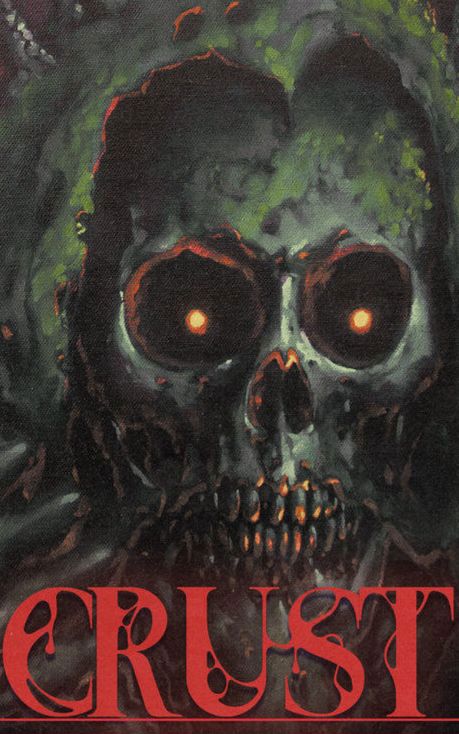
Crust

June 1976. England is scorched by the hottest, driest summer in two-hundred and fifty years. In Greenwood, a prehistoric peat bog known as Andertons Moss is drying out.
CRUST
June 1976.
Street-side telegraph poles sweat black ichor in the unrelenting summer sun. Tarmac adheres like pre-chewed gum to hot shoe soles. On Oxford Road, the Victorian neo-Gothic edifice of Manchester Museum looms large, casting a welcome shadow. Through double doors into the oak-scented coolness of the museum. Up the echoing stairs, through sunbeam-suspended dust motes, to the second floor. Past the Roman altar dedicated by Aelius Victor to the Mother Goddess. Past displays of scattered, tarnished coins, spotted fragments of pot, and all the rest. To a glass coffin case. A withered body lies within, its skin the colour of leather.
A framed newspaper clipping reads:
Evening Chronicle, March 16th, 1951.
'MOSS MAN' UNEARTHED
A shocking discovery was made at Andertons Moss in Greenwood last week. Two workers out cutting peat were astounded to find a dead man lying naked and face down in the bog. Experts claim that the Moss Man may have died a thousand years ago or more, his corpse miraculously preserved by the bog's waters. The gruesome discovery is now in the hands of the archaeology department at Manchester University, who plan to conduct further tests on the remains.
Beside the age-faded clipping, bold black letters on a white canvas square read:
Anderton Man – circa 10 BC / 100 AD.
Remains recovered from Andertons Moss peat bog, Lancashire, 1951.
Believed to have been a victim of ritual sacrifice. Anderton Man’s hands were found to have been tied behind his back, a leather garotte around his neck.
---
"Yet another scorcher for you today, folks, with temperatures set to climb as high as thirty degrees by midday in some places."
Looking up from her work, Kat raised a gloved two-finger salute towards the crackling radio balanced on the folding table. The DJ continued, oblivious.
The heatwave had begun a week or so earlier. The hottest, driest English summer in centuries. A Minister for Drought had been appointed, the public encouraged to conserve water any way they could. The tabloids loved it. "Save water. Bath with a friend". Meanwhile, Andertons Moss was drying out.
Kat had written her dissertation on Bog Bodies and Ritual Sacrifice Theory. In short, she didn't believe it. There was no proof. Disordered necklaces, bracelets, hair ties and other items of clothing would have shrunk and tightened in the waters over time. Almost all of the "garrottes" and "ritual bindings" could be explained that way. Those with dramatic injuries could easily have sustained them post-mortem at the hands of unknowing peat-cutters, plough blades, and trampling animals. Ritual Sacrifice Theory was a grisly Hammer Horror fantasy perpetuated by academics who should know better. The eeriness of the remains – skin tanned like leather by the lightless, airless bog waters – had got the better of them. They had stopped thinking scientifically and instead begun telling ghost stories.
Kat had been working in Manchester’s archaeological department for five years. Every time she passed that case on the museum's second floor, every time she read those words - "believed to have been a victim of ritual sacrifice" - she knew she had to do something. Now time was running out, so here she was. Waist deep in the heat-crusted mud.
"You shouldn't be out here!"
The voice made Kat start. She twisted her torso to look around her, wellies planted too firmly in the mire. She caught sight of a figure. No, two. Standing in the shade of the trees at the edge of the bog, maybe two hundred feet from where she'd set up camp.
“I have permission,” Kat blurted out, guiltily. It was a lie.
“I’m an archaeologist,” she added, hoping to sound more official.
They were children, she realised. A boy and a girl, maybe eight years old or so.
“You shouldn’t be out here,” the first repeated.
“Moss Man will get you,” the other added.
---
In wood of green, untamed and old,
Lies a moss lake, black still and cold.
The Will o’ wisps mark many graves,
Of those whose souls could not be saved.
Men, women, children, pixie-led,
Now sleep upon the black bog’s bed.
So never venture without care,
The old Moss Man you must beware.
This rhyme (as recorded in Gilchrist's Journal of the English Folk Dance and Song Society, 1937) can still be heard in the playgrounds of Greenwood’s schools. Notably, a version may also be heard during the annual Summer Festival here, when a guiser clad in moss gathered from Andertons Moss plays the role of Moss Man. Folklorists would doubtless compare the Moss Man to that other figure of Lancashire lore Jenny Greenteeth, who in turn has been linked to the Germanic Nixe.
Kat turned to the inside cover of the History and Folklore of Greenwood. Published 1957. Though it read like some Victorian curio, the saddle-stitched guidebook was only twenty years old. A row of faded copies stood beneath the optics behind the White Horse’s bar. The landlady had handed Kat one after learning she was an archaeologist.
The children lived there with their mother, who had introduced herself as Meg. They’d been sent to find the woman who was camping out at Andertons Moss. Bring her back to the pub to get out of the sun, and have some lunch. Kat’s efforts at keeping a low profile hadn’t amounted to much, evidently. She took a long, refreshing swig of her pint of lager top. It was certainly better than the milk-less tea she’d been drinking at camp. The pub was even cool and shady enough to enjoy the pie and chips Meg had brought over with a friendly smile. The first hot food she’d had in days. Maybe, Kat thought to herself, things weren’t so bad after all.
---
The tent had been zipped into its canvas bag. Equipment boxed and bagged. Everything was stacked neatly next to the spot where Kat had parked, just beyond the trees which ringed Andertons Moss. Despite the obvious care that had been taken, the message was clear. They wanted her gone.
The unexpected welcome she’d received had been a ruse. A distraction. She felt ridiculous. She’d trusted them. Trusted Meg. Chatted and told her more than she should have. All about her thesis, and how she believed that Anderton Man had simply drowned in the bog. How, now that Andertons Moss was drying out, time was running out to find evidence to support her hypothesis. Bodies. She was looking for bodies. Animal, most likely. Not sacrificed to some unknown, imagined thing, but who’d lost their way and found themselves stuck. Just like in that old rhyme she’d read, warning children to be careful of the place. Meg had said something about how the drought was affecting Greenwood. How farmers were losing crops already. She’d barely listened, she now realised. Too fond of the sound of her own voice. Prattling on about work and proving herself right. God, she was an idiot. Furious, Kat slung her gear into the car and slammed its boot.
---
It was mid-afternoon, the malevolent sun now past its zenith, and Kat was lost. For what had seemed like hours, wrong turn after wrong turn on indistinguishable hedgerow-walled dirt-tracks had only fuelled her rage. She’d put her foot down, bouncing the car in and out of petrified tractor tyre ruts, leaving clouds of grey dust in her wake. Now the adrenalin was gone. Her fury spent. She’d parked next to a the remains of a cottage at the crest of a hill – a ruin she was positive she’d already passed twice. Shaded from the sun, Kat opened her map on the car bonnet. She heard the voices before she could find her place.
Hidden in the ruin’s shadow, Kat watched the procession winding its way along the track below. Half a dozen men, a bull, and something else. The men walked close beside the beast, palms resting against its back and sides. They sang in unison. Dolefully. Like the chanting of monks. The figure leading the bull was swathed in green. Their head, face, arms, body, legs and even their feet draped in what Kat instantly knew was moss. This was why they had sent her away. This was what they didn’t want her to see.
She followed. Keeping her distance. Remaining hidden behind bramble hedges and in the shadows of age-twisted trees. Slowly but surely, the procession wound its way towards Andertons Moss. From the blackness beneath the trees, Kat saw the men stop at the edge of the bog, their atonal song halting abruptly. The mossy figure led the bull on, deeper and deeper into the sun-baked mire. The rope by which the beast was led was tied to something out there. A petrified tree stump? A stake driven, who knows how long ago, deep into the earth? Kat could only guess. And that was all. It was over.
The moss-clad figure waded awkwardly out of the bog, shedding their disguise as they did so. All pretence of ceremony gone. The man joined the others and they began to laugh and chat. Seven red-faced farm workers, bellowing about rugby and women and beer, passed by Kat’s hiding place without a glance in her direction. She waited. Held her breath. Stayed stock still. Until, at last, their voices could hardly be heard. Then, deep in the heart of Andertons Moss, the bull began to low.
---
Bruise-coloured clouds churn overhead, the bright afternoon transformed to twilight. On Andertons Moss a bull lies on its side, a foreleg thrashing at the crusted mud. Beneath the black waters the beast tries to bellow, but something is fastened tightly – ever so tightly – around its muzzle. Something which sucks the very air from its lungs, the very life from its body. Something which draws with such force that the great, muscular torso begins to fold in on itself. Ribs cracking. The bog seems to boil around the huge animal as its struggles lessen and lessen. And then cease.
Fat drops fall like stones, pummelling the parched earth. The leaves of the trees surrounding the bog hiss with pouring rain. For Greenwood, the drought is over.
Out in the bog a woman is flailing wildly, her cries drowned by roaring rain. Halfway between where the sacrificial bull sank from view and the treeline, she disappears face-first beneath the waters. Coughing and gasping for breath, she rises again. Struggling towards the trees, mud sucking at her feet and legs, desperately she presses on. Something rises from the depths behind her. Slowly. Dripping black mud and plant life draping its form, making its true size and shape indistinguishable. It looks like nothing else but a man made of moss.
Two weeks later, the newspaper headline reads:
TRAGIC DEATH OF MANCHESTER ARCHAEOLOGIST RULED ACCIDENTAL
That is the end of Crust. Thanks for reading.
Get the app for the rest of John Reppion's writing, and everything else on Novellea.
Open in Novellea