
Dearest Margaret

A 19th century man writes to his sister about horror at Old Mother Shipton's Petrifying Well.
Dearest Margaret,
You know that I am an old fool by heart, mesmerised by tall tales and the folklore of these tiny English towns and villages. They speak, inexorably, to that most human of natures: to look up at the stars and to be amazed, or to find the fantastical in the scientific mundane. You have always said that I am a contradiction: a learned man (in your kinder moments, you have said this, sis!), a scientific man, destined to impose order on the chaos of Man’s imagination, but devoted also to those childish follies of imagination. I delight both in the fairy tale and the ordinary truth, that juxtaposition between wonder and knowledge. You have always condescended to encourage my foibles and travels, knowing that at least there shall be stories to tell. Thus, I offer you my latest payment, dear sis, the Petrifying Well of North Yorkshire.
I have been rambling about the Midlands, as you know, and heard tell of Mother Shipton’s Cave: some ancient witch of prophesy, they say, born in the cave, gifted with awesome powers of transmutation to turn Man to stone. Though the old crone is gone, her magic – they say – remains in her well, whose waters transmutes a deposited artefact to stone, producing ghastly, misshapen things. It might well scare a child to bed, lest they be thrown into Mother Shipton’s Petrifying Well! And this, and other stories collect about this place, united only in their fancifulness and their ghoulishness. I was hooked, sis, line and sinker, dragged by my nose to the rich aroma of the bizarre, as you know I am wont to do.
The nearest town is Knaresborough, a picturesque place, its medieval, winding streets occluded by smoke as the train puffs into the station. It is built into the side of a hill, like a leech parasitic on a human host, and I suppose the snaking streets are the capillaries of that host, servicing the local people working upon the misty River Nidd. If the streets are the blood vessels, then a tiny, gothic church is the heart. Its bell sounds lonesome, sis, echoed off the rising fogs that roll upwards in the early evening and mask the town’s strange beauty in its ethereal embrace. The train station is a testament to English ingenuity. It sits at the end of a grand viaduct that crosses the Nidd Gorge. From the train, one is spoiled with brilliant views of the river and of the surrounding woodlands: thick and green even at the clutch of early autumn. I was perfectly pleased when I arrived, following the town’s ancient, stone steps to the local alms-house, taking my fill of a rustic fish pie and a flagon of Yorkshire ale. Oh, sis, they are characterful here: the chap serving drinks was positively plastered, his eyes glazed over, his beard dripping with alcoholic vapours! Yet he was a friendly kind of drunk, letting me a room for a modest enough price. As such, I soon took to bed, exhausted as I always am by the rigours of travel, my mind foggy and quieted by the memory of those Bacchanalian vapours that clung to the innkeeper’s beard.
I awoke in a jolly state and took my stroll of the town. I watched the men in overalls start their descent to the water, observed the women in their weekday dress visit the grocers, listened to the echoing, mournful bell of the church. In that moment, I decided that this Knaresborough was a quaint enough place, nestled perfectly in the Old English traditions that I so adore.
I might have wandered longer, but I was eager to begin my adventure. Consequently, I made my way down to the docks, seeking to employ a man that might take me to Mother Shipton’s old well in the woods, knowing how lax I can be when armed with compass and map. Alas, I had no luck: it was as if I was a ghost, some alien creature, ignored by these hardworking men, lugging their crates and their nets and giving me nary a sideways glance. Such lack of etiquette! It took talk of a half crown to earn any kind of notice, from an old fisherman named Abel, and I shall recount our conversation as faithfully as I can remember:
‘Wha’y’wan’, ’en?’ he asked, shouldering up some arcane fishing materials and fixing me with a chilling stare. One of his eyes was rheumy, as if it had collected the fog of the River Nidd. In the absence of its twin, the other had cultivated such an intensity that I could barely dare to speak.
‘Hello, good sir,’ I replied, in the best humour I could manage, ‘my name is Harold Trent Esquire. Might you take me to Mother Shipton’s Cave?’
With that alone, a change came over him, even more vile than before, and he turned his face away from me and toward the river. ‘Y’leave alone, sir, no good in’tat.’
‘There’s a half crown in it for you,’ I pleaded, but he simply shook his head and moved on. Quite defeated, I watched him amble down to the river side and busy himself with an ancient rowboat, made more of rot than wood, unlikely in my mind to float, but there it was.
I have met suspicious folks before, journeying as I do to all manner of remote places, but I admit I felt dejected when the old church bell rang, as if it tolled the doom of my endeavour, and I did not try as hard as I might with other fishermen about the docks. Rather, I was inspired to ascend the stony steps in search of that mournful peal, which seemed to resound from the earth itself, bouncing off winding streets and the shimmering waters of the old Nidd. I confess I was quite out of breath when I reached that lonesome place, distanced from other townhouses by graves and an iron-wrought fence. Yet – though rather discouraged – I resolved to make a visit of this church, forcing open its protesting gate and making my way up the gravelled path, pushing open the heavy wood door and stumbling inside.
The nave was empty, its pews gathering mould from the rising condensation of the river, faint light struggling through stained glass depicting saints and our Saviour’s Passion, candles necessary but unlit, the stone walls radiating a profound, empty cold that shivered across my shoulders. At the far end was a shoddy pulpit and altar, risen above the absent congregation in empty boast, and two faded curtains hung either at side, seeming out of place. There was no space for anything as grand as a column or pillar: the space was just a stone box. It reminded me, unpleasantly, of the graves nearby.
While I examined the bleak interior, the old vicar made his appearance. He was a stooped fellow, his beard wild and white, his face red from the exertions of the bell. When he saw me, he mumbled quite incoherently, and I felt dejection rise in me again. Yet he tottered towards me with an outstretched hand, and I thought I might have a chance, at least, with this old Father.
‘Morn’,’ he mumbled, half-collapsing into a pew, and I took my seat beside him, not knowing what else to do.
‘Morning, Father,’ I replied, forcing cheer to my voice, and I explained my situation best I could, though I suspect he was barely listening to my words at all.
‘Won’t find many take y’there,’ he muttered, ‘bad history, aye, ver’bad.’
Naturally, I asked for clarification.
‘Might be y’think t’it silly,’ he said, ‘but int’tat cave is magic, aye, an’ unchristian at that. Old Crone Shipton, aye, she a witch, turning kings ’nd t’at to stone, aye, and communin’ with t’all manner of darkness, aye, spawn of Satan, sustained by t’at skully well, makin’ her prophesies an’ her curses, cacklin’ int’tat well.’
‘But this is surely ancient history?’ I pressed, astonished at his words. ‘The Witch of York lived in the 16th Century! Surely in this enlightened age we do not fear such spectres?’
He absorbed my words, nodding into his beard. ‘Aye, well, t’at magic remains, aye, turning all manner of artefacts t’stony stone, aye. Y’leave it, aye, leave it be, eh?’
Such rampant superstition I found in the little town of Knaresborough! What had first been charming had become troublesome, but something in their fear inspired my own curiosity, and, like the proverbial cat, I could not be dissuaded. If none would take me into the woods, I would go myself, and trust my own wit and ability with compass and map, for good or ill. So, sis, I acquired a map, a compass, and a sturdy set of boots too. Off I went, tramping into the countryside with nary a backwards glance, wondering what manner of magic and power I might find at Old Mother Shipton’s Well.
The trees rose about me like something of myth, deciduous yet stoic against the autumnal onslaught, green foliage resisting the touch of seasonal rot. If not for the chilly aspect of the day, I might have thought it summer. Moreover, it transpired that some Knaresborough folk were not so superstitious after all, for a natural path seemed to sprout from the end of my compass, a path to the well, such that my navigational skills – rather lacking, as you know – were not sorely tested, and I was making good time.
But before we reach the cave, dear sis, I must tell you of the perfectly ghastly thing I found in those woods, resting on a fallen log just before a tributary stream of the River Nidd. It was a patchwork doll, made not of cloth but of an intricate wicker of sticks, overgrown with sprouting mushrooms that took place of its eyes, dressed in a black rot that almost persuaded me to leave it be. It looked positively pagan! Nonetheless, sis, I’m afraid to say I took it, against the primal judgement of my timid ancestry, resolved to drop it in Mother Shipton’s Well: a fine witchy offering if there ever was one, to the memory of that Old Crone herself.
When I reached the cave, it was abandoned, though someone had taken the time to affix a sign, assuring me that I had reached my destination. The cave mouth seemed perfectly hellish. Stalagmites and stalactites had formed just further in, giving it the aspect of uneven, crooked fangs. Aha! I felt that familiar flutter of excitement that so often earns me your sisterly contempt, and I entered inside.
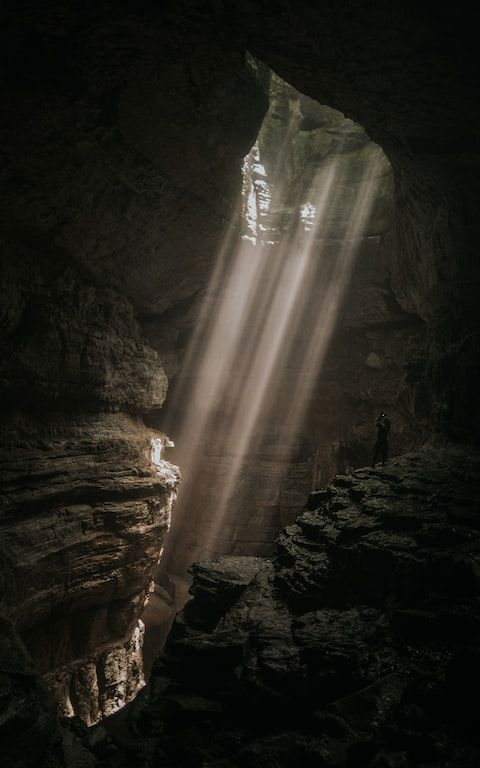
Happily, the cave’s roof was incomplete, rays of midday sun draped like dappled curtains and helping me find my path. Strange stony formations taxed my brain – I still have no idea, sis, how such strange patterns might be formed by any natural, erosive means. They were almost pyramidal, but where one might be concave, its neighbour was convex, demonstrating such disorder that might confound the best of scientists. A small path, gravelled and, to my eyes, well-trod, led around a corner, where the well awaited me, gaping and awful in its adornments: dolls and teddy bears hanging from rope as if sentenced to death, petrified to stone. The water shimmered almost gold, and I figured it coppery, surmising that this “petrification” might instead be the work of mineral deposits, and, as I theorised, I added my witchy doll to the well’s victims. And – I know you will think me positively ghastly – but I confess I took humour in fashioning my witch a noose, so that she might be hanged properly, and there she hanged, condemned to petrifying death, and I admit, I gave a little chuckle at what you might have said to me, lowering her into the water.
Now, I am no geologist, but I know some materialist techniques and theories, and I thought myself rather clever in my explanations. Alas, however, there was no accounting for the speed of petrification that took place: my witch, lowered into the water, was immediately heavy on the rope, and when I dragged her out, already the doll was hardened and grey. Lumpen with rocky deposits, she looked even more hideous, almost hunchbacked, stony buboes and a crooked, rock nose, resembling those cruel descriptions of Old Mother Shipton. And, with no explanation of how the minerals in the water might produce such extreme effects, I confess to a little thrill of fear, for I had invoked the Old Witch with my stolen effigy, and if there was magic hanging on this place, surely it was present now! But I quickly took hold of my senses, and resolved to further study. So resolved, I spent much of the day there, snacking on dried biscuits and the ale from my flask, and making my written notes, and, as it happens, writing much of this letter to you. And I’m pleased to report that I had a merry old time.
It seemed like winter by the time I reappeared from that dark cave, for an icy wind howled among the trees, and the leaves had begun to fall gold and brown. I must have been muddled by the fumes of the well, or by my time in the dark, for the simple path that had led me from Knaresborough to the cave seemed gone. Thrashing about, I must have made a foolish sight, for the path had led me right up to the cave’s mouth, and yet still I could not find it, as if the natural erosion of feet had undone itself, and nature had reclaimed what once was trod by Man. I felt my good humour fade as the woods came alive to monstrous noise: chirrups and rustlings and howls, which are quite explicable but adopt a dread aspect in the night. I had just resolved myself to spending the night at the cave when the path finally revealed itself, so under my nose that I might have tripped up over it! With the wind picking up, I decided to make haste.
What had been a jolly walk in the day became more sinister at night. The woods were alive with their eerie sounds: the hoot of an owl, the sudden scream of a dying rat, the tortured yowl of an injured or amorous wildcat. By day, I had enjoyed the vibrancy of a blue sky, but now I could barely see the stars, occluded by some stretching canopy. As you might intuit, sis, I was on edge, the alchemical properties of the well quite forgotten, my thoughts seized by fear. In retrospect, it seems rather queer, and yet perhaps my memory is contaminated by what happened next: you see, dear sis, the most frightful aspect is yet to come.
Given my state of alert distress, I was keenly aware of individuals walking towards me. I could not see them, for neither side had thought to bring lanterns, and the pale moon offered only limited illumination; yet, I heard footsteps, and the muttered words of some conversation between two or more fellows. I called out to them, forcing a cheer to my voice, but there was no response, indeed, even the sound of their footsteps ceased, and, when I called to them again, once more there was no reply. I inched forwards, my eyes straining, silvery moonlight twisting through the leaves, but when I reached closer, there was no one to be found. I might have chalked it up to frayed nerves, but I felt certain, and when I bent down to investigate, my fingers ran along the unmistakeable groove of recent footprints.
Next, I felt a sharp pain to the back of my skull, then blackness!
When I came to, it was nearly morning, the song of whippoorwills trailing off to the rising sun. I felt groggy and nauseous, but I had full recollection of the night before. My clothes were stained with mud from where I had fallen. My limbs ached. Yet my head ached worse: pounding shoots of pain blossoming across my skull and shooting down my spine. I tried to stand and found that I could, though I was a little unsteady on my feet, and, with nowhere else to go, I shuffled towards Knaresborough. Along that gloomy walk I had an unpleasant thought: surely my attackers had come from Knaresborough, and they might know my face even if I did not know theirs. But, with my pride a little bruised, I decided that I would not be intimidated, and with a renewed vigour I marched back to the sleepy town of Knaresborough, just as the mists of the River Nidd were dispersing before the day.
I must have been quite the sight to the fisherman beginning their days on the riverbank! But I’m glad to say that some young chap offered his assistance, and the resultant events are rather muddled. I’m finishing this letter to you in Dr Edelman’s bed. I’m being kept for observation. The good doctor insists that I must have been struck with a falling branch. He claims that only I would be foolish enough to wander the woods in the dark without a lantern! He is rather direct, you see, but he is amiable enough. He tells me that I have suffered from a minor concussion. I shall be rather sore for a few days, perhaps a little confused, but I’m in good spirits as I write this letter to you. I’m already planning my return to Old Mother Shipton’s Cave. I shall spelunk its depths, take samples, and finally – once and for all – discover the alchemical secrets of the Petrifying Well. Wish me luck!
Your adoring brother,
Harold
***
Dear Inspector Harris,
Firstly, I would like to apologise for contacting you by letter: I hope you shall understand that I must stay in Knaresborough for a little time.
I am obliged to report the murder of my brother, Harold Trent Esquire. The facts are as follows.
My brother was found near the Yorkshire town of Knaresborough, at the bottom of the well in Old Mother Shipton’s Cave. He was found by a local fisherman named Eric Fletcher. The locals allege that my brother must have slipped and hit the back of his head, and then drowned. I am in possession of my brother’s body and intend to bring him to London at the earliest opportunity for burial.
You may enquire as to my suspicions. They follow from letters received from Harold which chronicle his time in Knaresborough. In particular, he offers an alternative explanation of his head injury, which you will see took place some days before he returned to Old Mother Shipton’s Cave.
I include two further correspondences, allegedly from my brother. I confess that the first extract seems to have been written by Harold’s hand, but I must stress to you, Inspector, this was not written by my brother. The second extract, I believe, was written by Harold just before he died. I hesitate to include the letter, due to its more fanciful elements, but I include it in this package for completeness, so that your investigations can be armed with all the evidence I have to offer.
I trust you shall handle the matter with the gravity that is merited.
Yours sincerely,
Margaret Leeter
***
Dear Margaret,
I’m writing to you from Old Mother Shipton’s Cave, just beside the Petrifying Well!
I’m afraid you will think me quite silly, indeed, the good Dr Edelman certainly does. I had to firmly insist on my discharge from his care. A little grogginess from a fallen branch is no reason to delay scientific inquiry!
Yes, sis, I have given the matter thought and I must apologise for my last letter. As soon as I passed it to Dr Edelman for posting, I regretted some of its more alarming details. How you must have worried! I rather doubt that I was attacked: it is so easy for your imagination to run away from you in the darkness of the woods, and a fallen branch does make rather more sense. I must say, I worry that other details – the speed of the doll’s petrification, the disappearance of the wooded path, the footsteps of strangers in the night – these too might be the fevered ravings of an amnesiac, convalescing in his bed! Do not fear, sis, I will get to the bottom of it, and soon, for I am just where I need to be.
Do not worry. I have taken some precautions. I have rope and harness, and I have informed a local fisherman where I intend to be. I confess, sis, I am excited! And you must not fret: despite what Edelman says, I feel right as rain, and steady enough on my feet. I have tied my rope to a sturdy rock, checked the knot twice, and I am ready to proceed.
Who knows what scientific discoveries I shall find at the bottom of this cave?
***
Margaret,
I write this by matchlight and with little time. I shall enclose this letter in the secret fold of my knapsack and pray that it somehow finds you. I fear, dear sis, that I shall die here.
There is no time, there is no
I am in the Petrifying Well. Everything is rather fuzzy. My legs are submerged and feel impossibly heavy. I’m writing this on a small ledge and trying to hold on, but I feel fuzzy, and my legs are so heavy, sis, I
I did not understand, sis, I did not
You must realise that this is not a well, but a door, and I have seen the hideous creatures that await on the other side, and the water is rising, and the door must be as stone, must be, lest we are all lost. I have seen the alien stars that unfold, nightmarish and incommensurate with all sane astronomy, and their senseless winking against the purple sky, and I have seen the things that lurk and gurgle and slither beneath them, too horrible to describe, impossible to describe but for the briefest impressions: slimy things, wormy things, always grasping and reaching and seeking, and they see me, sis, you must understand, they see us all and
There are bodies and blood in these foundations, sis, and I fear that I
This is not water, but stone, and I am not flesh, but stone, some hellish transubstantiation, but necessary, I think, sis, necessary if
I am slipping
Forgive me, sis, there
***
That is the end of Dearest Margaret. Thanks for reading.
Get the app for the rest of Stephen Duxbury's writing, and everything else on Novellea.
Open in Novellea