
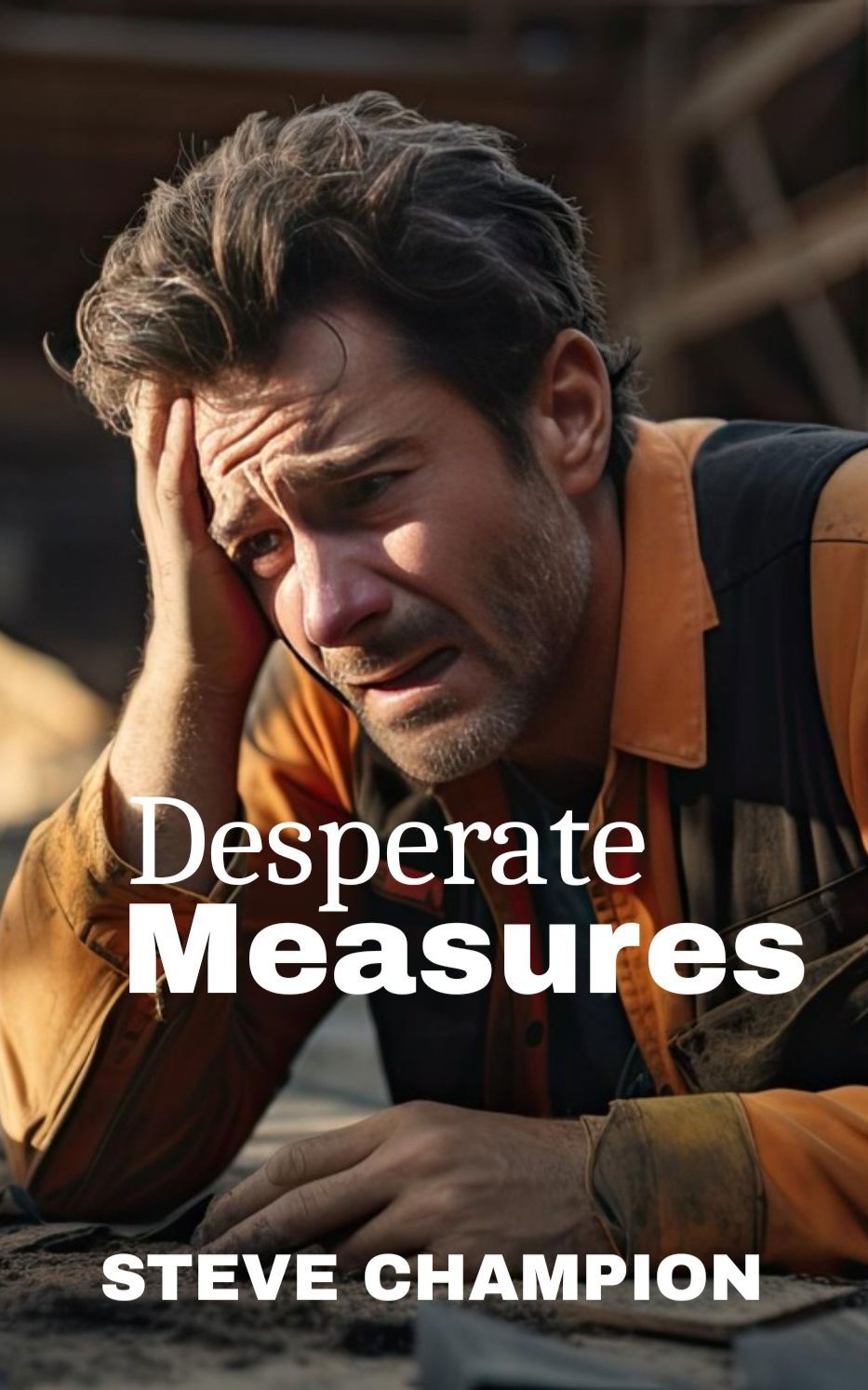
Desperate Measures

He had nowhere to turn, but was it time his family came first? Joshua had made his mind up.
Joshua tugged on the rope he had fastened over the beam in the cavernous hay barn. Lifting his feet from the floor he swung on it, twisting around to face out of the large wooden double doors and onto the public footpath that led from Constantine Village to Scott’s Quay on the Helford River.
Satisfied it would hold his weight, he released his grip and dropped a few inches to the floor. He dusted off the mildew from his hands which had transferred to his fingers and palms from the rope. Stepping over various bits of Land Rover engine parts, he passed the dismantled rusty and corroded vehicle itself to find something to turn into a platform. A platform on which he could stand and easily tip over with his feet.
The midday summer heat of that Wednesday in July had already warmed the barn and the surrounding hedgerows. It hadn’t rained for months. It had been the longest drought since records began. The inclement weather was mainly why Joshua was doing what he had to do today. His crops had failed for the last three years and the bank was now calling in his loan due to the lack of frequent payments. His wife, Siobhan, had supported him throughout these troubled times. But even she had had enough of late. His bad moods depressed both her and their kids, and with the endless moaning, coupled with his violent temper, with him smashing glasses and crockery, she had left him earlier in the month, taking their three children, all of whom were under five years of age, with her to her mother's.
He walked to the corner of the barn and wiped his brow free of sweat with a handkerchief from one of his overall pockets. Piled in the corner were lengths of sawn timber of differing thicknesses and lengths, an old wheel from a boat trailer, a collection of empty five and ten-litre tubs that once contained chemical insecticides, tins of dried-up paint, and the item he was looking for. He pulled it out from amongst its neighbours and blew the dust from the seat of the round, wooden three-legged stool. He smiled. He could clearly remember as a boy the day his father had turned the legs for the stool on the lathe in his workshop. ‘Here’s to you, father,’ he said in a thick Cornish accent, raising the piece of handmade furniture to the rafters, saluting his old man as if holding a pint of beer at his wake.
He didn’t expect a reply. After all, he was used to being ignored. By the bank especially. He had prayed to God night after night since Christmas, hoping that this year would be different from the rest, and he had found that God was great at ignoring him also; with the Deity remaining silent throughout his soul-crippling prayers of sorrow. Thanks a bunch, Lord!
He took the stool over to where he had secured the rope, set it beneath the beam and made sure it was level and steady. He didn’t want to fall off prematurely, thus breaking his ankle, or worse. He laughed at his ludicrousness. He was about to end his life, and here he was fretting about taking an unprepared tumble and landing awkwardly. Placing one foot on the stool he stepped up and stood centrally on the improvised platform. He reached up and took hold of the rope in both hands so he could tie a loop in it with a slip knot. He decided to forgo the traditional noose. He had tried several times the evening before to tie one and failed. Something else he was no good at. So, a slip knot would suffice.
After tying the knot, Joshua climbed down and sat on the stool. He leant forward, elbows on knees and, from his overall top pocket, he pulled out a half-empty packet of tobacco and a cardboard book of cigarette papers. He pulled out a length of tobacco from the packet in strands and placed it inside a folded-out paper which rested on his knee. Joshua then rolled himself a coffin nail; licking the adhesive strip with the tip of his dry tongue several times before the glue took effect. Pinching off any excess at either end, he brushed off any stray tobacco flakes from his legs, dropped the packet between his feet and flicked open his gas-filled Zippo. Lighting the end of the cigarette, Joshua drew long and hard on the roll-up. He wanted to savour this final moment of pleasure. Tilting his back he looked up at the looped rope above him and blew out a plume of greyish-blue smoke toward the beams and rafters. He sighed, closed his eyes and took another draw on the cigarette.
He thought about his wife and when they had first met in Truro six years ago. Siobhan was 31 and he was 26 at the time of their encounter. Four years and nine months separated their birth dates, and he often joked on social occasions that he was her “Toy Boy”. Their wedding day had been a blast. They had hired a cruise boat that set out from Falmouth and they had the ceremony and reception aboard the vessel. Siobhan and her bridesmaids had learned the dance routine from “Micheal Jackson’s Thriller”, while Joshua, his best mate Jon and the rest of the Helston Rugby Team had memorised the moves from “Madonna’s Vogue”. He smiled at the memory. Even when she had left, Siobhan had told him she still loved him, but she had the children to think about foremost. Slamming the door as they all departed, Joshua had broken down. A shattered man, he had collapsed on the wooden floorboards in the hallway and sobbed for hours. That was the final straw.
Beth, Joe and Issy had cried when they left with their mother. A further stab in the heart for him. He could recall each of their children’s first words, their first steps, playing hide and seek in their large inherited farmhouse, the games at Christmas, and the fun birthday parties; the times they had ridden their ponies over the fields of their farm, with all of them racing around a makeshift track, cobbled together with rolled bales of hay and bits of broken fencing. He was the luckiest dad in the world, and he knew they loved him unconditionally. And he loved them the same.
Despite all the memories, all the fun, and all the happiness and good times, they were nothing in comparison to all he had lost. Joshua knew it wasn’t purely all his fault. But the buck had to stop somewhere. His dad had left him the farm as a nest egg to give him and his family the best start when their first child, Beth, had been born. Three months later, his father had succumbed to cancer of the liver. A once heavily built, feared and steadfast man had been reduced to a crumpled, frail wreck of a human by the ravaging disease.
Looking back while sitting in the barn and smoking his final cigarette, it seemed that the passing of his father was the catalyst that started the beginning of the end. His mother had died in child birth of his younger brother, Daniel, when Joshua was only three. So, his father had played the part of their mother, too. He was both parents to the boys, equally and lovingly. Even when Daniel was killed in a motorcycle accident aged 17, his father had been there for him, as he always had.
But now his father was gone, and Joshua had no one else to turn to.
‘Sorry it's all gone to shite, pop,’ he whispered to himself. He took one last draw on his roll-up, the glowing hot end burning his fingers. He flicked the dog end to the floor and rubbed it out with the toes of his wellingtons. God, I don’t want to burn the barn down before I’ve had a chance to hang myself. There I go, talking to God, only to be ignored, yet again.
A murder of crows cawed as the neighbouring farmer in his tractor turned over his dry soil. His crops, too, had been victims of the scorching weather. The black, birds of death swooped down to grab whatever insects or seeds that had been unearthed by the blades of the plough. A tear formed in the corner of his left eye. Wiping it away, Joshua stood and one final time climbed onto the stool. From the rear pocket of his overalls, he pulled out two cable ties and a pair of pliers. He dropped the pliers as he didn't need them and they bounced off the stool and onto the barn floor. He joined the two ties together by slipping one end into the fastening lug, so it was one long black strip of plastic, and he pulled it tight. He then fastened the elongated tie into the free lug and created a wide loop. Joshua put both hands through the plastic loop and gripped the free end between his teeth. Then he pulled the cable tie tight, securing his hands together. Standing on tip-toes, he nudged the loop of the rope with his nose until it fell over his face and the front of his neck. Once happy it was in the right position, he slipped his head through the loop. Slowly, he lowered his feet so they were flat against the wooden seat of the stool, the rope pulling slightly behind his head, the knot sliding down a little further to the base of his skull.
Joshua sighed. Had it really come to this? Am I doing the right thing? Would Siobhan and the children miss him? Sure they would, to begin with, but they would heal as time went on, wouldn’t they? Should I subject them to the horror of discovering my swinging corpse in the barn? Could they all live with that mental image burned into their brains for all eternity? He shifted his weight slightly as he built the courage to go through with it.
The stool rocked.
He felt a rush of adrenaline flood his body, mixed with panic. A sensation he had never encountered before. His mouth filled with bile and thick phlegm. Tiny silver stars pinpricked his vision in swathes. His heart pounded in his chest, the speed with which it beat seemed too fast to measure. The sudden increase in blood flow made him feel giddy and unsteady. He didn’t like it.
The stool rocked again as he tried to stand on his tip-toes once more, in the hope the elevated stance would give him valuable seconds to re-evaluate his decision. He had to be sure he was doing the right thing. Would killing himself solve their problems? Initially, probably. But the huge debt and the loss of the farm would remain. Could his family cope with the stigma they would have to carry around with them for the rest of their lives? The shame it would bring on them. In such a tiny community in the Cornish village, it would no doubt be talked about for years to come, even decades! That on its own may be too much to cope with and they may, one day, end up in the same situation that he faced now, taking the easy way out.
Standing there on the stool, his life about to be snatched away by his own hand, Joshua decided he couldn’t live without his family and put them through the painful years of his actions; and despite the troubled financial times of late, he was sure they couldn’t live without him. He couldn’t carry out his plan.
The knot in the rope suddenly slipped further down and the loop tightened around his neck.
Full-on panic set in. He had changed his mind. Joshua was now trembling uncontrollably. He couldn’t gain his footing. He looked up at the rope that was fastened to the beam above his head. With his tethered hands, bound by the cable tie, he tried to reach up to grab the rope, to steady himself, but the movement shifted his weight forward and his right foot slipped off the stool, the makeshift platform becoming unbalanced. The stool toppled over.
Joshua fell before he could grab the rope. The slip knot cut into the back of his neck as the rope tightened, his body weight pulling it taught. Choking, Joshua sucked in breaths as best as his twisted mouth would allow. His eyes bulged from their sockets, his face red, the veins in his neck and head protruding as his legs and feet flailed around to try and reach something, anything, that would take the strangulated pressure from his neck and throat. He reached for the pliers in his rear pocket, to cut the cable ties that bound his hands, so he could try to release the tension in the slip knot with his fingers. He looked down when he remembered he had dropped them to the floor. The more Johsua struggled, the more he choked, wheezing and spluttering his last moments on earth. Tears streamed down his now crimson, bloated face. His eyes began to roll back into his head, the blood vessels inside rupturing under the strain.
Outside he heard something.
The familiar voices of his wife and children grew louder as they approached the barn. Joshua tried to shout out, to speed up their descent down the hill to the barn so they could save him. All that came out was spittle and strangulated groans. If he could just hold on. Any second they would be there. His family, his saviours. He stopped struggling and waited for them to appear, his body swinging from the rope at his neck.
Siobhan entered the barn with three adults, a man and two women, one of whom was carrying a small baby in her arms. Joshua looked at his wife. She looked frail and was grey-haired, sporting a hunched spine and a walking stick. She stopped and they all fell silent. Each in turn bowed their heads in respect.
Joshua began to swing back and forth, his legs propelling him. ‘Help me,’ he spluttered and wheezed, drool running out his mouth and down his chin.
The man held a bunch of flowers and walked towards Joshua. Joshua peered down at him as he swung back and forth. The man knelt and lay the flowers on the floor of the barn. Why can't he see me? My feet are just millimetres from his face.
The man looked up at the beam solemn-faced. ‘Here’s to you, Dad,’ he whimpered, wiping his cheeks dry of tears.
Joshua became still, his body suddenly lifeless and breathless. He felt no strain at the back of his neck nor the rope cutting into his throat, restricting his windpipe. He didn’t need to breathe any longer. All of Joshua’s physical pain was now gone, and his panic was over. He simply swung from the beam in the barn and witnessed the man stand up. Joshua was a few feet higher than him and the man looked straight through him. ‘Miss you, Dad. Everyday,’ he said. It was then that Joshua released this was Joe, his son. He had grown up, but how? The man turned and walked away to rejoin Siobhan and the two women.
The woman carrying the child then walked forward and laid her own bouquet next to Joe’s flowers on the floor of the barn. Joshua looked down at her. There was no mistaking who this woman was. It was Beth. He recognised her long red hair, the freckles and her deep brown eyes. She stood and smiled. ‘This is Emily. Your granddaughter, Dad,’ she revealed. She sobbed and a tear rolled down her cheek. Beth turned and joined the other three as Issy walked forward with her flowers. He knew it was his youngest. His baby.
Joshua tried to cry, filled with pride and sorrow, but nothing came. No tears or the dry choking in the back of his throat from the swell of emotion he still felt inside. ‘Love you, pops,’ she said, crying, and she lay the flowers next to her siblings bouquets.
Siobhan came forward to support Issy and she held her hand. ‘Here’s to you, Josh. You pig ignorant fool,’ she said as light-heartedly as she could. ‘Twenty-four years since you took your own life, and it still feels like yesterday. Love you, honey. I always will.’ With that Joe and Beth, joined them and they all sang “Madonna’s Vogue” in tribute to their late father.
The only man they ever truly loved.
That is the end of Desperate Measures. Thanks for reading.
Get the app for the rest of Steve Champion's writing, and everything else on Novellea.
Open in Novellea