
"Grim Bobby"

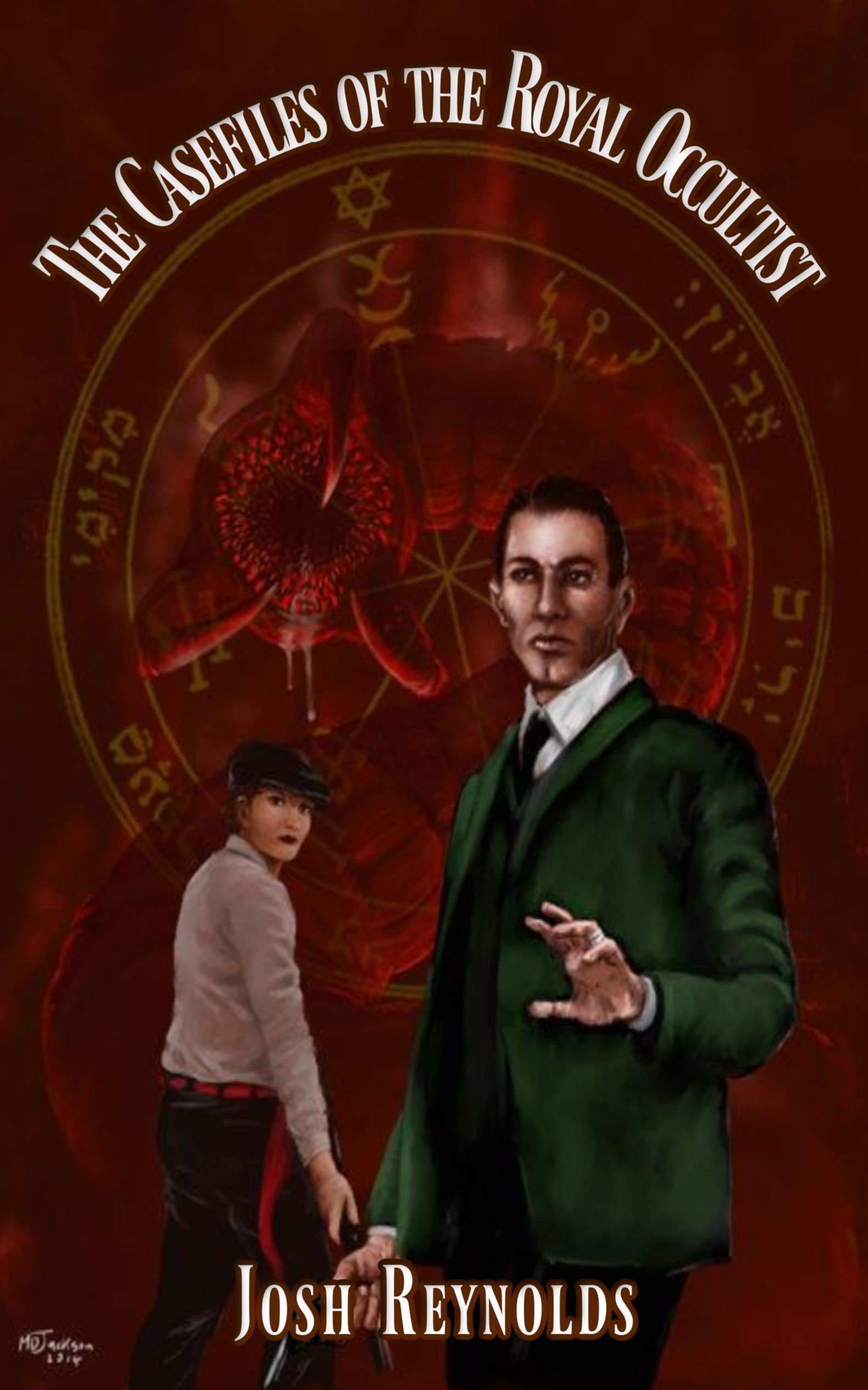
St. Cyprian and Gallowglass investigate a haunted churchyard...
“I do understand the concern, Vicar, really I do,” Charles St. Cyprian said, as he selected a cigarette from the silver case he held. He extended the case to his host, but the other man waved it aside. St. Cyprian snapped the case closed and slid it back into his jacket. His eyes slid lazily over the cosy confines of the vicarage of Treddwal, before his gaze settled once more on his host. “But surely the simplest course is to forbid them from visiting the dratted place. Exert some of that old parochial authority, what?”
Mortensen, the vicar in question, was a fleshy man of late years, with a round, friendly face and watery blue eyes hidden behind a pair of battered spectacles. He’d been the vicar in the village of Treddwal since before the war. He laughed gently at his guest’s suggestion and tapped the rim of his empty tea cup with a stirring spoon. “You don’t have much experience with children, do you, Charles?”
St. Cyprian smiled ruefully. In contrast to Mortensen, he was slim and well-dressed; a Leyendecker portrait come to life. “No. And now that I hear myself, I suppose that was a dashed silly thing to propose.” He lit his cigarette and shook the match out, tossing it into the ash-tray Mortensen helpfully extended. He sat back in his chair and puffed meditatively on his cigarette. “No, you’re quite right. Nothing encourages children more than the prospect of the forbidden. Put a lock on a book and they’ll spend all day trying to get it open, what?”
Mortensen nodded. “Exactly. Though if it were a book, I would not be as worried.”
“If you’d read some of the books I’ve read, you might not say that,” St. Cyprian murmured. He waved his own comment aside before Mortensen could respond. “Still, that’s neither here nor there. It’d help if I could have a chat with the lads in question. Hear what they saw from their own lips, what?”
Mortensen hemmed and hawed for a few moments, clearly uncomfortable with the idea. “It’s just, well, the folk here are – well,” he said, at last. “Royal charter or no, they aren’t comfortable with your presence here. Neither am I, come to that. Frankly, I sometimes wish I’d never heard of the Royal Occultist.”
“You’re the one who invited me,” St. Cyprian said, pointedly. The office of the Royal Occultist was charged with the investigation and occasional suppression of ‘unnatural sprytes’, for the good of the British Empire. The office had a somewhat erratic pedigree, stretching back to John Dee and the reign of Good Queen Bess; these days, the darksome duties rested on St. Cyprian’s not-particularly broad shoulders.
Mortensen, to his credit, had the good grace to look embarrassed. “Yes, well, I felt it was my responsibility.” The Church of England had a long-standing unspoken arrangement with the offices of the Royal Occultist. Vicars and rectors were often the first to take note of unusual doings in their parishes. When the worst happened, they lit the beacons, as it were. It was all very hush-hush, but it worked and that was the important thing.
In this instance, several examples of the local youth had apparently run afoul of a ‘saucer-eyed, hairy growling thing’ in a spinney of trees near the church. The boys had fled and, of course, told anyone who would listen of what they’d seen. The vicar had been consulted and being no fool, had duly placed a call to the rector, who, in turn, contacted a certain someone at Dean’s Yard in Westminster, and that someone rang up someone else and now here they were. The vicar refilled their cups as he continued. “Can’t have the local children talking to ghosts – or worse. Lord only knows what wickedness might come of that.”
“Talking to the dead isn’t the problem,” St. Cyprian said, accepting a cup of lukewarm tea with a nod of thanks. “It’s when they talk back that these things become a touch tricky.” He took a sip, grimaced, and set the cup down. It wasn’t any better now than it had been earlier. Mortensen’s taste in tea left something to be desired. “Nonetheless, I will need to speak to them at some point, if only to get an idea of what they might have seen.”
Mortensen frowned but nodded. “Very well. I will take you to see them. But you must be gentle with them, Charles. None of your usual boisterousness.”
“I’ve never been boisterous a day in my life,” St. Cyprian protested.
“Last time you visited, you yelled at Lady Wilkesbury.”
“She was possessed!”
“Be that as it may, one does not simply bellow in Aramaic at a member of the gentry over afternoon tea,” Mortensen chided.
“Hittite, I think you’ll find,” St. Cyprian grumbled, somewhat offended. “And I didn’t hear anyone complaining at the time.” Lord Wilkesbury, a somewhat loutish example of the local landed gentry in Treddwal, had been a consul in Trebizond for a time.
While there, he’d developed an abiding interest in historical artefacts – some of which he’d surreptitiously sent home. Unfortunately for him, one of those artefacts, a particular clay urn, dating from the Hittite period, had been cursed. Haunted, rather, by the ghost of a very indecorous Anatolian courtesan. St. Cyprian had expelled the spectre from her ladyship and returned it to its pot. Both pot and inhabitant now rested quietly on a shelf in his office in London…save for when he felt the urge to practice his conversational Hittite.
Needless to say, the whole affair had caused something of a sensation in Treddwal, and the greater parish. Such a sensation, in fact, that he’d never expected anyone to invite him to return. But here he was, back again – the proverbial bad penny. Or so he was certain it must seem to some of the residents.
“Yes, well, complaints were lodged in the aftermath. Especially regarding the egregious conduct of that assistant of yours – what was her name?”
“Ebe,” St. Cyprian said. “Miss Ebe Gallowglass. And I thought she acquitted herself well during that little fracas.”
“She destroyed an entire cabinet of crockery with that cannon of hers.”
“The crockery started it,” St. Cyprian said, leaping to his assistant’s defence. “Anyway, you won’t have to worry about her upsetting anyone. I’ve asked her to keep a low profile and snoop about.” He tapped the side of his nose. “She’s got a keen nose for that certain sort of wrongness we don’t like to see.”
Mortensen did not seem overtly content with this, but he refrained from saying anything more on the subject. Instead, he set aside his cup and stood. “Perhaps you’d like to see the spot in question first?”
“Oh, I do indeed,” St. Cyprian said, hopping to his feet and cheerfully following the vicar out the door. Outside, birds were singing and there were people out and about. Autumn was in the air, but the cold hadn’t yet reintroduced itself to the locals.
The village had changed little since his last visit; if anything, it looked even more like itself than it had previously. A little patch of English bucolic, with a sheen of Grimshaw over the top. Not a bad place, as places went. But not an especially lively one, either. Certainly not the sort of place one expected to find an evil spirit, saucer-eyed or otherwise.
When they reached the iron fence that banded the churchyard, he saw a familiar face perched awkwardly atop it, long legs kicking. St. Cyprian stopped and said, “Miss Gallowglass, I see you’re hard at work.”
“Busy morning, innit,” Ebe Gallowglass replied. She was short and dark, and dressed like a dockhand or a day labourer, down to the scuffed shoes, the flat cap perched on her head and the hand-rolled cigarette dangling from her lips. Someone, somewhere, might have called her pretty, but St. Cyprian suspected she was far too feral for such a description to stick. She scrubbed at her nose with a knuckle and nodded to Mortensen. “Wotcher, Vicar.”
“Yes, er – hello again,” Mortensen replied.
“Get down from there and tell me what you’ve been up to,” St. Cyprian said.
Gallowglass flicked the dogend of her cigarette away and thumbed up the brim of her cap. “Talking to the sexton, innit?”
“And what did he have to say?”
“He’s got a gammy hip, on account of him being at Verdun.”
St. Cyprian, a battered survivor of Ypres, raised an eyebrow. “He was in the war?”
“No. Fell in a ditch while on holiday.” She dropped lightly onto the path. “He also as might have mentioned that the church here is new.”
St. Cyprian glanced at Mortensen, who was nodding slowly. “Well, yes. That is to say, relatively speaking. The original church was built over an unfortunate subsidence.” He gestured vaguely towards a spot in the distance. “It was moved in – oh – 1673 or thereabouts. I don’t see how that’s significant, though.”
“Was the churchyard moved with it, by chance?”
Mortensen blinked. “I – I suppose.”
“Bodies dug up and reinterred, all that sort of thing?”
“I suppose I could find out, if you thought it was necessary.”
“It might be of some help, yes.” St. Cyprian studied a distant patch of trees and scrub speculatively – the haunted copse was an innocuous looking spot; a bit overgrown, but nothing to chill the blood. Still, it was in about the right spot for the original churchyard, he thought. “While you kindly attend to that, Miss Gallowglass and I will undertake a gentle perambulation of the grounds in question, as you suggested earlier.”
“A which what?” Gallowglass asked.
“We’re going to take a look at the trees. Come on.”
They made their way to the trees, and then among them. As he ducked beneath a low-hanging branch, St. Cyprian could hear the faint hum of insects and the creak of the higher boughs in the afternoon breeze. There was the expected faint aroma of wet earth and composting leaves, the scent of wild flowers and – something else. Not a smell, exactly. More like the memory of an odor. It made him think of childhood, of wet days and warm fireplaces, though he could not for the life of him name it.
“Smells like wet dog,” Gallowglass muttered.
“It does, doesn’t it. How odd.”
“A quick fire would clear all this up,” she said, picking up a stick. “Clear out the brush, and then we could salt the ground. Whatever is here wouldn’t be anymore, not after that.” She tossed the stick aside and wiped her hands on her trousers.
St. Cyprian frowned. “Perhaps.” Gallowglass had a doggedly pragmatic view of such matters. Haunted house? Burn it down. Cursed orchard? Burn it down. Et cetera, ad nauseum. He preferred to play things a bit more by ear. “I –” he began.
A sound interrupted him. It came from everywhere and nowhere, slipping through the trees and rolling along the air. At once shrill and deep, it set the roots of his teeth to itching fiercely. “You hear that, I trust?” he asked, looking at his assistant. You never knew, with phenomena such as this.
She nodded. “Getting colder, too,” she said. As if to prove the truth of her words, her breath plumed faintly on the air. “What do you want to do?”
“Back out the way we came,” he said, softly. “Slowly – don’t run.”
“What do you think it is?” Gallowglass had one hand inside her jacket, on the revolver she insisted on carrying everywhere. He gestured sharply.
“Something that will get very angry if you try and shoot it.”
“Sounds angry now,” she protested. He had to admit that she had a point. A branch cracked nearby, as if a great weight had suddenly pressed down on top of it. The sound made him flinch, despite himself. “Definitely angry,” she added.
“All the more reason to leave,” he said. She frowned, but did as he indicated, and pulled her hand away from the weapon. The growling did not still, but kept on – a basso thrum of displeasure. Whatever it was, it was big.
They retreated slowly, carefully. Their unseen observer followed. He could hear fallen branches cracking and grass rustling beneath its heavy tread, but saw no sign of it. Not even a glint of saucer-eyes in the gloom.
At some point, however, it stopped. The sounds faded as if they had never been. St. Cyprian paused and looked around. He spotted what he thought must be the remnants of the old churchyard wall. Was that why it had stopped? Was it bound to the churchyard? No answers were immediately forthcoming.
“Oi, what are you doing in here?” a thin, high voice called, interrupting his reverie. St. Cyprian turned to see a young boy standing at the edge of the trees, holding a packet of wax paper. The boy was thin, bespectacled; the sort who was never picked first for ruggers.
“Hunting for ghosts,” Gallowglass shot back. “What’s your name, then?”
“Who’s asking?” the boy shot back, pugnaciously. Gallowglass smirked.
“Oh, I like him.”
“You would,” St. Cyprian muttered. He forced a smile and took a step towards the newcomer. “I’m a friend of Vicar Mortensen. He asked me to – ah -” He hesitated.
“Hunt the ghost,” Gallowglass reiterated. “What about you? Seen one?”
“Are – are you talking about Bobby?” the boy asked.
“Bobby?” St. Cyprian asked, glancing at Gallowglass. “Yes, I believe we are. What can you tell us about this…Bobby?”
“He’s not dangerous,” the boy said, doubtfully. “Just lonely.” He looked down at the package he held. “And hungry.” He looked back at them. “You’re not going to hurt him. He didn’t do nothing!”
“We don’t want to hurt him, I assure you. We simply want to ensure that he doesn’t harm anyone else.” St. Cyprian took another step towards the boy, and heard a soft growl from somewhere behind him. He glanced over his shoulder, but saw nothing – or rather, he saw the vague impression of something, crouched just at the edge of the old churchyard. Bobby was giving them a warning.
The boy frowned. “He didn’t hurt anybody!”
“That’s not what the vicar said,” Gallowglass retorted.
“Technically, Mortensen is only claiming that the boys were chased – not that…Bobby harmed them.” St. Cyprian paused and looked at the boy. “Were you there that night, by chance? And what’s your name?”
For a moment, the boy looked as if he might flee. But it passed, and he lifted his chin. “Stickle. Barnaby Stickle.” He paused, as if waiting for laughter. When none came, he continued. “Bobby don’t like people he doesn’t know, is all. He growled at me too, right off. But I gave him my apple and we were chums after that.” He took a slab of bacon out of the wax paper and held it up. The growling behind them had been replaced by a soft panting. “He’s just lonely, like I said. And hungry.”
“Did he tell you that?” St. Cyprian asked, keeping one eye on the spot where he thought Bobby was crouched. Barnaby laughed scornfully.
“Bobby can’t talk! Don’t be silly.”
“Then how did you know?”
Barnaby looked at him. “He’s been here a long time, I think. He’s bound to be lonely, so long with no one to talk to him, ain’t he?” With that, he tossed the bacon into the churchyard. It vanished in moments, gobbled up by something they couldn’t see. St. Cyprian felt the hairs on the back of his neck stand on end. It wasn’t every day one saw a rasher of bacon vanish into the gullet of an invisible beast.
“Hungry too,” Gallowglass said. She glanced at St. Cyprian and he waved her back surreptitiously. No sense provoking their unseen observer more than they already had. There was more going on here than he’d first thought, but he thought he had the shape of the thing now. Gallowglass cleared her throat. “Play with him often, then?”
Barnaby shrugged. “Got no other friends.” He looked down as he said it, scuffing at the ground with his shoe – the very picture of resigned sadness. St. Cyprian, who’d suffered no lack of friends as a boy, felt a pang of sympathy nonetheless. He imagined that it was hard to be alone, when you didn’t wish to be.
“What happened that night?” St. Cyprian asked, gently. “When Bobby chased you and the others, I mean.”
“He didn’t chase me,” Barnaby protested. “Just them others! They were the ones chasing me.” He faltered. “They’re always chasing me.”
“Why?”
Barnaby fell silent and looked away. He suddenly looked very small indeed, and St. Cyprian felt a flush of anger to go with his earlier sympathy. “Ah,” he said. “I see.”
“What?” Gallowglass asked.
“You’re not going to get rid of him, are you?” Barnaby asked, in heartbroken tones. He knelt on the ground and reached out, as if to stroke something. A rumbling grunt echoed through the air. “Only, he hasn’t done anything. He didn’t hurt them none. He was just…looking out for me.”
“Yes, I expect he was.” St. Cyprian looked at the old churchyard. Its limits were easy to spot, now that he knew what to look for. From what he could make out, Bobby’s domain was not vast; more a kennel than a kingdom. But he was a fierce guardian of those under his protection – living or dead – even so.
Mind made up, he patted Barnaby’s thin shoulder. “Don’t worry. Bobby will be quite alright. I promise.” He turned. “Come, Miss Gallowglass. I wish to speak to the vicar.” They left Barnaby sitting there, murmuring to his invisible friend. St. Cyprian paused at the edge of the trees and looked back. Barnaby was sitting on a stone, and an indistinct something had its head in his lap, saucer-eyes shining dimly.
As it turned out, Mortensen was searching for them as well. He hurried towards them as they left the trees. “I just saw young Barnaby Stickle heading in there. Did you see him?”
“We did, as a matter of fact,” St. Cyprian said.
Mortensen made to move past them. “We must get him out of there! Hurry!”
Gallowglass intercepted him. The vicar stumbled back in surprise. “Fine, innit,” she said. “Happy as a pig in muck, yeah?”
“What? I don’t – I don’t understand.” Mortensen looked at St. Cyprian. “What’s going on? How could you just – just leave him in there?”
“Nothing in there will harm that boy,” St. Cyprian said. “Quite the contrary, in fact.”
Mortensen blinked. “What do you mean? The creature…”
“First, tell me this – was I right, then? Is this the old churchyard?”
Mortensen nodded. “Yes. It – it appears so. Is that…significant?”
“Yes. Quite significant. It tells me my suspicions were correct. Bobby won’t harm anyone, least of all young Mr. Stickle.”
“Won’t harm…but – but the boys? It chased them!”
“Ah. But who were they chasing?”
Mortensen paused. Something that might have been guilt flashed across his face. “Boys will be boys,” he began, half-heartedly. Then, seeing the look on St. Cyprian’s face, he sighed and said, “Yes, I know. His family haven’t been here long. Originally from Barchester. Bit of trouble getting into the swing of village life.” He paused. “I am told young Barnaby was – is – a bit of an odd duck. Bookish. Not sociable. I’m told the other children won’t have anything to do with him now. Not that he seems to mind.”
“I don’t see why he would. He has a friend now.”
“Yes, but – but what sort?”
“The sort a boy needs, Vicar,” St. Cyprian said.
“And what’s that supposed to mean?”
“It’s all very simple. Barnaby, unintentional as it may well have been, sought sanctuary in the churchyard. There are laws concerning such matters. Inviolable ones. Barnaby invoked sanctuary and it was given.”
Mortensen shook his head. “But that churchyard – it’s not even a place anymore!”
“And was the ground deconsecrated?”
“I – I don’t…”
“And what about the first occupant? Was he dug up as well?”
Mortensen stared at him blankly.
“I daresay that if we dig back far enough in the village records, we’ll find mention of it,” St. Cyprian said. “It was – and still is, in some places – a belief that the first soul interred in a churchyard must act as its guardian, against the transgresses of the Devil. Sometimes this task would fall to a local criminal, or even a stillborn babe. But often, for lack of infants or murderers, they would bury an animal instead – for instance, a dog.”
“Is there nothing we can do?” Mortensen said, staring at the trees with a perplexed expression. “Is there not some way of – of getting rid of it?”
“Not to my knowledge. Why would you? A church grim isn’t a bad thing to have. Adds a certain something to your average house of worship, I think.”
“But – but what about Barnaby?” Mortensen asked.
“What about him?” St. Cyprian smiled as from the trees echoed the sounds of a boy at play. From the amount of crashing about, it seemed Bobby was having fun as well.
“After all, no happier pairing than a boy and his dog, what?”
That is the end of "Grim Bobby". Thanks for reading.
Get the app for the rest of Josh Reynolds's writing, and everything else on Novellea.
Open in Novellea