
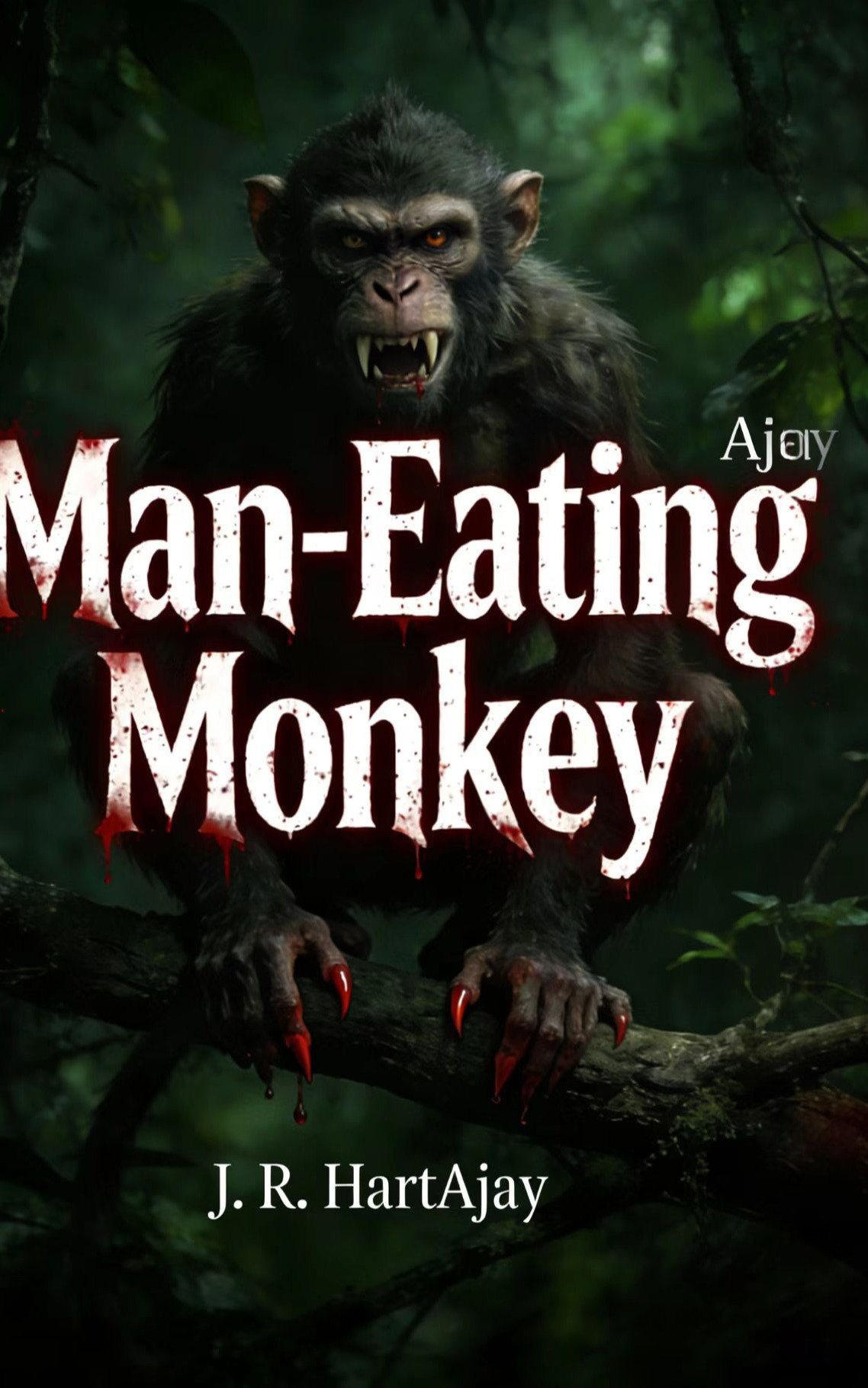
Man-Eating Monkey
My grandfather raised monkeys to eat their brains and sell their skins. An old monk came and stared at the cage. He shouted: “These monkeys are cursed. Kill them now!”
Chapter 1
In Yellow Mud Hollow Village, many families kept monkeys, but none raised them as well as my grandfather.
His monkeys were sleek-coated, plump and strong, yet more docile and obedient than an old hound.
Grandfather worked me like an ox. Mornings were endless chores and field labor; afternoons, I cleaned the cages and fed the beasts. If I so much as dawdled, the rod would find my back soon enough.
As the “worthless girl” in Grandfather’s mouth, I had long grown accustomed to blows. Sometimes I would catch sight of the smallest monkey in the cage—the one picked on most often—and think: it’s just like me. Hiding in the shadows, bearing it in silence.
Its cheeks were faintly ulcerated; its fingers were missing bits. It never fought for food like the others. It was always hungry. So now and then, I would slip it a corncob or a sweet potato. It was clever: if other monkeys were watching, it wouldn’t take what I offered. Only when it was certain no eyes were on it would it snatch the morsel swiftly and hide it away to eat in secret.
It was clever, that little monkey.
Too bad it would be killed, skinned, and eaten in the end anyway.
Everyone for miles around knew my grandfather was not only skilled at raising monkeys—he was even better at butchering them.
Monkey brain was Yellow Mud Hollow’s famed delicacy. Other families served only “dead monkey brain.” Grandfather alone could lay a “live brain feast.”
His talent for opening a living monkey’s skull was unmatched. Folk said the work required steady hands, brute strength, and blinding speed—a true craft.
This is how a live-brain feast went: a live monkey was dragged beneath a round table. At the table’s center gaped a hole just large enough to trap the animal’s head, leaving half its skull exposed through the aperture.
Grandfather’s blade would fall. With practiced finesse, he pried open the crown, revealing the pearly gray matter within. All the while the monkey was still alive, squealing beneath the table, its head locked fast. The diners would gather round, spooning out the steaming brains to blanch in bubbling broth. By the time the bowl was empty, the monkey yet clung to life. Then Grandfather would drag it away to be flayed.
Every time the bosses from town came to feast, they praised his skill lavishly. Grandfather swelled with pride.
Many young men in the village begged him to teach the craft. But Grandfather always shook his head like he was trying to rattle it off his shoulders: he wouldn’t take a formal disciple until he was too old to work.
Thanks to the brain feasts and the pelt trade, Grandfather had lined his pockets well. His voice carried weight in the village now.
Chapter 2
That day, the village lay still under a muted sky. Cicadas droned without end—the stifling heart of summer. Grandfather was whetting his boning knife in the yard. Grandma was hosing down the cages. I was scrubbing pots in the kitchen.
Then a bell tolled faintly from beyond the gate.
I looked up. An old monk stood at the edge of our yard, face seamed as withered bark, robes patched and threadbare, a carrying pole slung across one shoulder.
He set down his load, pressed his palms together, and murmured, “Amitābha.”
“Benefactor,” he said. “This mendicant is passing through. Might I trouble you for a bowl of rice?”
Grandfather glanced at him and looked away. But the monk looked tired, his eyes hollow, and I pitied him. I took his alms bowl and filled it with rice.
He received it with thanks, yet did not eat at once. He stood by the gate, bowl in hand, and fixed his gaze upon the monkey cage.
“Amitābha.” His voice was low. Then he called out to Grandfather: “Elder brother—there is something deeply wrong with these monkeys. You must kill them. At once.”
Grandfather had been intent on his whetstone. Now his brow furrowed. He set down the blade and glared. “What nonsense is this, you bald fool?”
The old monk shook his head. He pointed at the smallest monkey, the one huddled in the corner.
“That is no ordinary monkey,” he said gravely. “I fear it is a man-eater. If it grows to full strength, the consequences will be dire. You must destroy it now, or calamity will follow.”
My heart seized. I turned to look.
The little monkey was staring at the monk from its corner, its eyes brimming with pure malice. Then it caught me watching, and instantly lowered its head.
A chill crept down my spine.
But Grandfather cared for none of this. Before the monk could finish, he lunged forward, shoved him hard, and snatched the bowl from his hands. He dashed it to the ground.
“A beggar like you dares curse me? Get out!”
Rice scattered across the dirt. The old monk stumbled, his bowl spinning. He sighed, bent to look at the spilled grain, and seemed about to speak again.
Grandfather gave him no chance. He swung his foot and kicked.
“Spouting shit like that!”
He kicked and shoved, and as he drove the monk toward the gate, he wheeled around and slapped me across the face.
“Worthless
Chapter 3
A few mornings later, Boss Chen from town pulled up in his minivan, bringing a few men with him. They had come for the “live brain feast.”
Grandfather was delighted. He bustled them into the private dining nook and began arranging his skull-splitting tools.
Boss Chen and his companions settled in with tea, ready to watch the show.
Grandfather opened the cage and seized the plumpest monkey. He bound it, shoved it under the table, and positioned its head through the round hole at the center, the crown of its skull exposed.
The monkey’s mouth was gagged. It could only whimper, low and stifled, its whole body trembling.
Grandfather had trained them well. When he took one, the others dared not move. The little monkey in particular pressed itself into the corner, eyes squeezed shut, feigning sleep.
I handed Grandfather his tools and stood there wooden, twisting the hem of my shirt between my fingers.
In that moment, I felt like an accomplice.
Grandfather gripped his boning knife—razor-sharp—while his free hand traced the monkey’s skull, searching for the sutures.
Seconds later, the blade fell. A crisp crack split the air. The crown of the monkey’s skull, still sheathed in skin, was pried loose in one seamless motion. Not a single wasted drop of blood spilled.
Boss Chen and his men stared, mouths agape, then burst into applause.
Beneath the table, the monkey’s hind legs kicked weakly. Its muffled cries continued, but the strength had already bled out of them.
The sound of its keening filled my ears. I pressed my hands over them, turned my face away.
Grandfather spooned out the pale matter with a small ladle, divided it into little bowls, and presented them to his guests. Boss Chen dipped his spoon, swished a morsel in the hotpot for three seconds, and brought it to his lips.
“Exquisite!” he crowed. “Magnificent! Old Wang, your skill is truly one of a kind!”
Grandfather’s smile pleated his face into a nest of wrinkles. He clasped his hands in a grateful salute. “You flatter me, Boss Chen, you flatter me. Please, take your time, enjoy. I’ll just go tend to the monkey.”
He dragged the opened-skull creature out of the dining room.
It was barely alive. Grandfather cast a cold glance at its fading form, dropped it in the yard with casual contempt, and called for Grandma to boil water—it was time to flay.
I glanced at the other monkeys in the cage. They had heard their dying mate’s lament. They huddled together, half-dazed, half-terrified.
Grandfather always skinned his kills in full view of the survivors. He wanted them to watch the entire process.
Monkeys are cowards, he often said. Show them this, and they’ll be docile as lambs.
His blade slit through flesh and hide. The sound was soft yet obscenely sharp. Every now and then, the carcass twitched; a thin whimper escaped its slack throat.
I couldn’t bear to look. And yet, against my will, my eyes crept toward the cage.
Toward the little monkey.
Its gaze was different now. No docility, no fear. Only a dense, festering hatred, fixed on Grandfather’s every move.
That look curdled something in my chest.
“Grandfather,” I blurted, “that little monkey—its eyes—they look human.”
He looked up. The little monkey had already vanished behind the huddle of its kin.
“Shut your mouth, you worthless girl! Nothing but crazy talk! If you’ve got nothing to do, go help your grandmother stoke the fire. And keep your ears open—those bosses might call for something.”
He grabbed a rod and swung. I fled to the kitchen, not daring another word.
On my way, I glanced back at the cage. The little monkey’s expression was dull again, frightened, no different from the others. Perhaps I had imagined it all.
Grandfather finished the skinning. Boss Chen and his men finished their feast. Grandfather beckoned to Grandma; they hitched a ride with the boss into town to sell the pelts.
Before leaving, he jabbed a finger at me.
“Watch those monkeys. No fighting. If anything happens, I’ll skin you.” He brandished the fresh monkey hide, then strode off without looking back.
I nodded frantically, my heart a churning knot.
With Grandfather and Grandma gone, the yard emptied. Silence descended.
The afternoon heat intensified. I drew two buckets of water for the monkeys to cool them down.
The water sloshed; the cicadas droned; drowsiness crept over me. I propped my head on my arms and dozed off at the table.
A clatter jolted me awake.
I opened my eyes—and froze.
Through the window, I saw the little monkey standing upright at the cage door. Standing. Like a person.
It held a key in one paw. It was working the lock.
Where had it gotten a key? Grandfather always kept the only one on his person.
Panic surged. If the monkeys escaped, Grandfather would beat me bloody. I tried to lunge for the door—
But the little monkey looked at me.
Its eyes, ordinarily black and bead-like, had turned a spectral jade. They glowed like foxfire, two pinpricks of phosphorescent green fi.
That is the end of Man-Eating Monkey. Thanks for reading.
Get the app for the rest of Ajay 's writing, and everything else on Novellea.
Open in Novellea