
"Marked with Meaning" | Memoir | Part V of VI | Travel Journals

While waiting for a flight in Côte d’Ivoire, Mia Z. Edwards encounters a woman whose facial markings reflect a fading tradition.
As I waited at the airport in Côte d’Ivoire, Abidjan (West Africa), for an Air Afrique flight to Accra, Ghana, where I had a day of work ahead, I spotted a woman whose face was beautifully marked with intricate and stunning designs.
…..
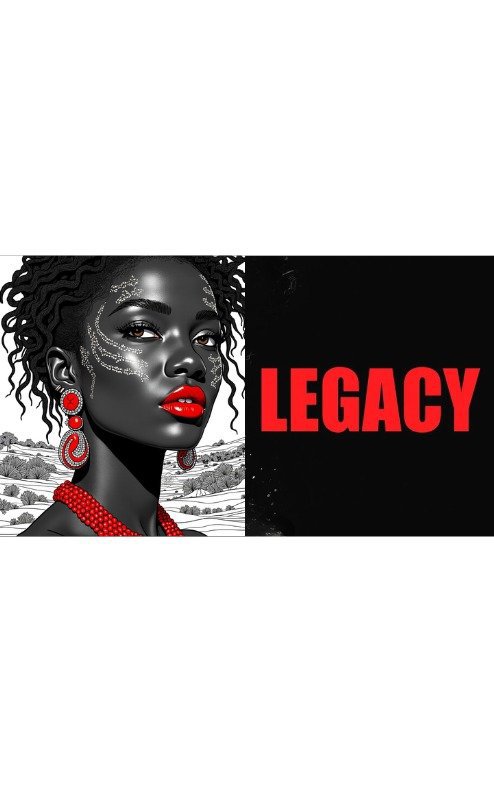
Her presence was magnetic. As I sat there, my eyes were drawn to a captivating older woman whose face was adorned with three deep, parallel marks extending from her nose to her ears on both sides. These were complemented by a delicate pattern of seven to ten slender marks that gracefully curved across her cheeks, resembling the form of a leaf design.
She sat with quiet dignity, her posture regal, her gaze steady. Mesmerized by her mark's intricate beauty, I observed her discreetly, ensuring she remained comfortable and unaware of my admiration.
The symmetrical lines on her beautiful face appeared as a masterful work of art, etched with history, pride, and quiet strength. Her face told a story that transcended language, one of heritage, resilience, and ancestral pride. Her presence lingered in my thoughts long after she disappeared from view. I felt honored to witness such living history, expressed not through words, but through skin.
…..
I was eager to learn about the tradition of facial marking in African culture, so when I found myself seated next to a young woman from West Africa, I decided to ask her about it.
Throughout the flight, the young woman and I engaged in lively conversation, sharing stories and laughter without pause. We snacked, sipped on Coca-Cola, and covered a wide range of topics, from relationships and men to the customs and taboos of her country in West Africa. Our conversation continued to Accra, likely fueled by the caffeine in our sodas and the joy of cultural exchange.
…..
My curiosity about the traditional facial markings among older Africans remained undeterred. I couldn’t stop thinking about the woman’s face, how it told a story without words. Her markings were not just decorative; they were declarations of identity, resilience, and belonging.
Since we were discussing the socially accepted standards and taboos in both America and Africa, I found a natural segue to inquire about facial markings and their intricate designs.
The young woman’s response was illuminating.
She said, “I would never cut my face. Our generation doesn’t practice facial markings. The designs on older people’s faces indicate their tribal affiliation, mark their transition to adulthood, and reflect their spiritual beliefs. It’s a tradition that’s fading, but it still holds meaning.”
…..
During my college Anthropology class, I gained a deep appreciation for honoring the norms and cultures of various countries. It was after spending two years traveling abroad that I truly understood the importance of respecting the cultural practices of other societies.
That moment in Abidjan reminded me that beauty, identity, and tradition are often carved deeper than skin, and sometimes, they speak louder than words.
The memory of that woman’s face remains etched in my mind, a quiet tribute to a culture that still whispers through its elders, even as time moves forward.
…..
(Copyright © 2025 by Mia Z. Edwards. All rights reserved.)
That is the end of "Marked with Meaning" | Memoir | Part V of VI | Travel Journals. Thanks for reading.
Get the app for the rest of Mia Z. Edwards's writing, and everything else on Novellea.
Open in Novellea