
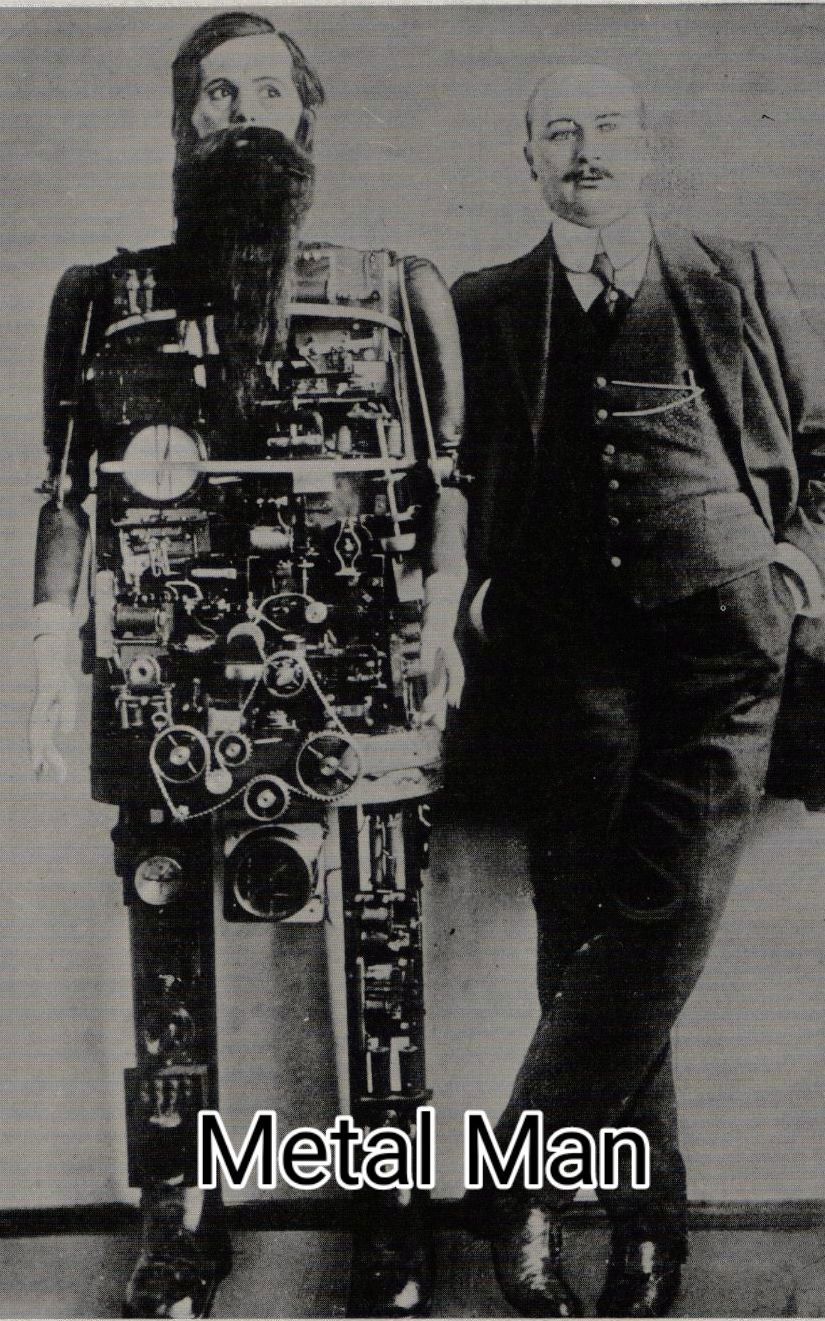
Metal Man

An unstable and unscrupulous inventor takes on a project that is more than he can handle, with dangerous consequences.
"It's a pile of junk in a box," declared Whitman in his Berlin accent, peering into the large wooden crate. He reached down inside, pushed at some straw, and fished out a circular brass plate. The plate was etched in the round with Cyrillic letters arranged in seventy two pairs. The center of the disk bore a symbol resembling a six pointed star. The whole thing had an air of occultism that Whitman found sickening. He tossed it back into the crate with feigned nonchalance, covertly taking care that it landed on top of a pat of straw, and not on top of any of the other pieces.
"I could find better stuff in any junkyard in the state, Parsons. I cannot build my Radiomensch with this! Where did you even dredge up this refuse?"
"Japan," answered Parsons in his Kentucky drawl. "I was told that it was looted from the storehouse of the late Japanese emperor. Evidently a gift from the Ottomans."
"Pshaw!" scoffed Whitman. "How did they convince you of that yarn?"
"With this," Parsons replied as he produced from his pocket a folded sheaf of thick rice paper. The paper bore a painting, in the traditional Nippon style, of the emperor receiving what appeared to be a mechanical automaton, in the shape of a man, from a Turkish nobleman. The marginal area around the painted scene was filled with inscriptions and seals.
"And you bought it based on this cartoon, eh?" Whitman took the paper and eyed it with suspicion.
"Based on the text surrounding the picture, yes," said Parsons. "The seals are authentic, and the inscriptions describe the story that I was told. This is an authentic walking, talking, Ottoman automaton, constructed by the royal commission of clockworks of the Ottoman Emperor."
"Sure it is," Whitman said. "Well, it's in a terrible state now. I can't see giving you as much as you're asking for it. Not with all the work I'll have to do just to get it ready to reassemble."
"How much were you thinking, then?" asked Parsons, warily.
"Half," declared Whitman.
Parsons snorted his derision. "That is too bad. I suppose I'll have to sell it to the new Electric Park in Muncie instead. They've offered me three quarters of my asking price, sight unseen." He moved as if to replace the lid of the crate.
"No, don't. All right. Three quarters," agreed Whitman.
"Up front, if you please," demanded Parsons.
"Yes, of course. You have a deal." Whitman pulled several large bank notes from his vest pocket, counted them out, and thrust them at Parsons.
Parsons took the money, bowed curtly, and left immediately. Whitman watched him go, then closed the large door of the barn which currently served as his laboratory. He had an avaricious gleam in his eyes as he marched over to the crate, rubbing his hands together excitedly. His previous disinterest had been a practiced ruse, designed to manipulate Parsons into lowering his price. As far as he was concerned, it had worked. Carefully, he began to remove the metallic contents of the crate from the mounds of straw, gently placing each item on a large wooden table where he had a battery powered lamp set up. The light spilled out over the odd collection of cogs, gears, cams, electric motors, copper coils and electromagnets. He examined the ends of a long roll of wires, discovering the uniquely shaped insertion prongs of the circuit contacts. These he studied well, looking over the bits and pieces on the table, trying to find the power source. He expected to find a chemical battery, which he imagined as a ceramic jar or box containing lead plates submerged in acid. He found no such device. Back into the crate he plunged his hands, casting about for more pieces. He found two further objects.
The first was a metal construct that defied his interpretation. Spirals and spikes of alloys completely unknown to him, combined seamlessly in the form of a spheroid basket, at the center of which could be seen a number of small metallic spheres set into a mass of blue glass resembling some sort of gelid egg. Heat radiated from it, with the warmth one might expect from a large candle, but without an open flame. There was not a single moving part in the entire construct. Whitman was utterly and delightedly mystified. After studying the baffling device for nearly an hour, he finally found contact receptacles arranged all around the underside of the base, with corresponding round switches. Each receptacle was marked with a different symbol, which he found to match markings on each specific wire. He wondered if that meant the object was the power source, or some type of voltage regulator. For all he knew, it could be both, or neither, or that and much more. It would require further study. He decided to turn his attention to something else, for the moment.
The second object was an ample velvet bag, with a silk cinch, containing something he judged to be shaped like a large birdcage. When he opened the bag and slid it down to reveal it's contents, he was shocked to his core. His mind reeled as he observed, wide eyed, a glass bell jar containing a preserved human head. He could tell instantly that it was a genuine piece of human remains, rather than some wood and papier mache imitation. Also, though the skin was parched from whatever means of mummification had been used, the head was still obviously male, as it retained not only the ruddy brown hair of the scalp, but also a full, and rather long, red beard. He simply stared in disbelief at the macabre thing sitting on his table for several minutes, before working up the nerve to examine it further. Gingerly tipping the jar over on it's side, he rested it on the velvet, and peered at the underside of the base. As he expected, there were contact receptacles present. Additionally, there was a small recess containing several vials of strange looking liquids, held in place by a metal bracket, with hoses inserted into their ends. The hoses disappeared into holes at one end of the recess. Next to that was a convex metal disk set within a matching grommet. He pressed it experimentally. Suddenly, a whirring sound could be heard, and then a sucking hiss as the fluids in the vials began to move. He quickly placed the jar right side up, and watched it for several seconds to see if anything changed. Nothing seemed to be happening, so he pulled the velvet back up and cinched it with the cord. He didn't want to see that horrible head.
Over the next several days, Whitman reassembled the automaton using the painting and his own inventiveness as guides. He was impressed by the steel framework, which somewhat resembled a human skeleton, and by the electric pistons which powered the movement of the limbs. The pistons he outfitted with radio controlled motors which he had built himself, based on Nicola Tesla's recent designs. He also added a battery to the main circuit with the relays which connected to the strange looking device which he was assuming to be a voltage regulator. The first experimental operation with the battery caused an explosion, and the battery was destroyed, but the electrical parts began to operate. The unidentified device seemed capable of powering the electrical system entirely on it's own.
After a week and a half of painstaking work, disappointment, discovery, and of trial and error, Whitman at last succeeded in building most of his automaton. There were some parts in the crate which he intentionally left out. These were some decorative metal sheets that were intended to form a sort of kilt around the legs, and a clock face that was supposed to fit onto the torso. Whitman decided to allow the view of the gears to be unobstructed, so that viewers of his mechanical marvel could be impressed by the sight of their movement and complexity. At that point, he needed a program module, but nothing in the crate seemed to fulfill that function. He had included the engraved metal disk, even though it seemed to serve no purpose. As he pondered the question as to whether the disk was intended as a part of the programming scheme, he remembered the head in the jar, and the contact receptacles on it's base.
He shuddered in private horror at the dawning realization that the head, which was obviously an intentional part of the automaton, was very probably the programming module that was required. He stifled his revulsion while once again opening the velvet bag to reveal the obscenely mechanized head. The hidden workings were still whirring and sucking softly. It was necessary now to study the thing in much greater detail. Mustering his scientific detachment, Whitman delved into the mysteries of the bell jar, with it's mechanical base, and it's gruesome contents. A thorough examination of the base revealed that the bell jar had been affixed to it with a steel collar of a different quality and workmanship than the original device. This suggested that the head might actually be a replacement for a different sort of programming module. Whitman consulted the painting, and found that the depiction of that automaton's upmost part was indeed different. He had not previously given much thought to it, an oversight on his part, but the painting showed the automaton's head to be made of metal, like the rest of it. First, he was startled, and then intrigued. He could not fathom how a human head could have come to be integrated into a mechanical creation, as a corruption of the original design.
He had to know more, and that would require removing the jar in order to get at the head. His horror of the dead thing was evaporating in the blaze of his curiosity. There was a release latch on the collar, secured with a peculiar lock. Whitman had not found a key with the machinery, so had to pick the lock. Luckily, he was familiar with such contraptions, and was able to figure out how it worked. When he lifted the jar away, it released a foul odor, like rotting leather and fetid breath. He coughed and waved away the fumes. Then, using probes so as to avoid touching it with his hands, he began his investigation. Once he pushed aside the beard, which now spilled out over the base by several inches, he found that the neck was attached directly to the surface it sat upon by the means of many small pins. The folds of the skin of the throat suggested the presence of some apparatus inserted into the natural equipment, perhaps to animate the jaw in a semblance of life. Around at the back of the neck several vertical ripples in the dessicated flesh hinted at wires having been run underneath. Along one side of the ripples, he discovered a seam. Using his probes, he pushed open the seam and verified that electrical wiring had been installed along the cervical vertebrae, transversing the back of the skull, and branched below a second, semicircular seam. There was also a length of red silk cloth, embroidered with asian language characters that Whitman could not decipher, securely affixed to the skin. He opened the secondary seam, flipped up the scalp, and observed the individual wires that terminated in contacts which were implanted into the skull itself at various precise intervals. The layout reminded him of a phrenologist's diagram.
The existence of the wires, being implanted in the calvarium as they were, seemed to do all but confirm his suspicion that the head was a programming module for the automaton. However, whoever had prepared that arrangement clearly had much superior skill and knowledge than the clockmakers who built the original machine. All that he had discovered proved to him that he would have to connect the head to his automaton, or he would not be able to make it operate. As he studied the connectors of the wires, hoses, and other workings visible on the underside of the base, he realized that the design included a mechanism for forcing air up through the throat. This might be accomplished with a bellows pump, a part which he had already installed in the torso, having assumed that it was for the circulation of air about the power source. He recalled that Parsons had mentioned that this was a talking automaton, yet he had come across no phonograph among the parts. Now he realized why that was. The automaton was meant to use the mouth and larynx of the head for speech.
He closed up the seams, turned the head to face him, and lowered the jar back into place. As he began to lock the collar back on, a small flutter of movement caught his attention. He froze, staring intently at the mysterious withered face behind the glass, waiting for another movement. None occurred. The eyes and mouth remained closed. After a moment, he completed the task he had set himself, thinking that he must have been distracted by a trick of the light. He carefully connected all of the hoses and tubes from the torso, then placed the head in it's proper position at the top, and locked it into place. Immediately, several parts began their functions. The engraved disk rotated clockwise, and gears began to turn. The bellows wheezed to life, small indicator lamps flashed on, strange liquids flowed through tubes, and a blue glow emanated from the power source, softly illuminating all from the heart of the construct.
Suddenly, the mouth convulsed and the jaw moved about sickeningly, the eyelids twitched and stretched open, revealing glossy natural orbs, slick with moisture. Whitman gasped in shock. He had expected artificial eyes made of glass or some other synthetic material, not true organs of vision. Improbably, the fleshly eyes spun about in wild flight, having the character of a wild animal at bay, seeking a means of escape. Their gaze fell upon Whitman, and the mouth moved tortuously, attempting to speak with a withered and blackened tongue that had been out of use for decades. A horrible wheezing sound issued from it, forming words that were barely intelligible through the glass.
"Siz kimziz? Simdi soyle!"
"Gott im himmel!" whispered Whitman, reverting to his native Deutsch. He clutched at his radio remote control device, and made sure that the switch that activated the motors in the limbs was in the off position.
"Hello, my creation," he said in English. "I am Doctor Whitman, your creator!"
The automaton stared at him for a moment, and then began to laugh maniacally. It was a chilling, mechanical, sound that somehow also conveyed the pall of death. It spoke again, this time in passable, if rasping, English.
"You? My creator? It was God who created me, to his dismay, and the Emperor of Nippon who made me into a clock! I was brother to the Sultan of Blood, the red right hand of Khan Abdul the Damned, and the greatest lover in all the world! I dared to love the emperor's daughter, and for that, my head was struck from my body. But, I did not lift up my eyes in the flames of perdition. Instead, I was damned to a hell of my very own. I am Ali Barbosa! I am the terror that lives!"
Whitman could not have been more surprised than he was at this speech, even if the devil himself had appeared and performed a waltz with a two headed gorilla. This no longer seemed to be a case of an automaton utilizing the head of a dead man as a component of itself, but rather of a man having had his body replaced by an automaton, yet somehow continuing to live. It, or he, had survived being torn apart, placed in storage, shipped across the sea, and being reassembled. What dark science could account for such a blasphemy, Whitman wondered. He felt that he must answer, to gain control of the situation. He held his remote control aloft.
"Be that as it may, Barbosa, the automaton is mine to control. If you will not have me as your creator, you will at least have me as your master."
Barbosa looked down at his mechanical limbs as though willing them into action. They did not heed his mental commands. "No!" he cried. "I cannot move! You have prisoned me somehow!"
"Yes," replied Whitman with a great sense of relief. "The body is subject to my radio signal. As I said, you are at my mercy."
Barbosa snarled defiantly. "Siktir git! Piç orospu çocugu! Damn your eyes!"
Whitman had had enough. He positioned the remote and flipped a switch that severed the connection between the power source and the electrical system of the automaton. The lights went out, the gears stopped turning, and the engraved disk slowed to a stop. The head of Barbosa twitched momentarily, but then fell back into a slackness resembling death.
Days passed as Whitman brooded over the revelation of the identity and disposition of his unusual guest. Beyond the consideration of ethics, there were frightening practical implications. The automaton required a program module, and whatever had been done by the emperor of Nippon had made Barbosa that crucial piece of machinery. Perhaps, in time, Whitman could devise a replacement, but for the moment, Barbosa was all that was available to him. Added to that was the basic concern about how an audience would react to the sight of the hideous head. Perhaps it could be disguised, but Barbosa's manner would never be conducive to showmanship. He needed something that could bring Barbosa to heel.
There was also one glaring question that still horrified him. Why was Barbosa even alive? How was it accomplished? The machinery provided him with basic life functions, but that couldn't be enough. He had been in storage, unconnected, for years! Some oriental alchemy, some dark sorcery, must be responsible, and that distressed Whitman greatly. He tried to put it out of his mind by drinking a few fingers of straight rum. Staring at the spirit in the glass, he had an idea. He needed to purchase a new bottle of liquor. But first, he put in a telephone call to Parsons.
The local liquor store proved somewhat disappointing in terms of variety, and Whitman was unable to procure the particular drink that he sought. He made do with a one hundred proof vodka. He prepared a table in the workshop, and maneuvered the automaton into position on one side. He took a seat opposite the mechanical man, and flipped the activation switch to the on position. The automaton began to glow, and Barbosa's face began to twitch. The eerie eyes opened slowly, and focused on Whitman's face. The dry lips peeled back to expose the yellowed teeth clenched in an expression of hatred.
"Welcome back to the land of the living!" exclaimed Whitman in a forced jovial manner.
"Bah!" the mechanized Ottoman replied tersely.
"Oh, don't be like that," Whitman wheedled. "I realize that we got off on the wrong foot, earlier. I meant no harm to you. You simply came as a surprise. I had expected only mechanical parts, not a living person. Here, let me make it up to you." Whitman poured vodka into a tumbler glass and set it in front of Barbosa.
Barbosa eyed the liquor suspiciously, and then looked at the glass which Whitman now held in his own hand. Barbosa could not tell that Whitman's glass held clear water, and not vodka. Whitman raised his remote control in his other hand, thumbing the mechanism which allowed Barbosa the freedom of movement, and gestured to the glass of vodka encouragingly. Barbosa took the glass carefully in his brass fingered hands, and lifted it to his lips. He tilted it so that the liquid trickled across his twisted tongue and into his parched throat. Whitman drank water from his own glass and smiled.
"Well?" Whitman asked, displaying a practiced grin that was intended to seem as amiable as possible. "It's good, isn't it? Not quite as good as what you were used to at home, I'm sure."
"It is swill," Barbosa snarled sourly. "Why do you do this? I cannot even get drunk."
"I had hoped that enabling you to whet your whistle would encourage a more productive conversation between us," Whitman said carefully. "Tell me, Barbosa, what is it like, when the machine is switched off? Are you sleeping? Do you dream?"
"Sleeping? Bah! Would that it were so gentle an existence. I have described it as Hell, and Hell is what it is like! Dreams! You speak of dreams, but every moment is the waking of nightmares! Demons and phantasms plague my undying brain at every instant. Only being awake, and feeling the flow of life energy from the mechanical heart of my automaton body is slightly less horrific." Barbosa drained his glass.
"So, you are saying that being attached to the power source, and activated, relieves these nightmares?" asked Whitman. "But, it is not the automaton that, eh, prolongs your existence, is it?"
"Why do you want to know? Why should my life interest you, eh Dutchman?" Barbosa asked suspiciously.
"Erm, German, if you please sir," whitman replied. "You may refer to me as Herr Whitman, or Doctor. Here, let me pour you another drink."
Barbosa held out his glass to receive the libation. He was enjoying it, even if he called it swill. As soon as the glass was full, he put it to his lips and drank with gusto. In spite of knowing that his condition did not allow inebriation, he was beginning to feel a warmth that had long been absent from what remained of his flesh. Unknown to him, this was due to a bladder mechanism which Whitman had installed prior to his reactivation. It was taking the vodka from his throat, and mixing it with his cranial fluids, to slowly inebriate his brain, in the hopes of making him more open to suggestion.
"I find it amazing, Barbosa," Whitman continued, "that you are able to control the automaton with your thoughts, indeed, that you are even alive at all. Truly, you are a wondrous creation. It is tragic that your existence torments you so. I wonder how any of it was accomplished. Can you tell me more about the power source, eh, the heart of the machine?"
"No, I cannot," Barbosa replied bitterly. "I know that it works. I know that when it works there is light. I know that I can feel the light, and heat, flowing through me, and it is almost like life, but maddeningly short of the mark."
"I see," Whitman pressed on. "And this heart, it was constructed by the Ottoman court engineer?"
"It was provided to the clockmakers by a craftsman of the empire. That is all I know," Barbosa answered tersely.
"Indeed?" Whitman said, and took another sip of water. "Well, that is unfortunate. I had hoped to better understand it's nature. Are you also ignorant of the force which animates your flesh?"
Barbosa's already wild eyes bulged, threatening to leave their withered sockets. He sputtered, and vodka dribbled out into his beard. "Eh? What do you say to me? Are you calling me ignorant? I am an educated man! I have had the finest tutors in the empire! I have composed books of poetry, charted the heavens, and performed complex mathematics! And none have ever bested me with a sword!"
"Oh. Well, except for that one time, eh? When you lost your head?" Whitman allowed himself a moment of humor at Barbosa's expense.
"You filthy swine!" Barbosa exclaimed. "You son of a jackal! I did not fail! I was ambushed by twenty Nipponese guards, and I would have killed them all, had their sorcerer not used his magicks on me. The coward used no blade, but attacked me with ribbons, worked with dark spells. I had no defense!"
"Ah, yes, magic ribbons! I have heard stories of such oriental fancies," Whitman mused.
"You think that I am lying?" Barbosa snarled. "What I say is truth!"
"Yes, I have no doubt that you speak truthfully. I am not insulting you. Do please calm down, Barbosa. Have another drink." He was thinking of the decorated ribbon that he had seen inside the skin of Barbosa's head. Perhaps the magic of the Nipponese sorcerer was real. If so, it could explain this bizarre situation, and provide a solution to his dilemma.
Barbosa allowed his glass to be filled again, but he did not drink. He merely glared balefully into it's depths. He muttered angrily. "I am the terror that lives!"
Whitman glanced at a movement in the shadows behind Barbosa. Parsons was concealed there, armed with a pistol in case the automaton man became violent or too uncooperative. Whitman had the utmost confidence in his remote control, but it only affected the electrically powered limbs of the thing, and he was possessed of an abundance of caution. Barbosa noticed the direction of Whitman's gaze and spun his head segment around one hundred and sixty degrees to see what he was looking at. He quickly spotted Parsons in his hiding place.
Barbosa spat and sputtered, drunkenly screaming Turkish obscenities, and flailed his mechanical arms wildly. He began to move his legs around to walk in Parsons' direction. Parsons' leveled his pistol at the glass dome of Barbosa's head, and ordered him to back away. Whitman, alarmed, tried to use his remote control to stop Barbosa's movement. Barbosa froze in place, but still he raged.
"Fiends! Murderers! You think you can best me, the greatest warrior in the Ottoman empire? I will destroy you! No sorcerer is here to save your worthless skins!"
The joints of the metal arms began to spark and smoke. The air was filled with a stench of burning ozone. The men heard snapping and popping sounds emanate from the automaton, as that bluish glow intensified, illuminating every dark corner of the laboratory. With a high pitched whine of metal tearing through metal, Barbosa lurched forward. The Tesla device bonds were broken, and he was free. With a terrifying ululation made more horrible by the deathly state of his flesh, Barbosa flung himself headlong at Parsons, who fired his pistol repeatedly, until every shot was spent. Bullets cracked the bell jar, and their fragments ricochetted about the room, striking the battery of the lamp. Sparks flew out over the lubricant stained wooden table, and it caught fire. The fire spread almost instantly to the various greasy rags, papers, and leftover piles of straw that were strewn about. Barbosa scooped up the bottle of vodka and hurled it into the flames, multiplying the blaze. Then he advanced on Whitman, metal hands reaching for the German's throat. Whitman panicked, and struck Barbosa with a large wrench, then ran to the door where Parsons was also making his escape. Barbosa attempted to follow, but his left leg had become inoperable. He tried to drag it toward the door, but stumbled and fell into a pile of burning straw. Some flammable liquid in his exposed workings ignited, and the metal body was quickly engulfed in flames. On the other side of the door, which they had closed and locked behind them, Parsons and Whitman listened to the mechanical Turk's howls of pain and rage. The cacophony continued for twenty minutes or more, as the fire devoured the building. The two men sat together in Parsons' truck, watching it burn.
Some time later, as the billows of black smoke subsided to curls of gray vapor, Parsons turned to his unfortunate customer and asked, "What will you do now?"
"Now?" Whitman replied numbly. "Now I will pick up the pieces, salvage whatever I can from amongst the ashes, and begin again. It may be too late for my original schedule, but I should be ready soon enough, if I make some sacrifices! I have ideas."
The German inventor turned to face his Kentuckian companion, and with a fevered gleam in his eye, he asked, "Tell me, have you ever been to Berlin? I think that you would do well, there.
That is the end of Metal Man. Thanks for reading.
Get the app for the rest of David Ray Hancock 's writing, and everything else on Novellea.
Open in Novellea