
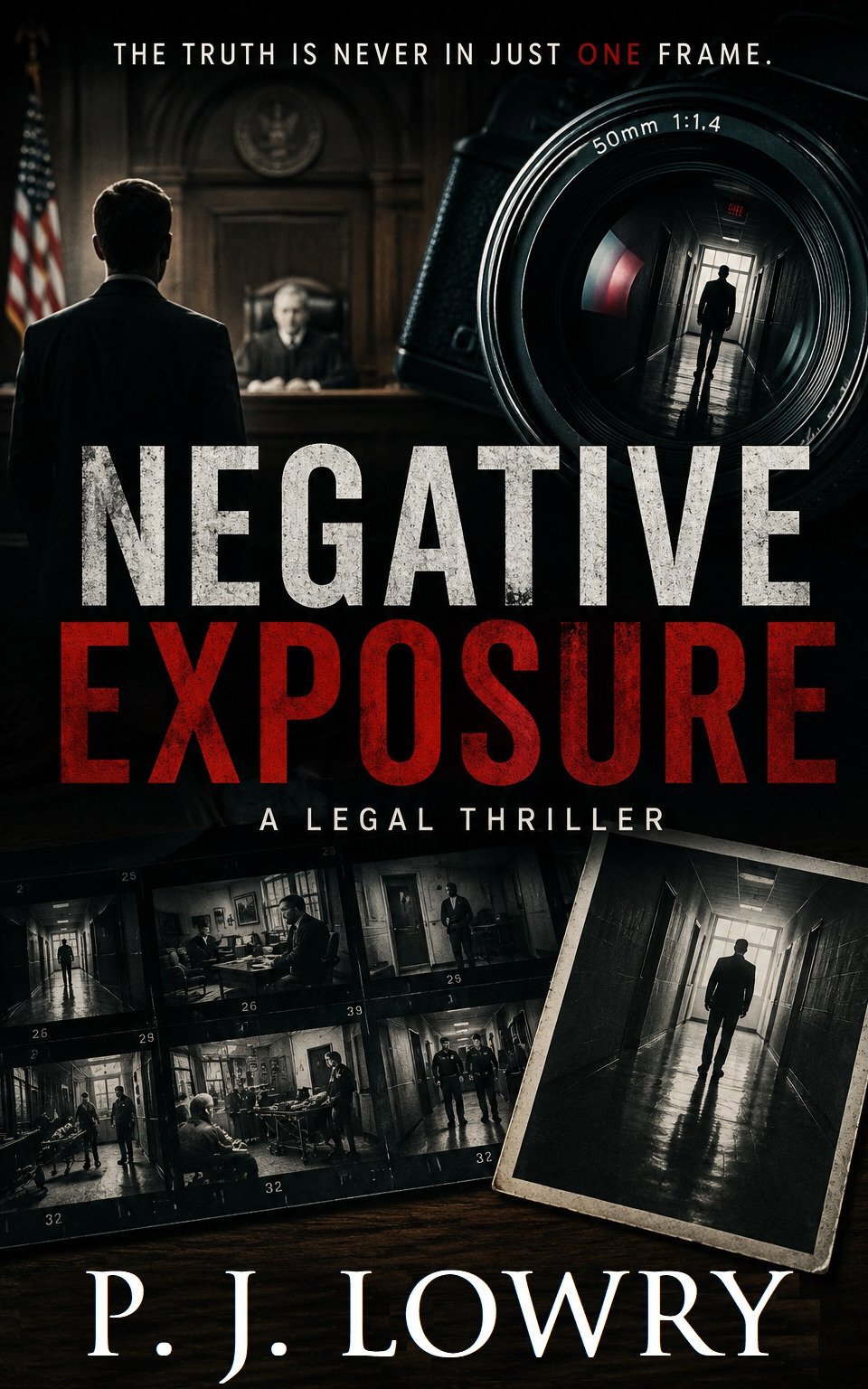
Negative Exposure
An anonymous photograph arrives during a murder trial. It could free an innocent man, or destroy everything. The truth lies just outside the frame.
Chapter 1
CHAPTER 1: Opening Jousts
The courtroom settled into the peculiar silence that existed only moments before something important was about to happen. It wasn't truly quiet, as there was the soft scrape of polished shoes across tile. The rustle of legal pads, and the whisper of a clerk organizing exhibits. Somewhere in the gallery, someone cleared their throat a little too loudly. Twelve jurors sat patiently in two neat rows, their expressions ranging from attentive to near exhaustion. They had already endured two days of jury selection and procedural motions. Now they would finally hear the stories that would shape every piece of evidence to follow.
At the defense table, Ethan Mercer adjusted the cuffs of his charcoal suit and closed the leather trial notebook that had rarely left his hands over the past six months. Across the aisle, Assistant D.A. Andrew Grant organized his notes into perfect stacks, his face betraying none of the confidence Ethan knew he possessed. Grant had earned a reputation for meticulous preparation. He wasn’t the kind of man who grandstanded, as he didn't chase headlines, and he also didn't bring cases to court that he didn't believe he could prove. It was one of the reasons Ethan respected him.
The bailiff rose.
“All rise!” he called out, and everyone in the room obeyed him.
After the room collectively stood up, Judge Bradley Whitt entered from the side door and took his seat above the courtroom.
“Be seated,” Judge Whitt casually recommended.
Whitt glanced briefly at both counsel before addressing the jury.
“Ladies and gentlemen,” Whitt started, “Thank you for your patience throughout the selection process. Today you will hear opening statements. Remember that these are statements, and not actual evidence. They are each party's opportunity to explain what they believe the evidence will show. I strongly suggest you keep an open mind until you've heard the entire case.”
The judge looked toward the prosecution’s table.
“Mr. Grant,” Whitt called out to him.
Andrew Grant stood up with practiced ease and slowly approached the podium that sat between the two tables. Mr. Grant spoke without theatrics, as his voice was measured and carried easily throughout the courtroom.
“Ladies and gentlemen,” Grant started, “This case concerns greed, betrayal, and cold-blooded murder.”
Grant paused there and allowed the words to settle.
“Victor Lang was a successful businessman,” Grant continued, “He built Lang Industries into one of the region's most respected commercial development firms. On the evening of October seventeenth, Mr. Lang was found dead in his office from a single gunshot wound. The evidence will show that the defendant, Matthew Hale, served as Mr. Lang's senior accountant.”
Matthew Hale sat beside Ethan, his shoulders tense, his eyes fixed on the table before him. He could feel everyone’s eyes on him as Grant pointed him out.
“The evidence will further show,” Grant said, as he was gaining momentum. “Is that Mr. Hale had both motive and opportunity.”
From there Grant began to lay out the prosecution's theory with careful precision. He mentioned missing funds, financial discrepancies, and an increasingly hostile relationship between Lang and accountant.
“We have witnesses who heard raised voices,” Grant informed the jury, “Electronic access records that placing Mr. Hale in the building when the crime was committed. There are also security logs and telephone records. I understand that each piece on their own might appear ordinary, but when you put them all together… the create an unmistakable picture. When shown that picture, I have no doubt the evidence will leave you with only one reasonable conclusion. Thank you.”
With that Grant walked away from the podium and returned to his seat at the table for the prosecution.
Judge Whitt then turned to look at the other table.
“Mr. Mercer,” he called out to the opposing table.
Ethan Mercer slowly rose from his seat and buttoned his jacket before walking over to the same podium that Grant just occupied. He paused for a moment and just looked around. Years in the courtroom had taught him that juries rarely remembered every fact but instead recalled how those facts made them feel.
“Good morning,” Ethan started with a voice that as calm and conversational, “If you've noticed one thing already, it's probably this.”
Ethan gestured lightly toward the prosecution's table.
“Mr. Grant used the phrase, 'The evidence will show,' several times.” Ethan reminded him, and he noticed that a few jurors nodded almost unconsciously. “I'd like you to remember those words.”
He stood at the podium and politely smiled.
“Because they're very different from another phrase,” Ethan continued, “The evidence proves.”
There was another silence. It wasn’t uncomfortable, but intentional.
“The law doesn't ask you to choose the most likely explanation,” Ethan explained to the jurors, “It asks whether the evidence leaves room for reasonable doubt.”
Ethan turned briefly to glance at Matthew Hale, and then back at the jury.
"The prosecution has presented you with a story,” Ethan carried on, “And I agree with Mr. Grant on one important point. This case is about a story, but the difference between us is simple. The prosecution believes they've already reached the final chapter of their story. I believe they’ve skipped several pages.”
Ethan saw one juror, a retired school principal, raise an eyebrow. Ethan liked that because curiosity always traveled farther than certainty.
“You'll hear about financial records,” Ethan continued, “You'll hear about access cards, and a great deal about security procedures. We’ll hear from witnesses who sincerely believe they're telling you exactly what happened.”
Ethan let that sentence linger.
“Sincerely being the key word here,” Ethan pointed out, “Because while people are capable of being honest, we are still capable of making mistakes.”
Andrew Grant made a note without looking up, and Ethan noticed. He always noticed and took a mental note of it.
“You’re going to hear assumptions presented as conclusions,” Ethan said as he gestured toward the evidence monitor, though it remained dark. “You'll hear that because someone entered a building, they must have committed a murder. Someone might have the audacity to suggest that just because two events happened so close together, one must have caused the other.”
Ethan shook his head gently.
“I’m afraid life doesn't work that way.” Ethan informed the jury, “And neither does justice.”
Ethan looked once more toward Matthew before continuing.
“My client has been accused of an unspeakable crime,” Ethan reminded them, “And at the end of this trial, you are going to be asked to return a verdict. I'm not asking you to make that decision today. All I ask of you today is to listen and question everything, especially the things that appear obvious.”
Ethan’s gaze swept across the jury one final time.
“Because appearances can be remarkably persuasive,” Ethan said, “And remarkably incomplete. Thank you.”
Ethan returned to the defense table and when he sat down, Matthew Hale leaned ever so slightly toward him.
“I think they liked you,” Matthew softly whispered.
Without looking away from the witness stand, Ethan answered quietly.
“That isn't the goal,” Ethan informed his client.
“It’s not?” Matthew replied, even frowning a bit.
“The goal,” Ethan said, “Is making them like the truth.”
Judge Whitt adjusted his glasses and looked at the table for the prosecution.
“Mr. Grant,” Whitt called out, “You may call your first witness."
“The prosecution calls Thomas Kessler.” Grant replied.
A tall man in an immaculate navy suit entered the courtroom after his name was called and made his way confidently toward the witness stand. He carried himself with the quiet discipline of someone accustomed to responsibility. His posture was straight, his expression composed, and his voice was steady as he took the oath.
Grant smiled politely as he walked back up to the podium.
“Please state your name and occupation for the record,” Grant requested.
“Thomas Kessler,” the witness replied. “Head of Security for Lang Industries."
As Tom settled into the witness chair, Ethan opened his notebook and wrote only two words: too prepared.
Ethan closed the notebook again. Sometimes instincts mattered, but most of the time, they really didn't. The evidence would decide which this was.
Chapter 2
CHAPTER 2: The Cross
Thomas Kessler looked every bit the seasoned professional that Ethan had expected him to be. His navy suit was impeccably tailored, and his silver hair was neatly combed. Even the way he rested his hands on the witness stand conveyed a calm authority. He answered Andrew Grant's questions without hesitation, describing his responsibilities as Head of Security for Lang Industries with what appeared to be a practiced confidence.
“I oversee building security,” Kessler continued to testify, “That covers employee access, surveillance systems, emergency procedures, and coordination with local law enforcement whenever necessary.”
“And how long have you held that position?” Grant inquired.
“Just over nineteen years.” Kessler replied.
“And during those nineteen years,” Grant continued, “Have you become familiar with the routines of the employees who worked at Lang Industries?”
“I have.” Kessler confirmed.
Grant moved deliberately through his examination as Mr. Kessler described the office building, the electronic access system, and how the security protocols work after regular business hours. He explained that employees required personalized key cards to enter restricted floors and that every use of those cards was recorded automatically. The man’s testimony was methodical to the point it was comforting. Exactly the kind of evidence juries tend to trust.
Finally, Grant approached the heart of the matter.
“Were you on duty the evening of October seventeenth?” Grant asked.
“I was,” Kessler replied.
“Did you review the electronic access records following Mr. Lang's death?” Grant inquired, getting closer to his moment.
“I did.” Kessler answered.
“What did those records show?” Grant asked.
“That Matthew Hale entered the building,” Kessler replied, “Which was at exactly 8:47 p.m. that night.”
Grant let the answer settle before moving onto his next question.
“Was Victor Lang alive when Mr. Hale entered the building?” Grant asked.
Tom hesitated just long enough to sound thoughtful.
“To the best of my knowledge, he was.” Kessler responded.
Ethan wrote a single word in the margin of his notebook: Knowledge.
“And did Mr. Hale have authorization to be in the building on that evening?” Grant continued.
“He did not.” Kessler replied.
“Did anyone else enter shortly afterward?” Grant asked.
“No,” Kessler confirmed.
Grant turned toward the jury to see their response.
“So, according to the access logs,” Grant said, almost grandstanding, “Mr. Hale was the last recorded visitor before Victor Lang was found dead… correct?”
“That is correct,” Kessler confirmed.
Grant thanked the witness and returned to his table.
Judge Whitt looked toward the defense.
“Your witness, Mr. Mercer.” Whitt called out to him.
Ethan stood up, buttoned his jacket, and approached the same podium that Grant just left with unhurried confidence. He carried no notes, and that alone caused several jurors to glance up.
“Good afternoon, Mr. Kessler.” Ethan started, sounding quite pleasant.
“Good afternoon,” Kessler said, returning the courtesy.
“So, you've been Head of Security for nearly two decades?” Ethan asked.
“That is correct,” Kessler confirmed again.
“That means you must be very good at your job,” Ethan continued.
“I'd like to think so,” Kessler concurred.
That statement instigated a few smiles from the jury box.
“So would I.” Ethan agreed.
Even Judge Whitt allowed himself the faintest hint of amusement. Ethan took a moment to let it sit and straightened his tie.
“Mr. Kessler,” Ethan resumed, “Wouldn’t it be sage to say that security is really about reducing uncertainty, isn't it?"
“In many ways, yes.” Kessler confirmed.
“You don't guarantee that nothing bad happens.” Ethan said, leading the witness by his ego.
“No one can,” Kessler agreed.
“You simply gather information that helps explain what happened,” Ethan added.
“That's fair,” Kessler said, unsure where he was going.
Ethan nodded.
“So, your surveillance cameras,” Ethan continued, “They don't prevent crime, but merely records it.”
“That is correct.” Kessler agreed again.
“Access logs also don't tell you why someone entered a building,” Ethan said, “Do they?”
“No, they don’t.” Kessler said.
“They just tell you a card was used, and nothing more.” Ethan said, “Correct?”
“Correct,” Kessler repeated.
Ethan smiled politely as he looked at the jury like Grant did earlier, as he was about this deliver his point to them.
“That’s an important distinction,” Ethan declared, “Isn’t it?”
“It is.” Kessler said, as he returned the smile.
“So, the access log cannot tell us whether someone entered willingly,” Ethan resumed, “Or if he was under duress, or because they received an emergency phone call from someone.”
“No, it does not.” Kessler replied.
“It merely records the entry, and nothing more.” Ethan noted, “Correct?”
“That is correct.” Kessler confirmed again.
“Earlier you testified that Mr. Hale entered the building at 8:47pm,” Ethan reminded him.
“I did,” Kessler replied, “Would you like the record read back?”
“That’s not necessary,” Ethan said, almost laughing. “But you did not testify that he killed Victor Lang at 8:47pm, did you?”
“I did not,” Kessler said, as the statement Ethan made was true.
“Because the access log doesn't record murders,” Ethan said, “Does it?”
A ripple of restrained laughter passed through the gallery. Even Judge Whitt raised an eyebrow to show his displeasure from the minor outburst.
“Let's keep the editorializing to a minimum, Mr. Mercer.” Whitt advised.
“Apologies, Your Honor.” Ethan said, as he turned back to the witness. “My point, Mr. Kessler, is simply that your system records movement and nothing more.”
“That's correct,” Kessler confirmed.
Ethan allowed for another brief silence and took a deep breath.
“You testified that no one else entered after Mr. Hale,” Ethan reminded him.
“I did,” Kessler again confirmed.
“But you based that answer entirely on electronic access records,” Ethan reminded him.
“Yes, I did.” Kessler said.
“You did not personally watch every entrance that evening, did you?” Ethan inquired, as most of the galley could now see where this was going.
“No, I did not.” Kessler replied.
“So, you cannot rule out someone already being inside the building at the time of the murder… can you?” Ethan asked, his question hitting down hard like a hammer.
Mr. Kessler paused for a split second.
“No.” Kessler simply answered.
“You cannot rule out someone exiting through a service entrance either.” Ethan continued to grill, “Can you?”
“No.” Kessler replied.
“You cannot rule out someone with master-level security credentials either,” Ethan asked, “Can you?”
This time Andrew Grant leap out of his seat.
“Objection, Your Honor.” Grant called out, “Calls for speculation.”
“Sustained.” Whitt ruled.
Ethan nodded respectfully.
“Withdrawn, Your Honor,” Ethan said, as he shifted direction so smoothly that Grant's objection almost seemed to help him.
“Mr. Kessler,” Ethan softly resumed, “Who possesses master-level security credentials?”
Tom answered immediately.
“I do.” Kessler informed him.
“And anyone else?” Ethan inquired.
“The facilities director,” Kessler replied, “The chief executive, and emergency maintenance personnel under limited circumstances.”
“So,” Ethan said, as he got the desired response, “There are more than a few credentials capable of bypassing standard employee access controls… isn’t there?”
“Yes, there is.” Kessler acknowledged. “But they're carefully monitored.”
“I'm sure they are,” Ethan chided back, as he let the answer hang in the air. He had no intention of pressing further as if yet, so he changed the subject. “You responded to Mr. Lang's office after receiving notification of an emergency?”
“Yes, I did.” Kessler answered.
“What did you observe?” Ethan asked.
“Mr. Lang was lying on the floor.” Kessler testified. “Police were notified, and emergency medical services were already en route.”
“And what about Mr. Hale?” Ethan asked.
“He was inside the office,” Kessler replied.
“And what was he doing in there?” Ethan inquired.
Kessler looked directly at Ethan, like he didn’t want to answer the question.
“He was kneeling beside Mr. Lang.” Kessler answered.
There it was. The image the prosecution wanted the jury to imagine. Matt Hale and a dead man. No witnesses. No explanation. Ethan waited a heartbeat.
“Did you see a weapon in Mr. Hale's hands?” Ethan asked.
“I did not.” Kessler admitted.
“Did you see him fire a weapon?” Ethan grilled.
“No.” Kessler replied.
“Did you witness Mr. Lang being shot?” Ethan asked.
“No.” Kessler confirmed.
“So, everything you know about how Victor Lang died.” Ethan said, almost grandstanding himself, "Comes from what you saw after the fact… correct?”
“Yes,” Kessler said, “That is correct.”
“And what investigators later concluded?” Ethan added.
“Yes.” Kessler agreed.
Ethan inclined his head.
“I have no further questions, Your Honor.” Ethan declared, as he left the podium to return to his table.
Matthew Hale leaned toward him.
“That's it?” he asked his lawyer.
“For now,” Ethan whispered back to his client.
“You barely challenged him!” Hale said, sounding a little frustrated.
Ethan kept his eyes on Tom as the witness stepped down.
“I wasn't trying to challenge him.” Ethan confessed.
“I don't understand,” Hale said, “Why not?”
Ethan closed his notebook.
“The jury just met the prosecution's most reliable witness,” Ethan replied, "If I attacked him today, they would just defend him.”
Hale looked confused.
“I let him become someone they can trust.” Ethan told him.
“And then?” Hale asked.
Ethan watched as Tom returned to a seat near the front of the gallery. Not beside the prosecution, nor with the company executives. Just close enough to hear every word spoken for himself.
"Later on," Ethan said quietly, “I'll ask the members of the jury whether they trusted him for the right reasons.”
As the afternoon session continued, Ethan's attention drifted briefly across the courtroom. Near the back of the gallery sat a well-dressed woman in a charcoal business suit. She had attended both days of trial without speaking to anyone. A slim leather portfolio rested on her lap. When the clerk handed Andrew Grant a new exhibit binder, her eyes followed it with almost clinical interest.
Ethan glanced at the witness list. Rebecca Sloan Chief Financial Officer, Lang Industries. Scheduled for later in the week.
She sensed his eyes on her, and for the briefest instant they made eye contact. She offered the polite, restrained smile of someone observing legal proceedings that had nothing to do with her personally. Ethan nodded in return before looking away. To anyone else, she was just another corporate representative attending the trial of her former employer's accused killer.
By the time court adjourned for the day, Ethan had filled barely three pages of his notebook. Most of the pages were empty. Only a handful of words appeared in his neat handwriting: Knowledge. Master credentials. Too prepared.
Ethan closed the notebook and slipped it into his briefcase. For reasons he couldn't yet explain, he had the unsettling feeling that Thomas Kessler hadn't lied once while on the stand. The man had simply been very careful about which truths he wanted to tell.
Chapter 3
CHAPTER 3: Exhibit Unknown
The afternoon session began exactly where the morning had ended; with facts. Truth was Assistant D.A. Andrew Grant preferred facts. He called his next witness, a forensic accountant from the state police who spent the better part of an hour explaining spreadsheets, expense reports, and a labyrinth of corporate transactions. Numbers filled the courtroom monitors with columns, dates, transfers, and invoices. To most of the jurors, this was all painfully dry. Yet to Ethan Mercer, it was quite revealing. Not because of what the witness said, but what he wasn’t saying. The accountant was meticulous, honest, and very thorough. He explained how nearly three million dollars had disappeared over five years through consulting fees paid to companies that appeared to exist only on paper.
“Who uncovered these irregularities?” Grant asked him.
“Victor Lang,” the accountant answered.
“And what happened after he discovered them?” Grant inquired.
“He ordered a complete internal review,” The accountant said.
“Were those reviews completed?” Grant asked.
“They were not.” The accountant informed him.
“And why not?” Grant demanded.
The accountant looked toward the judge before answering.
“Because Mr. Lang was killed.” He answered.
“No further questions, Your Honor.” Grant declared before returning to his table.
“Mr. Mercer?” Whitt called out to the other table.
“Just a few questions, Your Honor.” Ethan said, as he slowly stood up. He approached the podium with his hands clasped loosely behind his back.
“You just testified these payments were fraudulent,” Ethan started.
“Yes, I did.” The accountant confirmed.
“And they were authorized using Mr. Lang's executive credentials?” Ethan asked.
“That is correct.” The accountant again confirmed.
“Do you know who actually entered those authorizations?” Ethan inquired.
“No,” The accountant answered, “I do not.”
“You've traced the money,” Ethan continued, “But you haven't identified the person operating the shell companies, have you?”
“No.” The accountant revealed.
“So, when you tell this jury that someone stole three million dollars,” Ethan said as he turned to look at the jury. “You are unable to say who actually took it. Is that correct?”
“That is correct.” The accountant confessed.
“You also cannot tell them whether Matthew Hale benefited financially,” Ethan continued, grilling the accountant pretty hard.
The witness hesitated.
“I cannot.” The accountant confirmed.
“Did your investigators happen to find unexplained deposits in Mr. Hale's personal accounts?” Ethan asked.
“We did not.” The accountant answered.
“Hidden investments?” Ethan continued.
“No.” The accountant replied.
“Any Luxury purchases?” Ethan added.
“No.” The accountant said again.
“So, despite tracing millions of dollars,” Ethan elaborated, “Not a single dollar has been connected directly to my client. Is that correct?”
“That is correct.” The accountant agreed.
Ethan smiled politely.
“Thank you,” Ethan said, turning to the judge. “Nothing further, Your Honor.”
As Ethan returned to the defense table, he noticed that Andrew Grant was watching him with an expression that landed somewhere between admiration and annoyance. Grant leaned toward his junior prosecutor and whispered something that made her nod. Ethan had seen that look before. Grant knew the weaknesses in his own case, and the man simply believed its strengths outweighed them.
Judge Whitt glanced at the clock.
“We'll take a fifteen-minute recess.” Whitt said, as he pounded his gavel.
The courtroom came alive, as the jurors disappeared through a side door. The lawyers gathered their notes while low murmur of conversation replaced the formal cadence of testimony.
Matthew Hale exhaled for what seemed like the first time in hours.
“How are we doing?” Hale asked his lawyer.
Ethan slipped several exhibits into his briefcase.
“They're proving someone stole money.” Ethan informed his client.
“But not that I killed Victor,” Hale added.
“Exactly!” Ethan said, as he knew his client was reasonable smart.
Hale allowed himself a faint smile.
“So that's good?” he asked.
“It's better than good,” Ethan replied as he looked toward the prosecution table. “They're spending a lot of time on trying to prove motive here.”
“Which means they know opportunity alone isn't enough.” Hale said.
Before Matt could respond, the court clerk approached.
“Mr. Mercer?” she called out to him.
“Can I help you?” Ethan asked the clerk.
The clerk held out a plain, cream-colored envelope.
“There’s no return address,” the clerk replied, “It was left downstairs with courthouse security.”
“And it’s for me?” Ethan asked.
“Specifically, for you.” The clerk answered.
She pointed to the front. His name had been typed neatly:
Ethan Mercer, Defense Counsel
“Who delivered it?” Ethan asked.
“It was handed in by a courier.” The clerk replied.
“Thank you.” Ethan said, taking the envelope from her. Hale glanced at the envelope.
“More paperwork?” Hale asked.
“I sure hope not.” Ethan said with a faint smile. “If it's another motion from Grant, at least he paid for decent stationery.”
He broke the seal with his thumb. Inside was a single folded sheet of stiff photographic paper. There was no letter, no explanation. As he unfolded it, everything around him stopped. The courtroom noise dissolved into a distant blur.
The photograph showed Victor Lang's office, laying motionless beside his desk. His white shirt was stained dark across the chest, and he had one arm rested awkwardly beneath him. There was another man in the picture, kneeling beside Victor’s body. He had hand pressed against Victor's shoulder, while the other was on his neck and most likely checking the man for a pulse. This was the last person Ethan had expected to see in this picture. The photograph showed someone who shouldn't have been there. A person who had no business being in this picture let alone at the scene of this specific crime.
It was Ethan.
His own face was unmistakable. There was no possibility of mistake. Ethan continued to stare at the image. The angle suggested it had been taken from outside the office, through the large floor-to-ceiling windows overlooking the street. His stomach tightened, as he remembered Victor's office. He remembered the windows… he remembered… No! He didn't. Not this night.
“Ethan?” a voice called out.
Matthew Hale’s voice sounded far away.
“Are you okay, man?” Hale asked.
Ethan folded the photograph back up before Matt could see it.
“I’m fine,” Ethan replied, but it was a bald-faced lie.
“You don't look fine, Ethan.” Hale replied.
“It's nothing,” Ethan said, as that lie came more easily than he expected.
“You've gone pale.” Hale informed him.
“I skipped breakfast,” Ethan admitted, “I need to get something to eat.”
Matt didn't look convinced.
Across the room, Andrew Grant laughed quietly at something one of the detectives had said. Judge Whitt was speaking with the court reporter. No one was paying attention to Ethan, which was preferred at that moment. His heartbeat hammered against his ribs. He needed to get some air, so Ethan left the courtroom and into the hallway. He sat down on a deserted bench outside and looked back inside the envelope. It looked like there was nothing until he reached the bottom. There was a second piece of paper. It was small… no larger than a business card. Typed in the same machine font as the envelope, and it contained only one sentence:
The truth is outside the frame.
There was no signature, not even any initials. Nothing else.
“Ethan?” Another voice called out. This time it wasn't Matt.
It was Jules Mercer, his little sister. She stood just inside the courtroom doors, a camera bag slung over one shoulder. She hadn't expected to find him in the middle of recess, and he hadn't expected to see her either.
“I figured court would still be in session,” Jules admitted.
“What are you doing here?” Ethan asked her.
“Dropping off those vacation photos Mom wanted enlarged,” Jules said as she held up a small envelope from the photography lab before noticing his expression.
“Sorry,” Ethan said as he might have snapped at her.
Her smile disappeared.
“Ethan?” she asked, “What happened?”
He glanced around the for a second to make sure no one was watching. Then he quietly handed her the photograph. She studied it for only a second before every trace of color left her face.
“Where the hell did you get this?” she demanded.
“It was delivered five minutes ago.” Ethan answered.
She looked at him. Then back at the image. Then back at him again.
“You were there?” Jules asked.
“Honestly?” Ethan said, thinking about it. “I don't know.”
“What do you mean you don't know?” Jules demanded.
“I mean,” Ethan started, then paused. He lowered his voice. “What I mean is that I have absolutely no memory of this.”
Jules stared at the photograph another moment.
When she finally spoke, her tone had changed. She was no longer Ethan's younger sister and was now a forensic photographer.
“This wasn't printed on an inkjet.” She noted.
“Nope,” Ethan agreed.
“It's a silver gelatin print,” She noticed.
“You can tell already?” Ethan asked.
“I don't need a microscope,” Jules confirmed. She turned it over carefully, touching only the edges.
“What else?” Ethan asked.
“The paper's older than the trial.” Jules added, as she studied the surface under the courtroom lights. "No visible retouching. No digital artifacts.”
She looked up.
“If someone faked this,” She continued, “They didn't do it on a computer.”
Ethan noticed that people were starting to walk back into the courtroom.
“Shit,” Ethan said as he stood up. “Recess is almost over.”
“We need to talk.” Jules said as she slipped the photograph back into Ethan's hand. “Not here.”
“Alright,” Ethan said as they both walked towards the courtroom.
As they reached the door, Ethan’s sister grabbed his arm.
“Ethan,” Jules said softly. “Whatever this is don't let it change what you're doing in there. Matt still needs his lawyer.”
“Alright,” Ethan agreed, “I’ll call you later tonight.”
“You better,” Jules ordered as she watched Ethan re-enter the courtroom.
As Ethan was reaching his desk, the bailiffs voice echoed through the courtroom once again.
“All rise!” he called out.
The jurors began filing back inside and Judge Whitt entered. Ethan slid the photograph back into its envelope and placed it inside his briefcase. His hands were steady, but mind was not. As the jurors settled into their seats, Ethan forced himself to breathe slowly. One thought repeated itself over and over.
It wasn’t “Why am I in that photograph?”
There was a different question in his mind, one that was far more dangerous.
Who knew to send it today?
Someone hadn't wanted to frame him months ago.
Someone wanted to derail his defense, right now. As Andrew Grant called his next witness, Ethan opened his notebook to a fresh page.
He wrote three words: Outside the frame.
Then he underlined those three words once. For the first time since the trial had begun, Ethan Mercer wasn't thinking like a defense attorney. He was thinking like a man who had just become evidence.
Chapter 4
CHAPTER 4: After Hours
The remainder of the afternoon passed in a blur that Ethan Mercer would struggle to remember. Normally, he could recall a witness's testimony almost word for word. Years in the courtroom had trained his mind to catalog details automatically, such as hesitations before answers, changes in tone, subtle shifts in body language. Yet today, that discipline became an act of will. Every few minutes his thoughts drifted back to the envelope resting inside his briefcase. The photograph. The words.
The truth is outside the frame.
“Mr. Mercer?” a voice called out.
Judge Whitt's voice cut through the haze.
Ethan rose immediately.
“My apologies, Your Honor.” Ethan replied.
Andrew Grant stood patiently at the prosecution table, a document in his hand.
“I asked if the defense had any objection to admitting Exhibit Twenty-One.” The judge informed him, as he was still waiting for an answer.
Ethan looked at the exhibit projected onto the courtroom monitor, which was a financial audit. He had reviewed it weeks ago.
“I have no objection, Your Honor.” Ethan answered.
Grant gave him a curious look before handing the document to the clerk.
It was a tiny mistake, but the sort no one in the courtroom would remember. Ethan would remember it, as he never missed routine objections. Not when he was fully present. Matthew Hale leaned over as the next witness was sworn.
“You sure you're alright?” Hale asked.
“I'm fine,” Ethen said.
“You've said that three times.” Hale reminded him.
Ethan kept his eyes on the witness stand.
“And eventually you'll believe me,” Ethan said.
Matt smiled faintly, but it quickly faded.
“I've watched you for six months, Mercer.” Hale informed him.
“So?” Ethan replied.
“You only joke when something's bothering you.” Hale said.
Ethan didn't answer. The afternoon session ended shortly before five. Judge Whitt thanked the jurors for their attention and reminded them not to discuss the case before dismissing them until morning. The courtroom emptied with practiced efficiency. Grant exchanged a few words with Detective Gabrielle Shaw before gathering his files. Tom Kessler spoke briefly with one of the investigating officers. Rebecca Sloan remained seated in the gallery for another minute, quietly watching everyone leave. Then she closed her leather portfolio and walked out without speaking to anyone. Ethan noticed, but he wasn't sure why.
“Mr. Mercer,” Someone called out to him.
Ethen turned to see Andrew Grant approach, briefcase in hand.
“You seemed distracted this afternoon,” Grant noted.
Ethan smiled.
“I'll consider that a compliment, councillor.” Ethan retorted.
“I wasn't criticizing,” Grant said with a smile.
“I know,” Ethan said, as he knew Grant was right.
“For what it's worth,” Grant started, but hesitated.
“What?” Ethan asked.
“I still expect a fight,” Grant confessed.
“You should,” Ethan said, as he intended to give him one.
“I'd be disappointed otherwise.” Grant added.
Grant extended his hand to his opponent.
“See you tomorrow.” Grant said.
Ethan shook it.
“Tomorrow it is.” Ethan confirmed.
As Grant walked away, Detective Shaw crossed the aisle.
She was still wearing the tan suit she'd had on all day, though the jacket was now slung over one shoulder.
“You looked tired, Ethan.” She observed.
“I appreciate your concern, Detective.” Ethan replied.
“It's not concern,” Shaw replied with a smile, “Just an observation. Try to remember that I make my living observing people."
“So do I, Gabby.” Ethan reminded her.
For the first time, she smiled back.
“Fair enough.” She replied.
She nodded toward the courthouse doors.
“Have a good evening, Ethan.” She softly said, but she left before Ethan could respond to it.
Only after the last juror had disappeared did Ethan retrieve the envelope from his briefcase. He stared at it for a long moment and then slipped it inside his jacket.
It didn’t take him long to make his way to the forensic imaging laboratory occupied the lower level of police headquarters. Unlike the dramatic laboratories portrayed on television, Jules' workspace was quiet and meticulously organized. It had neutral gray walls, color-balanced lighting and shelves lined with archival boxes. Every surface was spotless, and every camera and lens carefully stored.
Ethan had visited only once before, and he remembered thinking it looked more like an artist's studio than a police facility.
Once he was inside, Jules locked the laboratory door behind them.
“I don't want interruptions.” She informed him.
She pointed toward a stainless-steel table.
“Put it there.” Jules ordered.
Ethan removed the photograph from its envelope and laid it gently on the padded examination mat. Jules pulled on a pair of white cotton gloves.
“You touched the edges?” she asked him.
“Only the edges.” Ethan confirmed.
“Good,” Jules said as she adjusted an overhead examination lamp.
The photograph sprang to life beneath the bright, even illumination. Victor Lang. The office. Ethan kneeling beside the body. Neither of them spoke. After a very long, awkward silence, Jules finally spoke up.
“It's a good print.” She confirmed.
“I was hoping you'd say it was fake.” Ethan confessed to her.
“So was I.” Jules concurred.
She reached for a magnifying loupe.
“The thing about fake photographs,” Jules continued, “Is that they usually want to impress you. This one doesn't.”
She examined the image one section at a time.
“The grain is consistent,” Jules added, “No evidence of double exposure.”
“Shit,” Ethan said, as he knew what the meant. Hanging around with Jules all that time meant he knew more about this than the average person.
“No compositing either,” Jules continued, “No evidence of retouching.”
“What does that mean?” Ethan asked.
Jules looked up at her brother.
“If someone manipulated this image,” Jules replied, “Then they did it before the negative became a print.”
“So, it's authentic?” Ethan asked.
Jules sighed.
“As far as I can tell.” She confessed, “Yes.”
Ethan leaned against the workbench.
“I don't remember being there.” He told her.
“I believe you.” Jules replied.
“You do?” Ethan asked, somewhat surprised.
She set down the loupe.
“I believe you don't remember.” Jules explained, “That's different.”
Ethan frowned.
“So, you think I was there?” Ethan asked.
“I think this photograph was taken,” Jules said, as she tapped the print lightly. “Cameras don't have opinions, Ethan, nor do they imagine things. They simply record whatever the light gives them.”
A silence settled over the room.
“So, now what?” Ethan asked.
Jules didn't answer immediately. Instead, she walked to a filing cabinet and returned with three sample photographs.
She placed them beside the anonymous print.
“What do these three pictures have in common?” She asked him.
Ethan studied every picture very closely. One showed a child reaching toward another child on a playground. The other showed a man running through an intersection. The third captured a woman crying outside a church.
“I don't know.” Ethan confessed.
“They all tell a lie,” Jules explained to her.
Ethan looked back up at her.
“They're real photographs?” he asked.
“Exactly.” Jules confirmed, as she pointed to the first. “This little girl looks like she's pushing the other child, right?”
Ethan nodded.
“She wasn't,” Jules informed him. “She was catching her after she slipped.”
Jules slid the second image forward.
“This man appears to be fleeing.” She continued, “He’d just seen a cyclist struck by a car. He was running over to help.”
She touched the final print.
And this woman?” she asked her brother.
"Crying because someone died?" Ethan suggested.
Jules smiled sadly.
“She was laughing,” Jules corrected him.
“What?” Ethan said, as he couldn’t’ tell.
“She’s laughing,” Jules said again. “The photographer caught the instant after she'd wiped tears from laughing too hard.”
She gathered the samples.
“Every one of those photographs is genuine.” She reminded him, “But they’re also completely misleading because they only show one moment.”
Ethan looked back at the anonymous print.
“You think that's what's happening here?” Ethan asked.
“I think” Jules said, pausing for a moment, “That someone wants you to reach a conclusion.”
“Whether it's the right one or not.” Ethan added as he unfolded the small card that had accompanied the photograph and handed it to Jules.
Jules read the typed sentence aloud.
“The truth is outside the frame.” She said, thinking about it.
She looked at the photograph again.
“I don't think that's a threat.” Jules concluded.
“You don't?” Ethan asked.
“I do not.” Jules confirmed, “But I do think it's a clue.”
Ethan had considered that too.
“So, whoever sent this,” Ethan surmised, “They want me to investigate.”
“Maybe,” Jules said, “Or maybe they wanted to warn you.”
His sister carefully measured the borders of the print with a small steel ruler and made a small sound that gave Ethen the impressed she saw something.
“What is it?” Ethan asked.
Jules measured again.
“This is interesting,” Jules said, “The margins aren't symmetrical.”
“I don't follow.” Ethan admitted.
“Look at this,” Jules said as she pointed to the edges. “The top border is narrower than the bottom, and the left is slightly wider than the right.”
“So?” Ethan said, wanting more answers.
“It means someone intentionally cropped this photo,” Jules answered, “This wasn't printed full-frame.”
She retrieved another photograph from a drawer and turned it over.
“Most negatives produce an image with predictable proportions,” Jules continued to explain, “This one has been enlarged, and trimmed.”
“Trimmed?” Ethan repeated.
“Re-centered,” Jules said.
Ethan stared at the image.
“What does that mean?” Ethan asked.
“It means there was more,” Jules explained. “A lot more.”
Neither of them spoke for several seconds. The silence was broken by Ethan's phone vibrating in his jacket pocket. It was Detective Gabrielle Shaw. Jules glanced at the screen.
“Are you going to answer that?” She asked.
Ethan hesitated before accepting the call.
“Mercer,” Ethan announced as he opened the line.
“I’m sorry to bother you this late,” Gabby started, “I wanted to let you know tomorrow's witness schedule changed.”
“Oh?” Ethan said, his curiosity peaking.
“Grant intends to recall Thomas Kessler first thing in the morning,” Gabby informed him.
Ethan straightened up when hearing that.
“Any particular reason why he’s going to do that?” Ethan asked.
“Grant wants to clarify a few points about the building's security procedures,” Gabby answered, “I just figured you'd want to know.”
“I appreciate it, Gabby,” Ethan said, which was true.
Gabby paused for a second.
“Are you alright, Ethan?” she inquired.
Ethan looked at the photograph lying beneath the examination lamp.
“I'm managing,” Ethan replied, “but thanks for asking.”
“I'll see you in court, councillor.” Gabby said and the line disconnected.
Ethan slowly lowered the phone as Jules was watching him the whole time.
“Problem?” Jules asked.
“Kessler's testifying again tomorrow.” Ethan answered.
She looked back at the photograph.
“Then tomorrow,” Jules replied, “We should pay attention to what he does and doesn't say.”
Ethan folded the anonymous note and slipped it back inside the envelope.
“The truth is outside the frame.” Ethan said again.
Jules switched off the examination lamp.
“No.” Jules disagreed as she picked up the photograph one final time before placing it in a protective archival sleeve. “The truth is still inside it. We just haven't seen all of it yet.”
For the first time since opening the envelope, Ethan felt the faintest shift beneath his feet. The photograph had not answered a single question, but it had managed to destroy the most dangerous assumption of all. That they were looking at the complete picture.
Chapter 5
CHAPTER 5: The Timeline
Ethan arrived at the courthouse forty-five minutes before proceedings were scheduled to begin, which wasn’t unusual for him. On most trial days, he preferred the quiet before the building filled with lawyers, jurors, and reporters. The empty courtroom allowed him to organize his thoughts without interruption. Today, however, Ethan wasn't preparing for cross-examination. He was reconstructing a night. His briefcase lay open across one of the counsel tables, and beside it sat copies of the disclosure provided by the D.A. months earlier. The security logs, witness statements, emergency dispatch records, and even photographs from the crime scene. Ethan had them spread them across the polished wood. Not in chronological order but in the order that people had understood them. Then Ethan began rearranging them into the order they had actually occurred, or at least the order he believed they had.
The distinction suddenly seemed important.
“You're here early.” A voice called out to him.
Ethan looked up as Matthew Hale entered through the side door accompanied by a court officer. Matt looked tired, but he had enough energy to smile.
“I figured I'd beat you here for once.” Hale said.
“You almost did,” Ethan confessed, “I haven’t been here long.”
Matt noticed the documents covering the table.
“Working on today?” he asked.
“No, I'm working on October seventeenth.” Ethan admitted.
“The night Victor died?” Matt replied, with a small frown.
“Yes,” Ethan admitted, “I've spent months defending you.”
“And?” Hale asked.
“I realized something last night,” Ethan confessed.
“What was that?” Hale asked, quite curious to know more.
“I know everyone else's version of that evening,” Ethan explained, “The one I don’t know happens to be yours.”
“I've already told the police everything,” Matt replied, as he pulled out a chair.
“I know,” Ethan agreed, “But I want you to tell me again.”
Matt sat quietly for a moment before nodding.
“I left work just after six.” Hale started.
“You went home?” Ethan asked.
“To my apartment,” Hale confirmed.
“What did you do there?” Ethan asked.
“I ordered Chinese food,” Hale answered, “And watched the hockey game before falling asleep on the couch.”
“You never went to Lang Industries that night?” Ethan inquired.
“No, I didn’t.” Hale confirmed.
“You never met with Victor?” Ethan continued.
“No.” Hale verified.
“You never even called him?” Ethan asked.
“I did not,” Hale replied.
Ethan watched Hale carefully, but not because he suspected him. He just wanted to hear the answers without the filter of police interviews and courtroom strategy.
“What time did the police arrive?” Ethan asked.
“A little after midnight.” Hale answered. “They woke half the building.”
“Were you were surprised to see them?” Ethan inquired.
“I was,” Hale replied, “I thought somebody in my family had died.”
Hale leaned forward.
“Ethan,” he softly whispered, “I didn't kill Victor.”
“I know that Matt.” Ethan said.
“No.” Matt said, as he shook his head. “You believe I didn't. That's different."
Ethan studied him for a second.
“What do you mean?” Ethan asked.
Matt's expression softened.
“My own sister thinks maybe I snapped.” Hale explained, “And not even my parents are sure anymore. My neighbours avoid me. But you…”
Hale paused for a moment and faintly smiled.
“You never asked whether I did it,” Hale explained, “You asked what happened.”
Ethan closed the file in front of him.
“That's my job.” Ethan replied.
“No,” Hale said as he looked him squarely in the eye. “That's who you are.”
Before Ethan could answer, the courtroom doors opened. Andrew Grant entered carrying a banker's box overflowing with binders.
“Good morning, Counselor.” He called out to Ethan.
“Morning,” Ethan replied.
Grant glanced at the paperwork spread across the defense table.
“Still chasing timelines?”
“When am I not chasing timelines?” Ethan countered.
“Touche,” Grant replied with a smile. “They usually matter.”
“So I've heard.” Ethan confirmed.
The prosecutor continued toward his table. As Grant was unpacking exhibits, Rebecca Sloan entered quietly and took her usual seat in the corner of the gallery. She wore a dark green blazer today instead of charcoal. Otherwise, nothing had changed. She still had her leather portfolio, a notebook, and a near perfect posture. She acknowledged Andrew Grant with a polite nod, and nothing more. No whispered strategy, or conversation. She was merely another interested observer.
Ethan noticed something else. She watched Tom Kessler enter the courtroom but only for a second. It was a tiny glance. Tom acknowledged her with the slightest inclination of his head before taking his place outside the witness room. Most people would never have noticed it, and Ethan wasn't even sure why he had. Perhaps because, after yesterday, he had begun noticing everything.
Judge Whitt entered the courtroom promptly at nine-thirty and the jury filed into the box. Once everyone was seated, Andrew Grant rose to his feet.
“The Crown recalls Thomas Kessler,” Grant called out.
Kessler went back to the witness stand and took the oath once more. Grant strolled over to the podium to resume his questioning.
“Mr. Kessler,” Grant started, “Yesterday we discussed the electronic access records.”
“Yes, we did.” Kessler acknowledged.
“I'd like to clarify a few matters regarding the security system,” Grant said, as he displayed a floor plan of Lang Industries on the courtroom monitor. “Can you explain how employees access the executive floor?”
Tom Kessler pointed toward the screen.
“Employees use individualized access cards,” Kessler explained,
“And visitors?” Grant asked.
“They're escorted.” Kessler replied.
“And emergency personnel?” Grant continued.
“They're admitted by Security.” Kessler answered.
Grant moved deliberately through the building layout. Everything seemed routine so far. Then he asked a seemingly harmless question.
“Who had authority to access the surveillance archive?” Grant asked.
“I did.” Kessler responded without hesitation.
“Anyone else?” Grant inquired.
“The facilities director.” Kessler answered.
“No one outside Security?” Grant asked.
“No.” Kessler confirmed
Grant nodded.
“No further questions, Your Honor.” Grant declared.
“Any questions, Mr. Mercer?” Judge Whitt asked Ethan.
“A few, Your Honor,” Ethan said as he stood up. “Mr. Kessler…”
Tom smiled politely.
“Mr. Mercer.” He softly acknowledged.
“I won't keep you long.” Ethan reassured him.
“I appreciate that.” Kessler said with a smile.
“As do I, Mr. Mercer.” Judge Whitt added.
Ethan smiled as he slowly approached the podium.
“Yesterday we discussed electronic access logs,” Ethan reminded him. “Today I'd like to discuss time.”
Kessler looked puzzled.
“Time?” he repeated.
“Specifically,” Ethan continued, “Who keeps it.”
A few jurors exchanged curious glances.
“The clocks inside Lang Industries,” Ethan started, “Are they synchronized?”
“Yes, they are.” Kessler said.
“Automatically?” Ethan added.
“Yes.” Kessler replied.
“To what?” Ethan asked.
“Our central server.” Kessler answered.
“So, every security camera,” Ethan said, “Every access log, every workstation, every computer... they all share exactly the same time. Is that correct?”
“Yes,” Kessler confirmed, “That is correct.”
“So, no individual clock can drift?” Ethan asked.
“No.” Kessler agreed.
“The system updates every night,” Ethan continued, “Does it not?”
“It does.” Kessler acknowledged.
"So, if one record says 8:47…” Ethan said, “That would mean every other company system would also read 8:47 too.”
“That is correct.” Kessler confirmed.
“No discrepancies?” Ethan asked.
“None.” Kessler answered.
Ethan walked slowly toward the evidence monitor.
“The emergency dispatch log entered into evidence yesterday,” Ethan said, “That’s not maintained by Lang Industries.”
“No.” Kessler confirmed.
“That's maintained by the city's emergency communications centre,” Ethan said.
“That is correct.” Kessler concurred.
“So, two completely independent systems.” Ethan said, “Which means they don't synchronize with each other.”
Tom hesitated.
“I wouldn't know.” He answered.
“You've never compared them?” Ethan asked.
“No.” Kessler answered.
“So, you cannot tell this jury whether they differed by…” Ethan paused for a second to think of a random number. “Let’s say… thirty seconds?”
“No.” Kessler replied.
“One minute?” Ethan asked.
“No.” Kessler repeated.
“Five minutes?” Ethan continued. “Ten minutes?”
At this point Andrew Grant rose to his feet.
“Objection, Your Honor!” Grant called out. “Relevance?”
Ethan turned toward the bench.
“Your Honor,” Ethan replied, “The prosecution's theory depends upon a precise sequence of events.”
Judge Whitt paused for a moment and considered it.
“I'll allow limited latitude,” Whitt responded, “Overruled.”
Grant sat back down and Ethan turned back to face the witness.
“You don't know whether those systems were perfectly synchronized,” Ethan asked.
“No.” Kessler answered.
“You've simply assumed they were.” Ethan added.
Kessler paused.
“Yes.” He answered.
Ethan smiled as that was the answer he was fishing for.
“Thank you, Mr. Kessler.” Ethan said as he stepped back from the podium. “Nothing further, Your Honor.”
Ethan returned to counsel table. The answer seemed insignificant as no one in the gallery reacted, and neither did the jury.
Ethan wrote something in his notebook: Assumed.
Judge Whitt called for a lunch recess shortly after noon. Andrew Grant approached while the jurors filed out.
“You spent ten minutes establishing that clocks can disagree.” Grant reminded him, with a voice that sounds like he was more amused than annoyed.
“That I did.” Ethan confirmed.
“"I'm still waiting for the point.” Grant requested.
“As am I,” Ethan replied.
Grant laughed.
“Do you always do this?” He asked. “Ask questions that don't seem important?”
“They may not be important now,” Ethan explained, “but three days later everything is suddenly very important.”
Grant shook his head.
“I've learned not to underestimate apparently boring questions.” Grant said, as life had taught him some rather harsh lessons. After he walked away, Detective Gabby Shaw approached carrying a paper cup of coffee.
“You rattled Tom quite well.” Gabby said as she handed him the cup.
“I didn't notice.” Ethan confessed.
“You weren't supposed to notice.” Gabby replied. She leaned against the rail separating the gallery from the well of the court.
“He answered every question.” Ethan reminded her.
“He did.” Gabby confirmed, “But he stopped sounding comfortable.”
Ethan looked at her. “You've interviewed him?”
“Several times.” Gabby confirmed.
“Did he ever mention comparing the company timestamps with emergency dispatch?” Ethan inquired.
“No.” Gabby replied, “Should he have?”
“I don't know.” Ethan honestly answered.
Gabby studied him for a moment.
“You're chasing something.” She observed.
“I'm chasing accuracy.” Ethan informed her.
Gabby took a sip of coffee. Before she could reply, the court clerk called everyone back into the courtroom. Gabby walked away from Ethan and
started toward the prosecution's side before pausing.
“For what it's worth,” Gabby said, “I checked.”
Ethan looked up as that caught his attention.
“Checked what?” Ethan asked.
“The anonymous envelope.” Gabby replied.
Ethan’s expression remained carefully neutral.
“There weren't any usable fingerprints.” She informed him.
His pulse quickened.
“You knew about that?” Ethan asked.
“Courthouse Security logs unusual deliveries,” Gabby replied with a shrug, “And I read reports.”
She lowered her voice.
“If someone wanted you to have it,” She continued, “They were careful.”
Then she walked away while Ethan remained where he was. He hadn't told Gabby what was inside the envelope. This meant she either knew or she assumed. He wasn't yet sure which possibility troubled him more.
As the afternoon session resumed, Ethan opened his notebook to the page he'd started that morning. Beneath Knowledge, Master Credentials, Too Prepared, and Outside the Frame, he added one final line:
Every timeline begins with an assumption.
He underlined it twice. For the first time since the trial began, Ethan suspected the prosecution's case wasn't built on false evidence. It was built on a clock everyone had trusted without ever thinking to question it.
Chapter 6
CHAPTER 6: Outside The Frame
Court had adjourned for the day just after four-thirty. The jurors filed out quietly, followed by Judge Whitt. Andrew Grant remained behind discussing scheduling with the clerk while Detective Shaw gathered several exhibit binders from the prosecution table.
Ethan closed his notebook. Today's testimony had accomplished something unexpected. It hadn't answered any questions but had simply made him distrust certainty. Tom Kessler's timeline had sounded impeccable. Almost too impeccable. Every answer had fit neatly inside the prosecution's narrative. Almost as though the story had been assembled first and the facts arranged afterward.
Hale stood beside him, waiting for the court officer who would escort him back into custody.
“You've been somewhere else all day.” Hale noted.
Ethan looked up.
“I've been right here, Matt.” Ethan replied, “Doing my job.”
Matt smiled faintly.
“No,” Hale disagreed, “You've been chasing something.”
Ethan hesitated for a moment. There was no point burdening his client with a mystery that he couldn't help solve.
“I've found a loose thread.” Ethan admitted.
“And?” Hale asked with a raised eyebrow.
“I'm trying to decide whether to pull it.” Ethan replied.
Matt laughed quietly.
“You strike me as the kind of guy that could never leave loose threads alone.” Hale said almost laughing at the thought.
“No,” Ethan admitted, “I’m not.”
The court officer approached.
Matt offered Ethan a reassuring smile before being led through the secure doorway behind the courtroom. Ethan watched it close. Every extra day this trial continued was another day Matt remained behind bars. The clock wasn't just ticking. It was costing someone their freedom one day at a time. Once his client was gone, Ethan had decided it was time to take a little field trip.
The offices of Lang Industries occupied the top three floors of a modern glass tower overlooking the downtown waterfront. By the time Ethan arrived after coming over straight from the courthouse, the workday had ended and most of the lights were off. Only a handful of offices remained occupied.
Ethan stood across the street, staring upward. Victor Lang's corner office dominated the southeast corner of the building. Even from ground level, the windows were unmistakable as he could see the floor-to-ceiling glass. It was nearly impossible to miss as Ethan unfolded the anonymous photograph. The angle was very close. The photographer hadn't been inside the building when the picture was taken. He was outside. Watching.
Ethan slowly turned in a full circle to notice that across the street stood another office tower. It was a little older and shorter, but its upper floors faced directly toward Victor's office. Ethan crossed the road at the streetlight. The lobby directory listed twelve businesses. A financial planning firm, architectural company, marketing agency, and even a dentist. There was nothing unusual, but then one listing caught his attention from the seventh floor: Harbour View Executive Suites.
Temporary office rentals, Ethan thought to himself. Short-term leases, mostly conference rooms. That would mean windows overlooking Lang Industries.
The receptionist on the tenth floor looked up as Ethan entered the lobby after getting off the elevator.
“Can I help you?” she asked him.
“Yes,” Ethan replied, “I'm trying to identify a tenant who rented office space here on October seventeenth.”
The receptionist offered an apologetic smile.
“I’m sorry, Sir,” she replied. “I'm afraid we don't release client information.”
“I'm an attorney,” Ethan informed her.
“I'm sure you are,” The reception replied, with an attitude that suggested she didn’t care what he did for a living. “Privacy is part of what we sell.”
Ethan handed her one of his business cards.
“If someone rented a room that evening,” Ethan started, “And if they left something behind… would you be willing to pass along my card to that person?”
The receptionist glanced at the business card.
“Ethan Mercer,” The women read off the card, “I've heard of you.”
“Is that a good thing?” Ethan asked her.
“My husband says you're impossible to watch in court.” She replied.
Ethan laughed.
“I'll take that as a compliment,” He replied.
She slipped the card beneath her keyboard.
“If anyone asks,” She said to him, “I'll pass it along.”
She wasn’t offering much, but better than nothing.
“Thank you,” Ethan said, as he left her alone and departed.
Ethan went back on the road, but darkness had settled by the time Ethan pulled up to Jules' apartment. She answered the door carrying two mugs of coffee.
“You look terrible.” She told him
“I was hoping for determined,” Ethan said, as he took one of the mugs from her. “Thanks.”
“You can be both.” She said while walking back to the living room. Ethan closed the door behind him and locked it. The dining room table had disappeared beneath photography books, magnifiers, measuring tools, and several enlarged copies of the anonymous photograph.
“You've been busy.” Ethan said, looking around.
“I couldn't stop thinking about it.” Jules admitted.
“I hope you don’t mind I made enlargements.” Jules stated.
Ethan didn’t reply as he walked over and studied the prints. The quality degraded slightly as they increased in size, but new details emerged. A desk lamp. The corner of a bookshelf. Reflections in the polished conference table. Still nothing obvious.
“I've been looking at the borders.” Jules said as she pointed to one enlargement.
“Not the picture, but the borders.”
“I'm listening.” Ethan said, as he sipped his mug.
She retrieved a transparent template marked with various photographic formats.
“The print itself measures eight by ten.” Jules informed him.
“So?” Ethan asked.
“So whoever enlarged it,” Jules answered, “Didn't use the entire negative.”
She aligned the template over the image.
“See this?” Jules asked.
The crop removed nearly an inch from the left side, and slightly less from the right. Almost two inches from the bottom. Ethan leaned closer.
“There was considerably more visible." Jules added.
“What would have been down here?” Ethan asked.
“I don’t know,” Jules said with a shrug. “The floor, a doorway, or maybe it’s another person. Maybe it’s nothing.”
“What do you know?” Ethan asked.
“What I know, “Jules responded, “Is that someone deliberately decided you didn't need to see it.”
Ethan stared at the enlarged print.
“The note,” Ethan reminded her, “The truth is outside the frame.”
“Whoever wrote that note,” Jules said, “Clearly knew exactly what had been removed from this photo.”
Silence settled between them. Finally, Ethan decided to ask the question that had been bothering him since yesterday.
“If you wanted to crop a photograph,” Ethan started, “Then why not just destroy the original?”
Jules answered immediately.
“Because photographers don't work that way.” She told him, as she opened a reference book and turned it toward him. “Negatives are originals, and prints are copies. You can make hundreds of prints from one negative.”
"So, the negative still exists?” Ethan asked.
“It almost certainly did,” Jules answered, “Unless someone destroyed it.”
“But they didn't destroy this print,” Ethan said.
“No,” Jules agreed, “They mailed it to you.”
“That means whoever sent it had access.” Ethan concluded.
“Exactly!” Jules agreed.
“There are three possibilities,” Ethan said, sighing deeply.
“Let’s hear it then.” Jules requested.
“One: the sender took the photograph.” Ethan started, “Two: the sender worked with or for the photographer. Three: the sender found the photograph after someone else took it.”
“That’s where I’d start.” Jules agreed.
Ethan looked once more at the image.
"The photographer,” Ethan said, “"Whoever they were… they're the only person who saw everything.”
Long after Ethan left his sister’s apartment, he found himself sitting alone in his home office and it was nearly midnight. His laptop illuminated a legal pad covered in names. Victor Lang. Matthew Hale. Rebecca Sloan. Tom Kessler. Andrew Grant. Gabrielle Shaw. Jules Mercer. He stopped reading it, and quickly wrote another heading:
Unknown Photographer.
Beneath that Ethan listed everything he knew. That the photo was likely taken outside the building, and from an elevated position. The person used professional equipment, and according to his sister had access to the original negative. The person had mailed the photograph to Ethan because they wanted him to investigate. It wasn’t much, but Ethan believed that might be enough to form a profile.
His train of thought was interrupted by his phone. The number on his cell said whoever was calling was unfamiliar. He took a deep breath and put the call on speaker.
“Hello?” Ethan said after opening the line.
A woman's voice answered.
“Mr. Mercer?” She called out.
“Yes?” Ethan answered.
“My name is Linda Foster,” the lady replied, “From harbour View Executive Suites. We spoke earlier tonight.”
“The receptionist?” Ethan asked.
“Yes,” Linda confirmed, “I told one of our regular clients about your card.”
Ethan sat upright.
“And?” Ethan asked.
“Our client did remember something from that night,” Linda replied, “He said there was a photographer who was occupying the conference room he was renting without his consent. Our client remembers the incident because he argued with the man and called security to take care of him. I remember that our guards tossed the man out of the building once we confirmed he wasn’t authorized to be here.”
“Really?” Ethan said as he reached for his pen. “Did security managed to get the name of this photographer?”
There was a brief rustle of paper.
“Yes,” Linda replied, “After speaking with our client, I asked the security guard who was on duty that night. He said the photographer was a Mister Richard Voss.”
Ethan wrote the name in large block letters.
“Do your man happened to get a contact number?” Ethan asked, aware he might be pushing his luck.
“I'm afraid not,” Linda answered, “Our guard asked for his ID because this was not the first time Mr. Voss had tried to use one of our rooms that month. That night we kicked him out was the last time we saw him.”
“Thank you,” Ethan said, as he paused for a moment. “Linda, I can’t help but ask… why are you helping me now?”
“Two reasons,” Linda replied, “The first being Mr. Voss isn’t a client. I am not compelled to protect the privacy of trespassers.”
“Makes sense,” Ethan said, as that was understandable. “What’s the other?”
“My husband gets into trouble a lot,” Linda answered, “One day he might need a good lawyer to get his sorry ass out of the slammer.”
“Say no more, Linda,” Ethan said, as he knew where this was going. “Keep the card I gave you in your purse. I officially owe you a big favor.”
“Thank you, Mr. Mercer,” Linda replied, “I hope I never have to use it.”
“That makes two of us,” Ethan said, “Good night.”
After the call ended, Ethan stared at the name for several long seconds, as the anonymous sender wasn't anonymous anymore as he had a name. He added Richard Voss to his list and then slammed the notebook shut. Tomorrow, before court began, Ethan intended to find him. He just hoped that someone else hadn’t already reached the same conclusion.
Chapter 7
CHAPTER 7: Richard Voss
The address belonged to a converted warehouse on the east side of the city. It was once home to a printing company, and the red-brick building had been divided into various art studios, small offices, and workshops. The painted sign above the entrance had faded after years of neglect, but the brass directory inside the lobby looked like it was still polished every morning. Ethan walked up to the directory and found the name halfway down the list: Richard Voss Photography - Studio 3B
For the first time in days, Ethan felt as though he wasn't simply reacting to events. He was finally catching up and waited impatiently as the elevator groaned its way to the third floor. The hallway beyond smelled faintly of fixer chemicals and fresh paint, an odd combination that reminded Ethan of his high school darkroom where he'd once developed photographs for an art elective he'd promptly forgotten.
Studio 3B sat at the very end of the corridor. The frosted glass door bore Richard Voss's name in clean black lettering. The blinds were drawn, and there was no light showed beneath the door.
Ethan knocked on the door, and there was no answer. He knocked again, and still there was no reply. A woman emerged from the neighboring studio carrying a portfolio beneath one arm.
“Are you looking for Richard?” she asked him.
Ethan turned around to face her.
“Yes, I am,” Ethan replied.
They lady glanced at the closed door.
“He usually answers.” She informed him.
“Usually?” Ethan repeated.
“I haven't seen him since yesterday morning.” She said, looking worried.
“Yesterday,” Ethan repeated as he tried to peek inside.
“He missed a meeting.” The lady said, “That's not like him.”
“You know him well?” Ethan asked her.
“As well as neighbors usually do.” The lady replied. “But he keeps to himself most of the time and never missed a deadline.”
Ethan thanked her and walked back toward the elevator. He had almost reached it when something caught his eye. A uniformed police officer stepped through the lobby doors below. Then another. Followed by Detective Gabrielle Shaw and his stomach tightened. By the time Ethan reached the ground floor, yellow tape was already being stretched across the entrance to Studio 3B.
Gabby looked up, and for just a second surprise crossed her face.
“Ethan?” She called out.
“What going on here, Gabby?” Ethan asked her.
“How did you know to come here?” Gabby replied with her own question.
“I asked first.” Ethan reminded her. “What happened?”
Gabby studied him carefully before answering.
“We received a welfare check request this morning.” She told him, “His neighbor hadn't seen him. We found Richard Voss inside.”
Ethan didn't ask her, as he already knew.
“Voss is dead, isn’t he?” Ethan asked her.
“Looks like a fall.” Gabby replied.
“A fall?” Ethan repeated.
“Down the interior staircase,” Gabby replied, but she didn't sound convinced. “We're still investigating.”
There was a short pause as Gabby put her hands on her hips and gave Ethan a rather stern look.
“Now answer my question, Ethan.” Gabby demanded. “Why were you looking for Richard Voss?”
Ethan considered the photograph tucked safely inside his briefcase, but he wasn’t ready to reveal it. Not yet.
“I believe he may be in possession information relevant to my client's case.” Ethan replied.
“That's a very careful answer.” Gabby said, as her eyes narrowed slightly.
“I'm a lawyer,” Ethan reminded her, “Careful answers are my specialty.”
“Fair point,” Gabby conceded.
Before either could continue, a crime scene technician approached.
“Detective,” The tech called out, “We've finished the initial sweep.”
Gabby excused herself for a moment, and Ethan remained behind the tape as he watched the investigators move quietly through the studio windows.
There were cameras, tripods, and many boxes of photographic paper. Clear signs that a life was interrupted as Voss had enough supplies to keep taking pictures for another lifetime. Now they were all unnecessary, at least to Voss.
A few minutes later, Gabby returned.
“You can't go inside.” She informed him.
“I wasn't planning to,” Ethan replied.
“Good,” Gabby said, as she folded her arms that told Ethan she wasn’t going to let things go. “So, tell me. Who was Richard Voss?”
“A photographer,” Ethan answered.
“I gathered that,” Gabby retorted, as it was rather obvious.
“He was caught using a rental space overlooking Lang Industries,” Ethan informed her, confident that would catch her interest.
He was right as something flickered in her expression.
“How do you know that?” Gabby asked, somewhat curious.
“I've been asking questions,” Ethan answered.
“What kind of questions?” Gabby insisted.
“The kind that aren't part of your investigation,” Ethan said, sure she wasn’t going to like that answer.
“I wish you'd stop doing that,” Gabby said, her voice showing her annoyance.
“I wish I could,” Ethan said, “But this is how I roll.”
She looked back toward the studio, and then back at Ethan.
“He wasn't just a photographer,” she added, “We found contracts.”
“What kind of contracts,” Ethan asked, as it was his turn to be curious.
“Looks like corporate surveillance,” Gabby replied, “We’re talking insurance investigations and legal documentation.”
Ethan's pulse quickened upon hearing that.
“So, Voss photographed people.” Ethan concluded.
“He photographed evidence,” Gabby corrected him, and the words lingers for a few seconds between them.
Evidence. That was the world Ethan had hoped to hear.
“Did you find any cameras?” Ethan asked her.
“Several,” Gabby said with a nod.
“What about Memory cards?” Ethan added.
“You mean film?” Gabby corrected him. “We're cataloguing everything.”
“What about negatives?” Ethan continued.
She looked at him sharply, with even more annoyance.
“Negatives?” Gabby repeated.
“I asked a question,” Ethan reminded her.
“You did,” She noted, “And it was a very specific question."
“You noticed,” Ethan said as he smiled faintly.
“I always notice, Ethan.” Gabby said, almost flirting.
For a moment neither spoke.
“If there's something you know,” Gabby said softly after taking a step closer to him, “This would be the time to get ahead of it.”
Ethan looked through the studio window. An evidence technician was carefully placing several binders into a cardboard box. On the spine of one binder was a handwritten label: October.
Another technician could be seen carrying out a steel filing cabinet drawer filled with hanging folders. Every instinct Ethan possessed told him that somewhere inside that studio had once been the answer. Whether it was still there was a mystery to him.
“I don't have enough yet.” He replied.
Gabby's disappointment showed for only a fraction of a second.
“Just don't wait until someone else dies.” Gabby said, as she turned and walked back toward the tape.
Ethan remained across the street for another twenty minutes. Long enough to watch the evidence van arrive and watch the technicians carefully loading boxes. It was also long enough to convince himself he wasn't leaving empty-handed, because he'd learned something. Richard Voss hadn't been hiding. Someone had reached him and had done so less than twenty-four hours after Ethan started asking about the photograph. There was no way that was a coincidence. It was urgency.
By the time Ethan returned to his office, darkness had settled over the city. He unlocked the door, loosened his tie, and sat heavily behind his desk. Mere moments later, his cell had started to buzz. He knew from the ringtone that it was Jules. He put the phone on speaker.
“Hey, Jules.” Ethan greeted his kid sister.
“How did it go?” Jules asked, not beating around the bush.
Ethan went silent for a moment.
“You found him!” Jules guessed, “Didn’t you?”
“I did,” Ethan said, not sounding happy about it.
"And?" Jules asked, eager to know more.
“He was already dead, Jules.” Ethan answered.
The line remained quiet for a moment before she replied.
“I'm sorry, Ethan.” She softly whispered.
“So am I,” Ethan added.
“What happened?” Jules inquired.
“Officially?” Ethan replied, “They're still investigating.”
“Unofficially?” Jules asked.
Ethan stared at the photograph lying on his desk.
“I think someone panicked,” Ethan answered,
Jules didn't answer immediately. Then she asked the question Ethan himself had been avoiding.
“Did they find what they were looking for?” she asked.
“I don't know.” Ethan honestly replied.
“Did you?” Jules countered.
“No.” Ethan said, sighing deeply.
There was another short silence.
"Ethan,” Jules finally said, “If Richard mailed you that photograph, I’m quite confident he did so aware that it would put him in danger.”
“I've been thinking the same thing, Jules.” Ethan agreed.
“People like Richard don't spend their lives preserving images,” Jules continued, “And then leave the only important one lying on a desk.”
“What are you saying?” ethan asked as he sat up.
“I'm saying photographers organize everything.” Jules reminded him. “Negatives, prints, contact sheets, and more than a few backups.”
“Okay,” Ethan said as she had his attention.
“If he believed someone might come after him,” Jules continued, “I am pretty sure he would have hidden the important part.”
Ethan closed his eyes. Not out of frustration but realization. He'd spent the entire day searching for Richard Voss. When he should have been searching like Richard Voss.
“What do photographers do when something matters?” Ethan asked.
He could hear Jules smiled softly on the other end of the line.
“They make copies.” Jules replied.
After hanging up, Ethan crossed to the wall calendar beside his desk.
He wrote one name in the margin of October seventeenth: Richard Voss.
Then beneath it, he scribbled down a sentence:
Photographers don't preserve photographs. They preserve negatives.
He underlined it once while outside, rain began tapping gently against the office windows. Ethan stood looking into the darkness because Jules helped him realize the truth. That somewhere in the city, hidden by someone who had understood exactly how valuable it was, existed the original negative. Richard Voss had died protecting it, and Ethan intended to find out where they were.
Chapter 8
CHAPTER 8: The Whole Negative
By early morning, the courthouse steps glistened beneath a pale autumn sun. The city's streets reflected passing traffic like dark ribbons of glass, but Ethan barely noticed. He had slept less than three hours, as Richard Voss's death replayed in his mind with relentless clarity. Someone had silenced the only man known to have witnessed what happened through the windows of Victor Lang's office. The man was taken out not because Richard had taken a photograph, but for keeping one.
The trial resumed at precisely nine-thirty. Judge Whitt welcomed the jury back, and Andrew Grant called another witness from Lang Industries: Rebecca Sloan.
Ms. Sloan walked confidently to the witness stand, dressed in another conservative business suit, carrying only a slim folder. She looked composed, professional, and entirely in control. Grant’s examination of her was quite brief. Sloan explained her role as Chief Financial Officer, described Victor Lang's management style, and confirmed the financial discrepancies that were already introduced through previous witnesses. Sloan spoke with remarkable precision, as she never volunteering information nor appeared defensive.
Ethan watched every answer, not because he expected her to reveal anything. He just wanted to understand how she thought.
When Grant finished, Judge Whitt looked toward the defense.
“Your witness, Mr. Mercer.” Whitt called out to him.
“Thank you, Your Honor.” Ethan said as he rose to his feet. He walked towards the podium and pause for just a second.
“Ms. Sloan.” He called out to her.
“Mr. Mercer.” Sloan replied, not intimidated in the slightest.
“You've worked for Lang Industries for how long?” Ethan asked.
“Eleven years.” Sloan answered.
“You and Mr. Lang worked closely together?” Ethan continued.
“Yes.” Sloan confirmed.
“And you respected him?” Ethan asked, almost poking her.
“I did.” Sloan said, taking no offense to the implied suggestion.
“You were responsible for authorizing company expenditures,” Ethan said, “Were you not?”
“I supervised them.” Sloan corrected him.
“But final approval belonged to Mr. Lang,” Ethan suggested, “Correct?”
“That is correct.” Sloan verified.
“And when irregularities were discovered,” Ethan carried on, “Then it was Mr. Lang who would immediately order an internal review. Correct?”
“That’s right,” Sloan answered, “And he did.”
“And you supported that decision?” Ethan asked her.
“Of course.” Ms. Sloan replied.
“You wanted whoever was responsible identified.” Ethan assumed.
“I did,” Sloan replied, “I still do.”
Every answer came smoothly, as if they were rehearsed. Ethan decided to change direction.
“Ms. Sloan,” He softly started, “Did Mr. Lang ever tell you why he postponed the review for nearly two weeks before informing the Board of Directors?”
For the first time Rebecca hesitated. Barely, but Ethan saw it.
“I don't recall.” Sloan replied.
“You don't recall?” Ethan repeated.
“No.” Sloan confirmed.
“Did you attend the executive meeting on October tenth?” Ethan asked.
“Yes.” Sloan answered.
“And was the audit discussed at that meeting?” Ethan inquired.
“I believe so.” Sloan replied.
“You believe so?” Ethan repeated again.
Andrew Grant stood.
“Objection, Your Honor.” He called out. “Counsel is arguing.”
“Sustained.” Judge Whitt ruled, as he then looked toward Ethan. “Pleas move along, Mr. Mercer.”
“Of course, Your Honor.” Ethan said, smiling politely. “No further questions.”
As Rebecca stepped down from the stand, she glanced toward Ethan. Only for an instant, but her expression was unreadable. Her hesitation wasn't. It was the first genuine crack Ethan had seen in the prosecution's carefully assembled picture.
Court adjourned shortly after four and as the jurors departed, Detective Gabby Shaw approached Ethan before he could leave.
“I've been looking for you.” Gabby said.
“I was right here.” Ethan reminded her.
She handed him a business card. “The medical examiner ruled Richard Voss's death.”
Ethan looked down at it: Undetermined.
“He didn't fall?” Ethan asked her.
“We can't prove that that he did or didn’t.” Gabby replied. “But… his camera equipment was untouched. So was his wallet.”
“So, nothing obvious was stolen.” Ethan said, thinking about it.
Ethan slipped the card into his pocket.
“Except something wasn't there.” Ethan added.
Gabby looked at him.
“You keep saying things like that.” She noted.
“Because they keep being true.” Ethan said.
Gabby sighed.
“If you're holding something back…” She started.
“If I am,” Ethan replied, “I'm trying not to compromise Matt's defense.”
She studied him for another moment before nodding.
“Okay, I believe you.” She declared, but the words surprised him.
“You do?” Ethan asked, almost shocked.
“I don't think you'd obstruct a homicide investigation.” Gabby replied, “But I do think you're stubborn enough to try solving it yourself.”
“Fair point,” he replied, almost smiling.
As Gabby walked away, Ethan's phone vibrated. It was Jules.
“What is it?” Ethan asked as he opened the line.
“I think I've found something.” Jules replied.
The Mercer family home had been sold years earlier after their parents retired to Nova Scotia. The old garage, however, remained the same. Their father had converted it into a workshop long before retirement. After moving east, he offered the space to Jules as a private darkroom whenever she needed it.
She was already waiting there when Ethan arrived. The safelight cast the room in a dim crimson glow. On the workbench sat a cardboard archive box. Across the top, written in fading black marker: R. VOSS.
Ethan stopped and looked at his sister in stunned silence.
“Where did that come from?” Ethan asked her.
Jules smiled like a cat that had already eaten the bird.
“I asked a different question than you did.” Jules replied, “I wasn't looking for Richard… "I was looking for the lab.”
She started to explain as she removed her gloves.
“Richard Voss didn't develop all of his own film,” Jules told him, “He often used a commercial archival lab for larger jobs. They knew me, and the also knew Richard.”
Ethan looked at the box.
“So,” Ethan said, “They just gave it to you?”
“They said police had already collected everything from his studio.” Jules answered, “They were cleaning out old client storage and found one unclaimed archive.”
Jules carefully lifted the lid, and inside were dozens of labeled negative sleeves. They came from commercial shoots, insurance claims, and even construction documentation. It represented years of Richard’s work. Each meticulously catalogued. Richard Voss had been exactly the kind of photographer Jules thought he was; organized and methodical to near obsession.
Ethan started to inspect each sleeve. October, September, and November. Then he spotted one envelope with no writing at all. Just a small strip of blue masking tape. Jules noticed it at the same time.
“No label.” Jules noted.
“Is that unusual?” Ethan asked.
“Bet your ass it is,” Jules said, as she opened it carefully.
Inside rested a single strip of thirty-five-millimetre negatives. Eight frames and nothing more. Neither of them spoke as Jules carried the strip to the illuminated light table. As the negatives settled against the glowing surface, dark shapes became visible. Office windows, a desk, and human figures.
Ethan felt his pulse quicken.
“Can you enlarge them?” he asked his sister.
Jules looked at him.
“I don't have to.” Jules replied as she reached into another envelope. Richard had already made contact prints.
Small, Thumbnail-sized, and on one complete strip. Eight photographs. She laid the contact sheet on the table beside the negatives.
Frame One: Victor Lang seated alone at his desk.
Frame Two: Rebecca Sloan entering the office.
Frame Three: Tom Kessler arriving moments later.
Frame Four: The office blinds partially closed.
The meeting continuing.
Ethan froze when they came to frame five, because it was the photograph he had already seen. The one that had arrived anonymously. Except... it wasn't. The image extended well beyond every edge as the crop was immediately obvious.
Jules quietly slid the anonymous print beside the full frame and the difference was astonishing. The cropped version ended just behind Ethan's shoulder whereas the original continued another several feet. Enough to include the office doorway and the corridor beyond. Enough... to include Tom Kessler standing in the hallway. He was watching Ethan kneel beside Victor Lang. Watching instead of helping.
Ethan stared at it.
“He testified,” Ethan recalled, “That he entered after emergency services.”
Jules nodded.
“This says otherwise,” Jules said, smiling back at her brother.
“No,” Ethan disagreed, “It says something even worse.”
Ethan pointed toward the lower corner of the photograph, near Tom's polished shoes. There was a faint reflection in the glass: red and blue lights. Just beginning to flicker across the window. Emergency vehicles. Already arriving. This meant Tom had been standing there long before the police reached Victor's office. That would make his testimony impossible.
They both looked at one another and didn’t speak for what felt like a long time. Finally, Jules she reached for the remaining photographs.
Frame Six: Tom disappearing down the corridor.
Frame Seven: Paramedics rushing toward the office.
Frame Eight: Police officers arriving moments later.
The sequence told an entirely different story than the single cropped print.
Not because any individual photograph proved murder.
Because together they revealed movement, timing, and context. The truth had never existed in one image. It had existed in all of them. Ethan slowly picked up the anonymous photograph and laid it back beside the contact sheet.
“The note,” Ethan reminded her.
Jules nodded. “The truth is outside the frame.”
“It was here,” Ethan agreed.
“But it was always inside the negative.” She told him.
Ethan looked at the complete sequence one last time. The investigation was over and he finally understood what had happened. Now he had to prove it tomorrow in open court against witnesses who had spent days convincing twelve jurors that they already knew the truth. Ethan carefully slipped the contact sheet back into its protective sleeve.
“We're done investigating.” He informed her.
“We are?” Jules asked, with a raised eyebrow.
“I’m done being a P.I.,” Ethan declared, “It’s time to go back to what I’m good at and be a lawyer.”
Chapter 9
CHAPTER 9: Crossfire
The courthouse seemed quieter that morning, not because fewer people had gathered to witness it. Rather that Ethan Mercer finally knew what he was walking into. For six days, he'd lived in two worlds. One governed by rules of evidence and the other by unanswered questions. Now, for the first time since the anonymous envelope had arrived these worlds had become one. He wasn't carrying a theory into court, as the evidence was finally on his side. Jules had placed the contact sheet and the recovered negatives inside archival sleeves before sealing them in a rigid evidence folder.
“You know what to do,” Jules said, almost smiling.
“I know how to ask questions.” Ethan replied, smiling back.
“And now you finally know the answers.” Jules reminded him.
“Are you going to be there?” Ethan asked his sister.
“Damn right I am!” Jules declared, “I wouldn’t miss this for the world!”
Jules was sitting in the back row behind Ethan’s desk and watched from afar as Judge Bradley Whitt adjusted his glasses while the jury filed into the box.
“Good morning.” Whitt called out to the jury.
The jurors answered in kind.
Andrew Grant rose.
“The Crown recalls Thomas Kessler.” Grant called out.
Tom stepped confidently back into the witness box. If the man was surprised to be called again, he didn't show it. He looked exactly as calm and collected as he had every other day.
Grant approached the podium to begin.
“Mr. Kessler, I have only a few additional questions.” Grant started as he began to revisit the security procedures, as well as the emergency response. The sequence of events after Victor Lang's body had been discovered. It was nothing new and went about as Ethan had anticipated. When Grant finished, he nodded toward the bench.
“Nothing further, Your Honor.” Grant declared, not using too much of the court’s time to revisit a few things.
“Mr. Mercer,” Judge Whitt called out to him. “Anything for this witness?”
“A few questions, Your Honor.” Ethan said as he stood up. As he walked up to the podium, Ethan as carrying only a yellow legal pad. The evidence folder remained closed on counsel table for now.
“Good morning again, Mr. Kessler.” Ethan greeted the witness.
“Mr. Mercer.” Kessler acknowledged.
“I'd like to revisit a few topics.” Ethan informed him.
“Of course.” Kessler said.
“You've testified under oath on three separate occasions during this trial,” Ethan reminded him, “Correct?”
“That is correct.” Kessler confirmed.
“And your testimony has remained consistent thus far,” Ethan continued, “And I appreciate the consistency.”
“As do I.” Tom said, smiling politely.
“I'm sure you do,” Ethan chided back, and a few jurors glanced up as the first hook had been set. “You've described yourself as meticulous?”
“I try to be.” Kessler said.
“You keep detailed incident reports.” Ethan added.
“Yes.” Kessler confirmed.
“You review surveillance footage personally.” Ethan said, “And document times carefully. Is that right?”
“Yes,” Kessler said, “Whenever possible.”
“You pride yourself on accuracy.” Ethan said, “Correct?”
“That is correct.” Kessler replied.
“So, if there were a mistake in one of your reports,” Ethan continued, “I am sure you’d want this jury to know about it.”
“Certainly.” Kessler agreed.
“No matter how small the error?” Ethan added.
“Yes.” Kessler agreed again.
“No matter whom it helped?” Ethan asked.
Tom hesitated for the briefest instant.
“Yes.” Kessler said again.
Ethan let the silence linger for just a moment and then changed direction.
“Mr. Kessler,” Ethan started, "When you first entered Victor Lang's office, you testified that you found Victor Lang deceased.”
“Yes.” Kessler confirmed.
“And you testified that Matthew Hale was present.” Ethan reminded him.
“Yes.” Kessler confirmed.
“You remain certain of that?” Ethan asked.
“I do.” Kessler said, sticking to his guns.
“You also testified that you were among the first people to respond.” Ethan continued. Is that correct?”
“That is correct.” Kessler said.
“I'd like to discuss something that wasn't included in your testimony,” Ethan said, even though Tom's expression remained composed.
“What wasn't included?” Tom asked.
“How about my presence,” Ethan replied, “Why wasn’t that included?”
The courtroom became noticeably quieter. Tom didn't answer immediately. Instead, he looked at Ethan as though weighing every possible response.
Ethan didn’t wait for him to answer and continued.
“Were you aware that I entered Victor Lang's office on the night of his death?” Ethan asked him.
Andrew Grant was on his feet instantly.
“Objection, Your Honor!” Grant called out. “Counsel is testifying.”
Judge Whitt looked toward Ethan.
“Mr. Mercer?” Whitt said as he turned to face him.
Ethan inclined his head respectfully.
"Your Honor,” Ethan replied, “I'm laying the foundation for newly discovered evidence that directly impacts this witness's credibility and the reliability of the investigative timeline.”
Judge Whitt considered the request.
“I'll allow limited latitude.” Whitt decided, “Overruled”
Grant reluctantly sat back down.
Ethan turned back to Tom.
“I'll ask again,” Ethan started, “Were you aware that I entered Victor Lang's office that evening?”
Tom's jaw tightened almost imperceptibly.
“Yes.” Kessler answered.
The single word seemed to echo through the courtroom.
“You recognized me?” Ethan asked.
“Yes.” Kessler answered.
“And you spoke with me as well?” Ethan added.
“Yes.” Kessler answered.
“You observed me beside Victor Lang.” Ethan continued.
“Yes.” Kessler said again, his composure cracking.
“And yet,” Ethan said as he picked up Tom's incident report from the evidence table, “My name appears nowhere in this report.”
Tom remained silent. Ethan dramatically flipped several pages.
“It doesn't appear in your supplemental report.” Ethan said, as he flipped another page, “It doesn't appear in your witness statement, and it doesn't appear in your interview with Detective Shaw.”
Ethan closed the file.
“Can you explain that omission to the jury?” Ethan requested.
Tom shifted in the witness chair.
“It wasn't relevant.” Kessler replied.
Ethan let the answer hang in the air.
“It wasn't relevant?” Ethan repeated.
“No.” Kessler said, looking more uncomfortable.
“So, the presence of another person at the scene of the crime,” Ethan continued, “A licensed attorney who had previously represented the victim… wasn't relevant?”
Tom hesitated.
“I didn't believe it was.” He answered.
“And you made that decision yourself?” Ethan added.
“Yes, I did.” Kessler confirmed.
“You didn't ask investigators whether it mattered?” Ethan asked, “And you didn’t even tell the D.A.’s office either, did you?”
“No.” Kessler confirmed.
“You simply decided it wasn’t relevant.” Ethan repeated.
“Yes.” Kessler said, now starting to sweat.
Andrew Grant slowly lowered the pen he'd been holding. For the first time since the trial began, genuine confusion crossed his face. Ethan noticed and that was good, because it meant Grant hadn't known. That meant Tom had concealed Ethan's presence from everyone. Not just the jury, but the police, and the office of the district attorney.
“This morning, Mr. Kessler,” Ethan said as he walked back to his table, “You told this jury that you valued accuracy.”
“I do.” Kessler answered.
“You told us that every detail mattered.” Ethan repeated.
“Yes.” Kessler said, “They do.”
“And yet you omitted an entire person from your account of the evening.” Ethan reminded him.
Tom didn't answer.
Ethan opened the evidence folder.
“Your Honor,” Ethan called to the judge, “The defense requests permission to mark this photograph for identification.”
Grant stood again.
“I renew my objection!” Grant called out, “Until foundation has been established!”
“So noted.” Judge Whitt said with a nod.
Ethan carefully removed the uncropped enlargement Richard Voss had taken. Unlike the anonymous print this version extended beyond every edge, and it showed the hallway. It showed the office doorway. And standing just outside that doorway was Thomas Kessler watching Ethan kneel beside Victor Lang. He was watching without rendering aid. Judge Whitt's eyes narrowed as Ethan handed the photograph to the clerk. Andrew Grant stepped forward to examine it and his expression changed almost immediately.
“What is this?” Grant asked.
“The complete photograph.” Ethan answered, meeting his gaze.
“This wasn't disclosed!” Grant snarled.
“No,” Ethan agreed, “But it couldn't have been.”
“And why not?” Grant demanded.
“Because no one knew it existed.” Ethan answered.
Judge Whitt accepted the photograph from the clerk without a word. He studied it for a long time, which was enough that the silence itself became uncomfortable. The enlarged image left little room for interpretation. Victor Lang lay motionless beside his desk, and Ethan Mercer knelt beside him. Just beyond the office doorway Thomas Kessler stood watching.
Judge Whitt slowly lowered the photograph onto the bench, and then he looked directly at Ethan.
“Mr. Mercer.” He softly called.
“Yes, Your Honor.” Ethan replied.
“When, exactly, were you intending to disclose your presence at the scene of the homicide to this court?” The judge calmly asked, as the question landed like a hammer.
No one moved, but Ethan answered without hesitation.
“The moment I could properly authenticate the photograph, Your Honor.” Ethan answered.
Judge Whitt's expression hardened.
“I find that answer,” Judge Whitt replied, “Profoundly unsatisfying.”
Andrew Grant stared at Ethan in open disbelief. Detective Gabrielle Shaw looked from the photograph to Tom Kessler and back again, her confusion growing by the second. Tom remained perfectly still and silent.
Judge Whitt removed his glasses and carefully folded them on the bench.
“Members of the jury,” Judge Whitt started, “I'm going to ask you to return to the jury room.”
The jurors exchanged puzzled glances but quietly rose and followed the bailiff from the courtroom. The heavy doors closed behind them. The silence that followed was somehow even louder. Judge Whitt turned toward the gallery.
“This Court is now in recess,” Whitt declared, “Ladies and gentlemen, I must ask everyone to leave the courtroom immediately.”
The spectators rose reluctantly as quiet conversations erupted throughout the gallery as people gathered coats and briefcases. Rebecca Sloan remained seated for only a fraction longer than everyone else. When she finally stood, Ethan noticed something for the first time since the trial had begun. She wasn't watching him this time, as her eyes were on Tom Kessler. Then she turned and disappeared through the rear doors with the rest of the public.
As the courtroom gradually emptied, Judge Whitt rose from the bench. While his voice remained controlled, his restraint barely concealed a brewing anger.
“Grant!” Whitt barked, “Mercer! Shaw... and you too, Kessler!”
He gathered the photograph from the bench and held it at his side.
“My chambers!” Whitt called out, “Now!”
Without another word, Judge Whitt strode through the door leading to the private judicial corridor, never once looking back to see if anyone followed him.
They all did.
One by one, they fell in behind him, encouraged by the unmistakable presence of the bailiff, who had no intention of allowing anyone to wander elsewhere.
Chapter 10
CHAPTER 10: In Chambers
Judge Bradley Whitt's chambers were considerably smaller than the courtroom they had just left. A broad oak desk dominated one end of the room. Floor-to-ceiling bookshelves lined the walls all filled with leather-bound volumes of case law accumulated over three decades on the bench. The chamber smelled faintly of old paper and polished wood. The judge waited until the last person entered before closing the door himself. The sharp click of the latch echoed through the room. Now there was no jury, no gallery, and no reporters. Only Judge Whitt, and the four people he called to join him in chambers. Andrew Grant, Ethan Mercer, Detective Gabrielle Shaw, and Thomas Kessler.
The judge remained standing as his frustration was clearly evident.
“Just so that we are perfectly clear,” Whitt began, his voice calm but carrying unmistakable authority, “This discussion is now before the Court and under seal until I determine otherwise.”
No one responded as Judge Whitt laid Richard Voss's photograph carefully on his desk. Then he looked directly at Ethan.
“Mr. Mercer.” Judge Whitt started. “Before we discuss this photograph, I require an explanation. You appear beside the deceased, which is a fact you apparently concealed that fact from this Court. You have continued to represent the accused throughout these proceedings.”
Whitt calmly folded his hands.
“Why?” The judge asked.
“I never intended to conceal it, Your Honor.” Ethan replied.
Judge Whitt's expression remained unchanged.
“And yet you did.” The judge reminded him.
“Yes, Your Honor.” Ethan confirmed, as his admission hung in the air. “I exercised poor judgment.”
Grant looked sharply at Ethan, while Shaw remained silent. Only Tom Kessler avoided looking at anyone, hoping everyone would forget he was even there.
“Sit down, Mr. Mercer.” Judge Whitt said, gesturing to a chair and he watched as Ethan obeyed. “Now begin at the beginning."
Ethan took a slow breath.
“The afternoon before Victor Lang died, he called my office.”
“You knew Victor Lang personally?” Grant asked.
“I represented him several years ago during a corporate acquisition,” Ethan replied, “Nothing more. We hadn't worked together in years.”
Judge Whitt nodded for him to continue.
“He left a voicemail.” Ethan said as he reached into his briefcase and removed his mobile phone. “I preserved it.”
He pressed a button and Victor Lang's voice filled the quiet room.
"Ethan... it's Victor Lang. I need to speak with you privately. It's important. Give me a call when you can."
The message ended.
“I was in court that afternoon,” Ethan added, “By the time I listened to it, my office was closed. I called Mr. Lang's direct line but received no answer.”
“What happened next?” asked Judge Whitt.
“At approximately eight-thirty that evening, my phone rang.” Ethan looked at Detective Shaw. “The call displayed Victor Lang's number.”
Shaw made a note.
“I answered immediately.” Ethan added, “But there was no one on the other end. The line remained open for several seconds before disconnecting.”
“And you went to see him?” Grant asked, leaning forward.
“Yes.” Ethan answered.
“Why?” Grant asked.
“Because it wasn't like Victor.” Ethan answered, “I believed something was wrong.”
“What happened when you arrived?” Judge Whitt asked.
“The executive floor was unusually quiet.” Ethan replied, “Mr. Lang's office door was partially open. I called his name but there was no answer, so I entered the office.”
The room remained perfectly still.
“Victor was already dead,” Ethan informed everyone. He looked briefly at the photograph lying on the judge's desk.
“I checked for a pulse,” Ethan added, “I knew immediately there wasn't one.”
“Did you touch anything else?” Judge Whitt asked quietly.
“I did not.” Ethan answered.
“Did you move the body?” The judge asked.
“No.” Ethan answered. “I had just reached for my phone when Mr. Kessler entered the room.”
For the first time, every eye in the room turned toward Tom. Judge Whitt spoke without looking away.
“Mr. Kessler,” the judge called out, “Did you encounter Mr. Mercer in Victor Lang's office?”
Tom swallowed.
“Yes, Your Honor.” Kessler answered.
“You never disclosed that!” Grant snapped at Kessler.
“What happened next?” Whitt asked Ethan.
“Mr. Kessler told me Security had already contacted emergency services,” Ethan answered, “He said officers were on their way. I remember saying I should stay.”
Judge Whitt leaned forward slightly.
“What did Mr. Kessler say?” The judge asked.
Ethan's eyes settled on Tom.
“He told me there was nothing more I could do.” Ethan replied, “He said the scene needed to be secured, and told me my presence would only complicate matters.”
Shaw's brow furrowed. “And you believed him?”
“Yes.” Ethan replied.
“So, you left?” The judge inquired.
“I did.” Ethan confirmed.
Grant spoke for the first time in several minutes.
“And when disclosure arrived,” Grant added, “your name wasn't in it.”
“It was not,” Ethan confirmed again.
“What did you think?” Grant asked.
"I assumed,” Ethan said, as he paused for a moment. “Mr. Kessler had decided my brief presence wasn't relevant because I hadn't witnessed the shooting.”
Judge Whitt regarded him for a long moment.
“That was a remarkable assumption for a trial lawyer, Mr. Mercer.” Whitt informed him.
“Yes, Your Honor.” Ethan agreed. “It was.”
“Mr. Kessler,” Judge Whitt said, turning to face Kessler.
“Did you intentionally omit Mr. Mercer's presence from your reports?” He asked.
Tom hesitated. “I didn't think…”
“That was not my question, Mr. Kessler.” The judge pressed.
Judge Whitt's voice had sharpened.
“Did you intentionally omit him?” The judge repeated.
“Yes.” Kessler finally admitted.
“You concealed a material witness from the prosecution!” Grant roared. “And you concealed him from the police!”
Shaw slowly opened the investigative file she'd carried into chambers. She turned page after page. Not once did Ethan's name appear. She closed it again.
“I took your statement,” Shaw reminded him, “You never mentioned him!”
Judge Whitt rested both hands on his desk.
“Mr. Kessler,” Judge Whitt said, resting his hands on his desk. “Help me understand something. If Mr. Mercer was standing exactly where this photograph shows... why would you erase him from the investigation?”
Tom opened his mouth. Then closed it again. Judge Whitt picked up the uncropped photograph. He studied it once more. Then looked at Ethan.
“This image also places you in a rather unfortunate position, Mr. Mercer.” The judge reminded him.
“I know, Your Honor.” Ethan agreed.
“You understand that had the Court known of your presence,” Whitt continued, “Your continued representation of Mr. Hale would have been immediately questioned.”
“Yes, Your Honor.” Ethan concurred.
“And now you have produced evidence demonstrating that your presence was deliberately concealed by the very witness upon whom much of the prosecution's timeline depends.” Judge Whitt said, as he was dwelling over the ethical dilemma that stood before him. “The issue before this Court is no longer simply whether newly discovered evidence exists. It is whether this trial has proceeded upon an investigation from which material facts were intentionally withheld.”
“If that is true, Your Honor,” Grant stated, “Then the people have a duty to correct the record.”
Judge Whitt inclined his head.
“I agree, Mr. Grant.” He concurred as he turned to look at Shaw, “Detective, I believe your investigation is no longer confined to the death of Victor Lang.”
Shaw understood immediately.
"Yes, Your Honor." Shaw agreed.
Finally, the judge returned his attention to Ethan.
“Mr. Mercer.” Judge Whitt started, “You were correct about one thing. The photograph was never the problem.”
Judge Whitt laid it gently back on his desk.
“The problem,” Judge Whitt continued, “Was everything that had been kept outside its frame.”
Judge Whitt straightened.
“We will reconvene at three o'clock this afternoon,” Judge Whitt declared. “The Court will determine the admissibility of this evidence before the jury returns.”
He looked at each of them in turn.
“Until then,” Whitt said, his voice hardening. “Get out of my chambers.”
Chapter 11
CHAPTER 11: The Whole Picture
At precisely three o'clock, the courtroom was once again called to order. Word had spread quickly through the courthouse what had happened earlier, and that resulted in a packed public gallery when court reconvened. The jurors filed silently into the jury box, each of them sensing that something had changed, though none of them knew why. Judge Bradley Whitt entered without ceremony, took his seat, and looked toward the clerk.
“The record will reflect,” Whitt started, “That following a hearing in chambers, I am ruling that the defense's newly discovered photographic will be admissible for these proceedings."
A murmur swept through the gallery before dying beneath a single glance from the bench.
“The jury is reminded that the admissibility of evidence is a matter of law,” he reminded them, “The weight you assign that evidence remains entirely your responsibility.”
He turned toward the Ethan.
“Now let’s resume where we left off,” The judge reminded him, “You were in the process of crossing Mr. Kessler.”
Every eye in the courtroom followed Tom Kessler as he returned to the witness stand to allow Ethan to begin where court had last adjourned. He no longer carried the quiet confidence that had marked his testimony throughout the trial. He wasn't frightened, but he looked resigned. After being sworn once more, Kessler took his seat.
Judge Whitt looked toward the defense.
“Proceed, Mr. Mercer.” He called out.
Ethan stood at the podium for a moment. He carried only the enlarged photograph and nothing else.
"Mr. Kessler,” Ethan started.
Tom looked at him and for a long moment neither man spoke.
Finally, Ethan broke the silence.
“Why you intentionally omit my presence from your incident report?” Ethan asked him for what was the second time that day.
Kessler didn’t respond and drew a slow breath. His eyes drifted briefly toward the jury, and then back to Ethan. When he spoke, his voice was calm and measured. It was the same voice the jurors had trusted throughout the trial.
“I decline to answer,” Kessler replied, “I am respectfully invoking my rights under the Fifth Amendment of the United States Constitution.”
There was another pause, as no one in the courtroom moved.
“Mr. Kessler,” Ethan resumed, “Did you knowingly withhold material information from the police and office of the district attorney?”
“I’m invoking my Fifth Amendment rights,” Kessler repeated, “And decline to answer the question.”
“Did you alter the investigative timeline surrounding Victor Lang's death?” Ethan asked, refusing to let up.
“I’m invoking my Fifth Amendment rights,” Kessler repeated, “And decline to answer the question.”
Ethan looked down at the photograph in his hands, and then back at Kessler.
“Were you standing outside Victor Lang's office while I attempted to render aid?” Ethan asked.
Tom closed his eyes for the briefest moment. When he opened them again, they were fixed straight ahead.
“I’m invoking my Fifth Amendment rights,” Kessler repeated, “And decline to answer the question.” Silence settled over the courtroom.
Judge Whitt looked toward the jury.
“Members of the jury,” Whitt called out to them. “You are instructed that Mr. Kessler has exercised a constitutional right afforded to every citizen. You will consider the evidence before you under the instructions of this Court.”
He turned to Andrew Grant.
"Mr. Grant?" Judge Whitt called out to him.
The prosecutor rose slowly and gone was the certainty with which he had opened the trial. He looked toward the jury before speaking.
“Your Honor,” Grant replied, “In light of the evidence admitted by the Court and developments arising from today's proceedings… the People can no longer rely upon Mr. Kessler's testimony.”
Grant closed the file in front of him.
“Nor can the People maintain that the timeline previously presented to this jury remains reliable,” Grant looked briefly toward Ethan, and then back to the bench. “The People respectfully move to dismiss the charge against Matthew Hale without prejudice pending further investigation.”
Matt's head snapped toward Ethan. He could scarcely believe what he had heard. Judge Whitt considered the motion for only a moment.
“The motion is granted,” Judge Whitt ruled, and he turned toward the jury. “Ladies and gentlemen, the charge before you have been dismissed. On 0behalf of this Court, I thank you for your service.”
The gavel struck once.
“This matter is concluded.” Judge Whitt called out.
For several seconds no one moved, and then the courtroom erupted. Reporters hurried toward the doors and spectators began talking over one another. Court officers moved to restore order, while Matthew Hale remained seated.
He looked as though someone had removed the weight of the world from his shoulders, yet he still wasn't certain he was allowed to stand.
Ethan placed a hand on his shoulder.
“It's over,” Ethan told him.
“I don't,” Matt stopped as his voice caught, “I don't know how to thank you."
“You don't have to,” Ethan said, smiling at him.
“But I need to know,” Matt said, as there was something on his mind, “Why would you defend me if you knew Mr. Lang?”
“It’s because I knew him that made me want to defend you,” Ethan explained, “He called me that day asking for my help. I hadn’t worked for him in years, so what that told me was he needed someone neutral, and unbiased, to come in and assist him. He didn’t trust the people around him, and neither did I.”
“What does that have to do with me?” Matt asked.
“Something felt off, Matthew,” Ethan continued, “And that was all I needed to know with regards to your guilt or innocence. I represented you because I wanted to make sure justice was served.”
“Thank you,” Matt said, nearly on the verge of tears.
Ethan reached over and put his arm around Matt’s shoulders.
“Go home.” Ethan told him.
Nothing more needed to be said.
As Matt was escorted from the courtroom, Andrew Grant approached him.
“I owe you an apology.” Grant confessed.
Ethan shook his head.
“No.” Ethan replied, “"You were trying the case you were given.”
“You were right.” Grant said as he extended his hand.
Ethan accepted it.
“No.” Ethan disagreed, as he glanced toward the photograph still resting on counsel table. “Richard Voss was.”
Grant followed his gaze. Without another word, he turned and walked toward Detective Shaw who was already gathering her coat. Neither of them looked toward the public gallery. Neither needed to, as they had work to do.
Three days later the red glow of the light table filled Jules Mercer's darkroom. She carefully removed a strip of thirty-five-millimetre negatives from an archival sleeve and laid them across the illuminated glass. Beside them she placed the cropped photograph that had arrived anonymously at Ethan's office. The very image that had started everything.
Ethan stood beside her, but neither of them spoke.
Jules slid Richard Voss's contact sheet onto the table. Eight frames showing one evening, and one complete story.
It started with Victor Lang alone.
Then Rebecca Sloan entering.
Tom Kessler following.
The meeting.
The murder's aftermath.
Ethan arriving too late.
Tom watching from the hallway.
Then Paramedics and the police.
Every frame honest and no single frame complete.
Ethan picked up the cropped photograph and laid it beside the contact sheet. The difference was almost impossible to comprehend. One image had nearly condemned an innocent man, but eight images had saved him.
Jules finally broke the silence.
“Photographers don't think in single pictures.”
Ethan smiled faintly.
“How do you think then?” he asked.
“We think in sequences.” Jules answered, “Or in rolls if you’re old school.”
Ethan looked at the negatives glowing beneath the light.
“Richard knew that.” Ethan said, sighing deeply.
“He sure did,” Jules agreed, “He trusted someone would find the rest. I think he trusted the right lawyer.”
Ethan said nothing. He simply reached over and, with the tips of his fingers, aligned the cropped print perfectly beside the complete contact sheet. For the first time since Richard Voss had pressed the shutter, every photograph was exactly where they belonged. Ethan and his sister were finally able to see the whole picture.
Outside, the evening sun slipped below the horizon. Inside, light continued to shine through the negatives. Not revealing a new truth, but the only truth that had been there from the very beginning.
That is the end of Negative Exposure. Thanks for reading.
Get the app for the rest of P. J. Lowry's writing, and everything else on Novellea.
Open in Novellea