
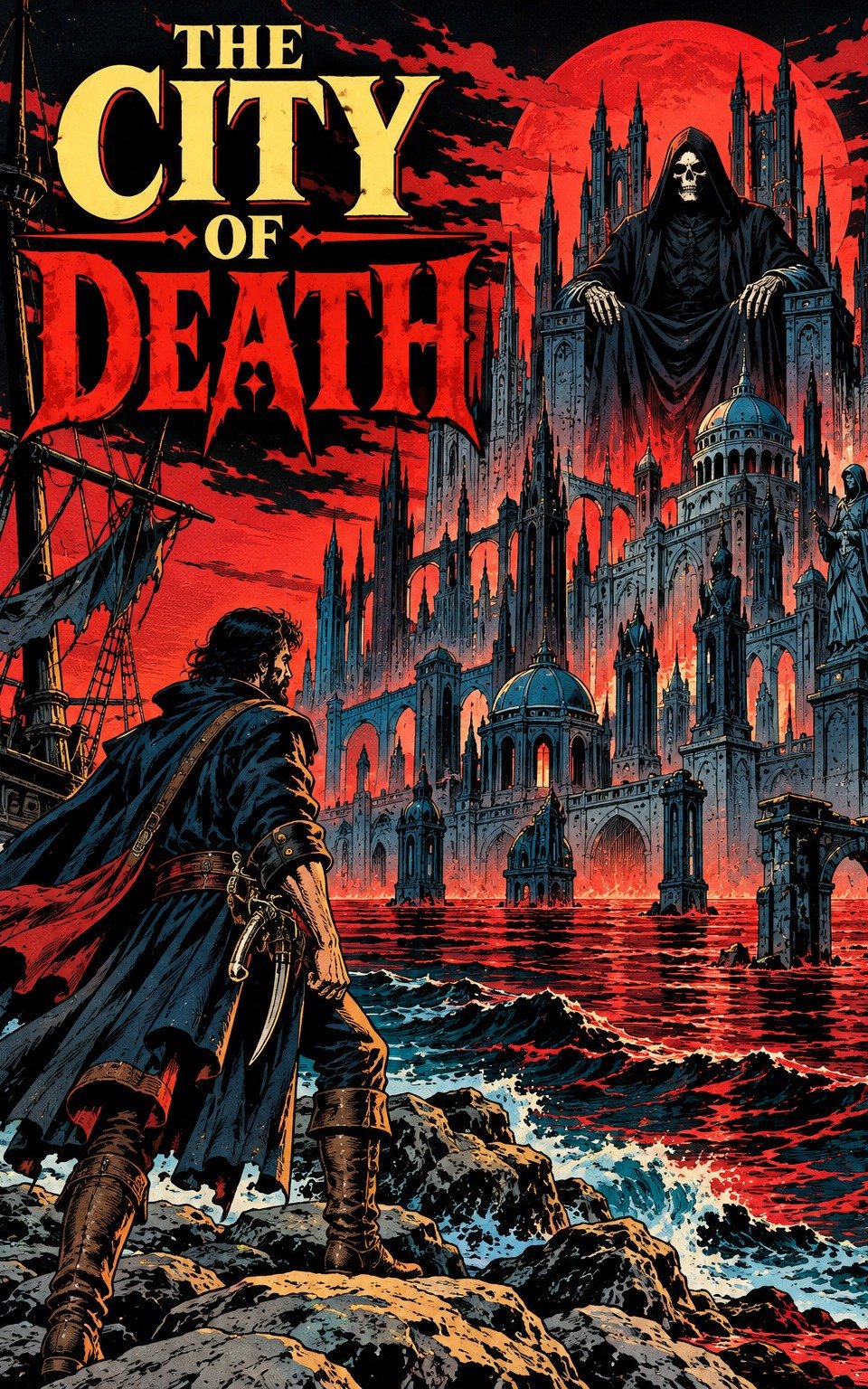
THE CITY OF DEATH

JUST IN TIME FOR HALLOWEEN! 💀 When a supernatural storm destroys his pirate ship, Captain Edgar Phillips awakens in a forgotten city ruled by Death himself. Inspired by Edgar Allan Poe
Inspired by Edgar Allan Poe’s “The City in the Sea”
There are places upon this earth that God, in His infinite wisdom, has abandoned. Places where no prayer is answered, no church bell sounds, and no living creature has drawn breath since the earliest days of creation.
Far beyond the western seas, past the last charts of honest sailors and the forgotten boundaries of ancient kingdoms, there stood such a place.
It was a city.
Its name had been lost to history, though its towers remained, rising in dreadful magnificence above a sea of black and motionless water. Great palaces stood beside ruined temples, their walls adorned with carvings of forgotten gods. Marble avenues stretched between buildings of impossible height, and beneath their foundations rested the bones of kings, beggars, saints, and murderers.
All had come there in the end.
The righteous and the wicked, the beautiful and the wretched, the beloved and the despised. Their earthly distinctions had been surrendered at the city's gates, and there they remained, undisturbed by the passing centuries.
No sun had ever shone upon those melancholy streets.
The heavens above were perpetually dark, though no clouds moved across them, and no stars offered their distant comfort. Instead, a strange crimson illumination rose from the depths of the surrounding sea, casting its unnatural radiance upon the city's innumerable spires.
And the waters never moved.
Not a ripple disturbed their polished surface. No wind troubled them. Even the ancient ships that lay half-submerged along the deserted quays remained perfectly still, their rotting sails hanging in dreadful resignation.
Above this forsaken kingdom stood a tower of black stone, taller than any other structure within the city. Its narrow windows overlooked the silent streets, and at its summit rested a throne fashioned from the marble of a thousand graves.
Upon that throne sat Death.
He wore no crown, for none had ever been required. His robes were ancient, his hands little more than bone, and beneath the deep folds of his hood rested a face upon which neither kindness nor cruelty could be found.
For a thousand years, he had watched the city.
And for a thousand years, nothing had stirred.
Until the arrival of Captain Edgar Phillips.
***
Captain Edgar Phillips had spent the better part of thirty years upon the high seas, and in all that time he had never considered himself a particularly fortunate man.
He had survived the guns of His Majesty's Navy, a mutiny off the Barbary Coast, and a fever that had killed half his crew in the West Indies. He had escaped the gallows twice, buried three quartermasters, and acquired enough enemies to populate a respectable English parish.
He had also survived two marriages, though he maintained that the Royal Navy had been considerably more reasonable.
His present circumstances, however, exceeded even his considerable experience with misfortune.
His ship, The Weeping Wench, was a swift, black-hulled brigantine carrying thirty-eight hardened rogues, twelve cannons, and a cargo of Spanish silver liberated from a merchant vessel three days earlier. She was a fine ship, well suited to the business of piracy, and Phillips had commanded her for nearly a decade.
Her name had been chosen by his first mate following an unfortunate incident in Tortuga involving a tavern keeper's daughter, a stolen wedding ring, and a magistrate whose understanding of maritime law had proved remarkably limited.
Phillips had never seen any reason to change it.
They had been sailing west under favorable winds when the sea began to behave strangely.
The first indication came shortly after sunset.
The wind died.
Not gradually, as winds commonly do, but all at once. The sails fell slack, the rigging ceased its familiar complaints, and the Weeping Wench came to a dead stop upon waters that had been rolling beneath her only moments before.
Phillips stood at the quarterdeck rail, watching the sea.
"Sound the depth," he ordered.
A sailor hurried forward with the lead line.
The weighted cord disappeared beneath the surface.
More line followed.
And more.
At last the sailor looked up.
"Cannot find bottom, Captain."
"Then you've either lost your arithmetic or we've sailed into a very deep patch of ocean."
"Begging your pardon, sir, but the line's gone cold."
Phillips frowned.
"Cold?"
"Aye, Captain. Cold enough to burn."
Before Phillips could answer, the sea began to glow.
A faint crimson illumination appeared beneath the hull, spreading outward through the black water. It deepened until the ship seemed suspended above an enormous submerged furnace.
The crew gathered along the rails.
One man crossed himself.
Another began to pray.
Phillips regarded them with considerable irritation.
"If the Almighty wished to hear from this crew, gentlemen, I suspect He would have sent for us long ago."
Then something moved beneath the ship.
It was enormous.
Far below the keel, a vast shape passed through the crimson depths, displacing water beneath the entire vessel. Phillips could distinguish neither head nor tail, only a terrible immensity moving with dreadful purpose.
For one brief instant, something opened beneath the surface.
An eye.
Larger than the ship itself.
It looked upward.
Directly at him.
Then the storm came.
The sea rose in monstrous swells. Lightning split the heavens, illuminating clouds that had appeared from nowhere. The Weeping Wench pitched violently, her timbers groaning beneath the strain.
"Reef the mainsail!" Phillips roared. "Secure the guns! All hands to their stations!"
Men scrambled across the deck.
A wave struck the starboard quarter, sweeping two sailors overboard. Another smashed through the forward railing, carrying away a cannon and the men attempting to secure it.
Phillips seized the wheel.
"Hold together, you miserable old girl!"
The ship answered with the dreadful cracking of her mainmast.
It fell across the deck, crushing the longboat and tearing away half the rigging. Men screamed beneath the wreckage.
Phillips struggled to turn the vessel into the approaching swell.
Then he saw it again.
The eye.
It had risen almost to the surface.
And it was watching him.
"Well," Phillips muttered, tightening his grip upon the wheel, "you are an ugly bastard."
The next wave struck.
The Weeping Wench broke apart beneath him.
Phillips remembered the wheel tearing free, the terrible cold of the water, and the distant cries of his drowning crew.
Then came darkness.
When he opened his eyes again, he was lying upon a marble quay beneath a sky entirely devoid of stars.
For several moments, Captain Edgar Phillips remained perfectly still.
He had awakened in unfamiliar places before, frequently with a sore head and occasionally with an angry husband searching for him. Yet never had he found himself upon a deserted marble quay, beneath a sky without stars, with his clothing entirely dry after being swallowed by the sea.
He sat upright.
His coat was unsoiled, his boots were dry, and the cutlass he had worn aboard the Weeping Wench remained secured at his hip. Even the silver watch his father had given him rested safely within his waistcoat.
He withdrew it.
The hands had stopped.
"Well, that is unfortunate."
Phillips stood, tested his legs, and examined the harbor.
Before him rose a city of astonishing grandeur. Great towers stood beyond the waterfront, their uppermost chambers disappearing into the darkness. Narrow bridges connected palaces of pale stone, and enormous statues watched over streets that stretched between buildings of extraordinary age.
The architecture troubled him.
During his years at sea, Phillips had visited cities throughout Europe, Africa, and the Indies. He had seen the temples of distant kingdoms, the splendid residences of wealthy merchants, and the ruins of civilizations whose names had been forgotten by all but scholars.
Nothing resembled this place.
The harbor itself was worse.
Ancient vessels rested along the quays, their hulls partially submerged in black water. Some possessed three banks of oars, others enormous square sails, and several were of a design Phillips had never encountered. Their timbers showed no evidence of recent decay, though their construction suggested they had lain there for centuries.
He approached the nearest ship and placed his hand against its hull.
The wood was cold.
"Hello aboard!" he called.
There was no answer.
He tried again.
"Any man alive aboard this miserable wreck?"
Silence.
Phillips considered the question he had just asked.
"Poor choice of words, perhaps."
He turned toward the city.
A broad avenue led away from the harbor, passing beneath an enormous archway decorated with figures of men and women in mourning. Their faces had been carved with extraordinary care, each displaying an expression of such profound grief that Phillips found himself reluctant to look upon them for long.
Beyond the archway stood magnificent houses whose doors remained open.
Phillips entered the nearest.
Its great hall contained a long dining table set for twelve. Silver goblets stood beside porcelain plates, and a magnificent chandelier hung above chairs upholstered in faded crimson velvet. At the head of the table rested a golden crown.
Phillips picked it up.
"Now there is a respectable piece of plunder."
He examined the jewels, tested the weight, and considered the difficulty of carrying it.
Then he noticed the occupant of the chair.
A skeleton sat beneath the crown's former resting place, its hands folded neatly upon the table. Fragments of royal clothing hung from its bones.
Phillips replaced the crown.
"My apologies, Your Majesty. I had not realized the table was occupied."
He departed without further investigation.
The next street led into a square surrounded by temples. Their great doors stood open, exposing chambers crowded with tombs. Within them rested kings still wearing their crowns, soldiers in corroded armor, priests clutching sacred books, and children lying beneath blankets untouched by time.
Phillips had seen enough death to recognize its familiar indignities.
Yet here there was no corruption, no odor of decay, and no dust upon the dead.
Even the air seemed absent of life.
He found a woman seated upon a marble bench beneath a flowering vine carved from stone. She wore a gown of faded blue silk, and upon her skeletal fingers glittered rings set with emeralds. Her head rested against the wall, and in her lap lay the remains of a small dog.
Phillips approached cautiously.
"Madam?"
He touched her shoulder.
The skull turned slightly, and a jeweled earring fell to the pavement.
Phillips withdrew his hand.
"Forgive me. I was merely looking for directions."
He replaced the earring upon the bench.
As he turned to leave, he noticed the woman's hand.
One skeletal finger had moved.
It pointed toward the highest tower in the city.
Phillips stared at it.
Then he looked toward the tower.
"Much obliged."
He followed the direction indicated.
The tower stood beyond a great square paved with black marble. Its uppermost chambers were illuminated by a dull crimson glow, and a broad staircase climbed toward a pair of enormous doors.
Halfway across the square, Phillips heard a voice.
"You have traveled far, Captain Edgar Phillips."
He stopped.
Upon the upper landing stood a tall figure dressed in black.
Phillips rested his hand upon the hilt of his cutlass.
"That depends upon where I have arrived."
"Farther than any living man should venture."
"Then perhaps you would be good enough to tell me how to leave."
The figure regarded him.
"Come forward, Captain."
Phillips remained where he stood.
"I have found that following strangers into dark places seldom improves one's circumstances."
"Nevertheless, you have come."
The figure turned and disappeared through the doors.
Phillips watched the entrance for several moments.
Then he sighed.
"Damned peculiar place."
He climbed the staircase.
The doors opened at his approach, revealing a vast circular chamber supported by columns of polished black stone. Ancient banners hung between narrow windows, their colors faded beyond recognition. At the far end stood a throne upon a raised platform.
And upon that throne sat Death.
Phillips recognized the figure immediately.
The black robes, the skeletal hands, and the skull concealed beneath a deep hood required little explanation. The creature held a narrow staff crowned with a silver bell, and its hollow eyes regarded the pirate with dreadful patience.
Phillips stopped at the foot of the platform.
"Ah."
Death said nothing.
"I had rather hoped you were someone else."
"Many have expressed that sentiment."
Phillips removed his hat.
"Then I presume I am dead."
"No."
The answer surprised him.
"No?"
"Your heart continues to beat. Your blood remains warm. Your soul has not departed its earthly dwelling."
Phillips placed two fingers against his neck.
Indeed, he could feel his pulse.
"Then I should be grateful if you would explain how I came to be here."
Death leaned forward.
"That is precisely what I wish to know."
Phillips frowned.
"You do not know?"
"No living man has entered this city since its gates were sealed."
"And when was that?"
"Before the first kingdoms of men."
Phillips glanced toward the windows.
"Then I have managed something of an achievement."
"Perhaps."
Death descended from his throne.
His movements were slow and deliberate, though Phillips heard no footsteps upon the stone. The ancient robes hung about a frame of remarkable height, and the silver bell upon his staff remained perfectly still.
"Tell me of your voyage," Death commanded.
Phillips described the Weeping Wench, the strange calm that had fallen upon the sea, and the crimson illumination beneath the hull. He spoke of the storm, the destruction of his ship, and the deaths of his crew.
Death listened without interruption.
Then Phillips described the enormous shape beneath the water.
At this last detail, Death became perfectly still.
"What shape?"
"I cannot say."
"Did it possess limbs?"
"I saw none."
"Eyes?"
Phillips hesitated.
"One."
Death approached him.
"Describe it."
Phillips looked toward the windows.
"It was enormous. Larger than the Weeping Wench. It opened beneath the water and looked directly at me."
"Did it speak?"
"No."
"Did you hear anything?"
Phillips considered the question.
There had been the storm, the screams of his crew, and the destruction of his ship.
Yet beneath those terrible sounds, he remembered something else.
A deep vibration passing through the water.
Almost a voice.
"I heard something," he admitted. "I cannot say what it was."
Death lowered his head.
For a long while, neither spoke.
Then a bell sounded somewhere beneath the tower.
Its deep, mournful note passed through the chamber and continued far beyond the city. Phillips felt the vibration beneath his boots.
"What was that?"
Death turned toward the nearest window.
"An ending."
The bell sounded again.
Phillips hurried to the window and looked down upon the streets.
The sea had begun to move.
At first the disturbance was slight, little more than a trembling upon its dark surface. Then a succession of waves rolled toward the harbor, breaking against the marble quays with sufficient force to scatter fragments of ancient stone.
Across the city, doors slammed shut.
The dead began to stir within their tombs.
Phillips watched in horror as a crowned skeleton rose from its resting place upon a temple balcony. It turned toward the sea, lifted its arms, and collapsed into a heap of bones.
"What is happening?"
Death approached the window.
"This city was never intended for the dead."
Phillips looked at him.
"Then why are they here?"
"Because I brought them."
Another bell sounded.
A tower near the harbor trembled, its uppermost stones breaking loose and falling into the water.
Death watched its destruction without speaking.
"Long before mankind raised its first altar," he finally said, "there existed powers whose dominion extended beyond the boundaries of creation. They possessed no mercy, no wisdom, and no understanding of the fragile lives that would one day inhabit the earth."
Phillips listened as the distant waters battered the city.
"They desired only dominion," Death continued. "Every living thing was to serve them. Every soul was to belong to them. Even the heavens were to be divided among their innumerable thrones."
"And what became of them?"
"They were imprisoned."
"By whom?"
Death turned his hollow gaze upon the pirate.
"By me."
Phillips looked again toward the sea.
"Then they are beneath us."
"Yes."
"All of them?"
"Every one."
The tower shuddered.
A great crack appeared in the chamber floor, running from the entrance toward the throne.
Phillips stepped backward, steadying himself against a column.
Death remained motionless.
"For ages beyond your understanding, the souls of the departed have strengthened the prison. Each burial, each forgotten life, each king and beggar brought to this city has added to the bindings beneath the sea."
Phillips remembered the countless tombs, the open graves, and the crowned skeletons lying beneath their jeweled canopies.
"Then the dead are prisoners as well."
"No. They are the guardians."
"And what happens to them when the city falls?"
Death looked toward the square.
"They shall at last be free."
Phillips approached the throne.
"Then why have the bindings failed?"
"Because the world has changed. Men no longer remember the ancient agreements. The dead are buried beneath monuments of their own making, their souls claimed by countless faiths, their names preserved upon stones that crumble with the centuries. Fewer have come to this city with each passing age."
He paused.
"And now the final soul has departed."
A tremendous crash interrupted them.
Through the window, Phillips saw the harbor wall collapse. Crimson water poured into the lower streets, swallowing statues, fountains, and the entrances to ancient palaces.
The city was sinking.
Phillips seized Death by the sleeve.
"Then do something!"
Death looked down at the pirate's hand.
"Release me."
Phillips obeyed.
"I have maintained this prison since the earliest age of the world," Death said. "I have gathered the departed, guarded the gates, and surrendered every comfort that eternity might have offered. There is nothing more I can give."
"Then we must leave."
"You may."
Death raised his staff.
The silver bell rang once.
Beside the throne, an ancient doorway appeared where moments earlier there had been only solid stone. Beyond it lay a sunlit beach, its golden sand washed by gentle waves.
Phillips recognized the coastline.
He could see distant cliffs and the familiar outline of an English fishing village. Smoke rose from cottage chimneys, and somewhere beyond the doorway a gull cried above the water.
He approached cautiously.
"That leads home?"
"Yes."
"And you?"
"I shall remain."
Phillips turned.
The chamber was trembling violently now. Dust fell from the ceiling, and the crimson light beyond the windows had grown brighter.
"You cannot mean to stay here."
"I have never abandoned my duty."
"But the prison is broken."
"Not entirely."
Death returned to his throne.
Phillips watched him settle upon the ancient marble, his robes arranged carefully around his skeletal frame.
Then he understood.
"You are part of the prison."
Death inclined his head.
"The final part."
Phillips looked toward the doorway.
The sunlight beyond it was warm and inviting. He could hear the distant voices of fishermen and the ordinary sounds of a living world.
He had been given his life.
Yet something troubled him.
"If you remain," he asked, "will they be held?"
"For a time."
"How long?"
"I cannot say."
Phillips considered this answer.
"And when you are gone?"
Death said nothing.
Another violent tremor passed through the tower.
Phillips braced himself against a column as a section of the ceiling collapsed near the entrance.
"You should go," Death told him.
The pirate hesitated.
Then, with the awkward solemnity of a man unaccustomed to expressing gratitude, he placed his hat against his chest.
"I thank you, sir."
Death regarded him.
"For what?"
"For allowing me to live."
The skull inclined slightly.
"Live well, Captain Edgar Phillips. It is a privilege granted to you only once."
Phillips stepped toward the doorway.
Then he stopped.
"One thing troubles me."
Death waited.
"My crew. The men aboard the Weeping Wench. Did they come here?"
For the first time, Death seemed reluctant to answer.
"No."
Phillips felt his stomach tighten.
"Then where are they?"
Death looked toward the rising sea.
"They were taken."
"By that creature?"
"Yes."
Phillips stared at him.
"Then the bloody thing has thirty-seven of my men."
Death remained silent.
Phillips looked through the doorway at the sunlit shore.
He thought of the men who had sailed beneath his command, the rogues and thieves who had followed him through storms and battles, trusting him with their lives.
He had failed them.
And now something ancient possessed their souls.
His hand settled upon the hilt of his cutlass.
"Can they be recovered?"
Death slowly raised his head.
"Not by any living man."
Phillips regarded the skeletal figure for a long moment.
"Then I suppose you had better make certain I remain one."
Death said nothing.
The captain stepped through the doorway.
Behind him, the city began its final descent.
Great towers broke apart and vanished beneath the advancing waters. Marble palaces collapsed into the flooded streets, their jeweled halls surrendering treasures that had remained untouched for countless ages. Temples split from their foundations, and the crowned dead were carried away upon crimson currents.
The great bell sounded once more.
Its final note passed through the city as the highest tower descended beneath the sea.
Death remained upon his throne.
The water entered the chamber, rising slowly over the broken floor. It covered the ancient banners, extinguished the crimson lamps, and climbed the steps of the platform.
At last it reached his feet.
From far below came a sound that had not been heard since the beginning of the world.
A voice.
Then another.
And another.
The sea parted.
Beneath the descending city lay an abyss of immeasurable depth. Within it stood a thousand black thrones, arranged in vast circles around a central darkness. Upon each throne rested a figure of dreadful antiquity, its form concealed beneath robes, scales, or the remnants of flesh that had never belonged to any earthly creature.
One by one, they rose.
And one by one, they bowed.
Not to Death.
But to the darkness beneath him.
Upon his sinking throne, Death lowered his head.
"I have kept my promise," he whispered.
The darkness moved.
Something immense stirred beneath the abyss, and the waters trembled beneath its awakening. Great limbs unfolded from the depths. Ancient chains broke apart, their links falling among the ruined foundations of the city.
Then two enormous eyes opened.
They regarded Death upon his throne.
And for the first time since creation, Death was afraid.
Far away, upon the sunlit shores of England, Captain Edgar Phillips fell to his knees upon the sand.
He had emerged from the doorway beside a quiet stretch of coastline. The morning was bright, and a gentle wind carried the familiar scent of salt and wet earth.
Behind him, the doorway had vanished.
He remained upon the beach for some time, listening to the waves and struggling to understand what he had witnessed.
At last, he reached into his waistcoat and withdrew his father's silver watch.
Its hands were moving.
Phillips smiled faintly.
"Well, that is something."
He rose, brushed the sand from his trousers, and began walking toward the village.
He had gone scarcely twenty paces when the church bell sounded.
Once.- Twice.- Three times.
Phillips stopped.
The bell continued.
Four.- Five.- Six.
He turned toward the sea.
Seven. - Eight.- Nine.
The water had become perfectly still.
Ten. - Eleven. -Twelve.
Then came a thirteenth toll.
Far beyond the horizon, beneath the deepest waters of the western sea, the last tower of the forgotten city disappeared into darkness.
And from a thousand thrones, Hell rose to do reverence.
For Death had never been their king.
He had been their jailer.
And his watch had ended.
THE END
That is the end of THE CITY OF DEATH. Thanks for reading.
Get the app for the rest of Cathalson 's writing, and everything else on Novellea.
Open in Novellea