
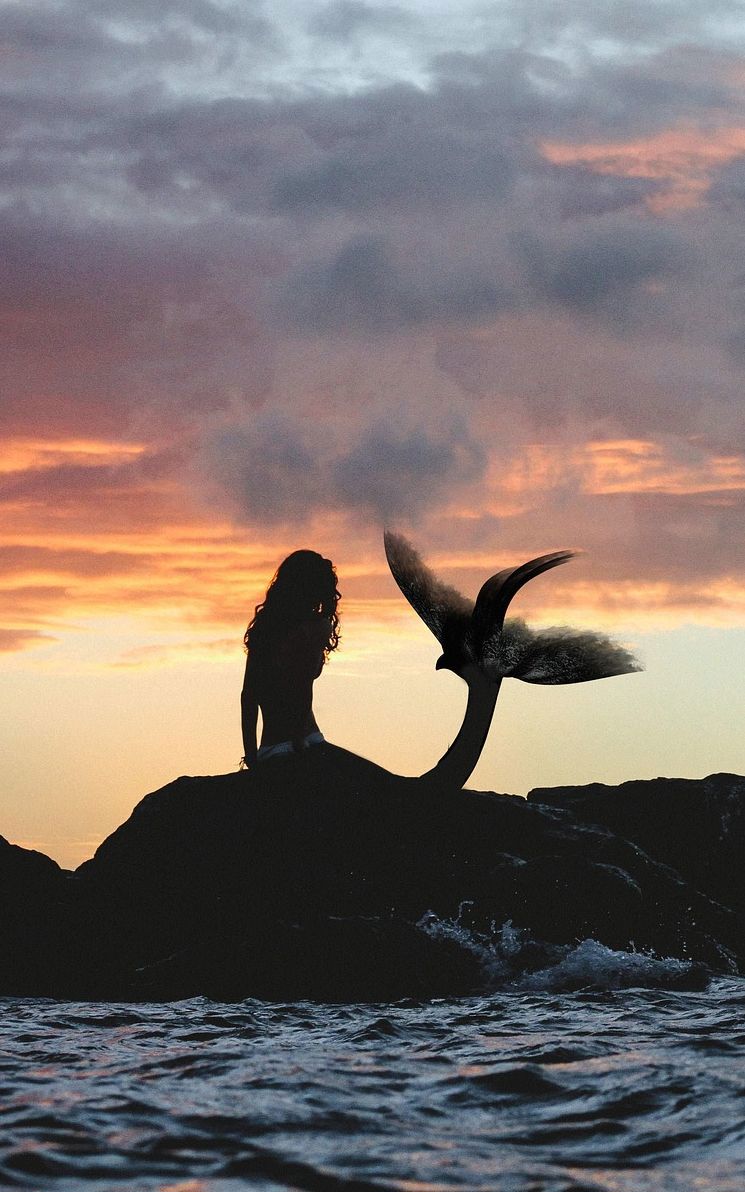
The In-Between: A Mermaid's Guide to Hybridity
Excerpts from a handbook for mermaids
On Origins
Eighty-seven percent of mermaids practicing or seeking to learn the hybrid lifestyle are Landborn. Chances are, if you’re reading this, you were raised Legged and discovered your Fishtail somewhere in your teenage years. According to most recent studies, the majority of Seaborns who explore aspects of hybridity and land living return to the ocean within one to three years. (The research on why exactly this is the case is inconclusive; for the latest theories and speculations see On Seaborn Flight, page 62.)
Regardless of origin, those who seek to sustain a healthy hybrid lifestyle must not value one form of living over another. It is easy to subconsciously list the pros and cons of land versus ocean living in one’s mind; however it is vital that you resist this urge. Hybridity is a psychology of halves, of bisecting one’s identity, and it is crucial to conceive of these bisections not as divisions in the body, but as components of a whole. Body dysmorphia has become an epidemic among Landborn mermaids, and symptoms tend to peak in intensity in the two to four years following Discovery. (For more information on the various forms of neuroses and illnesses surrounding Discovery, including body dysmorphia and dissociation, see On Post-Discovery Trauma, page 3.)
On Mothersickness
Mermaids most vulnerable are those abandoned by Seaborn mothers, a staggering ninety-six percent of Landborns seeking or practicing hybridity. (Approximately eighty-three percent of the entire hybrid community.) Mothersickness involves an acute hunger for one’s absent mother; most common manifestations are psychological (anxiety, jealousy of friends with mothers, depression, nostalgia for fabricated memories, suicidal ideation) but physical ones exist as well. These can include body-aches, fever, night sweats, secretion of sea fluids (for Landborns, these were most likely absorbed during gestation in Seaborn mother’s womb,) skin sensitivity, insomnia, and/or intense abdominal pain, possibly linked with menstruation (for Landborns, this will most likely be similar to the gastric/pelvic discomfort experienced during Fishtail growth and Discovery.)
On Friendship
According to the most recent research, Landborn adjustment to Aquatic friendships is overwhelmingly easier than Seaborn adjustment to Legged friendships. The reasons for this require further investigation; self-report data collected from Seaborns name frivolity, inconsistency, provincialism, and a newly-coined term “technologophilia” as contributors to loneliness, isolation, disenchantment with Legged life, and eventual abandonment of hybridity. Self-report data from Landborns suggest the opposite of Aquatic friendships: trust, reliability, compassion, sophistication, and “depth” (no pun intended) are the most common words used in their evaluations of Aquatic culture, which could very well explain the soaring levels of Landborn hybridity, particularly within the last decade. (For case studies in technologophilia and Seaborn culture shock see On Diving in Shallows, page 318.)
On Life Expectancy
Landborn hybrids spending fifty percent or more at sea live, on average, to eighty-seven (121% of their natural lifespan as of 2020.) Seaborn hybrids spending fifty percent or more on land have live, on average, to eighty-one (67.5% of their natural lifespan as of 2020.) A new study on the effects of climate change and ocean acidification on rates of hybrid morbidity may challenge this data; our most recent report suggests the scales may be tipping back in favor of Seaborn hybrids, in part due to less time spent in polluted water, but also to respite from anthropogenic depression, dysthymia, and related mood disorders which are currently skyrocketing among fully aquatic Seaborns. (For Seaborn perspectives on the benefits of hybridity despite reduced life expectancy, see On Love and Redwoods, page 16.)
For Fledgling Landborns: Pro-Tips from Veteran Hybrids
Marina, 64: Treat water like a love letter, like a treasure map buried somewhere secret. Let no one follow you there. Avoid swimming pools like the plague. (I won’t speak for all hybrids but chlorine makes my Fishtail molt like a bird.) Find a lake, a river, a beach if you’re lucky. It doesn’t matter how far; I have friends from Kansas and Oklahoma and Ohio who will take whole weeks away from their families just to drive to the coast. Once you see your tail for the first time, there is no going back. It is more memory than body part, more daydream than sensation. This isn’t to say it doesn’t have a physical shape, or weight - it does. But it is not a part of you like your arm or your hair or your eyes are parts of you. It’s like the way a fantasy changes the landscape of your thoughts, shapes and colors shifting to make way for your castle in the air. Keep it this way - airy and light. Illicit. Write it, paint it, dance it. Don’t talk about it with your therapist.
Delta, 47: Brace yourself for a rough patch, around week six after Discovery. Meeting your Fishtail is like the start of any other relationship - there’s a honeymoon period, and then there’s panic. It feels too good to be true, or too true to be good, or just too much. How can you go about your normal Legged life when there’s this other part of you, this buoyancy, this flippered magic? Why do you suddenly feel so heavy? Why do your feet burn? Why do edges of things seem sharper, like you could cut yourself on a door handle? These questions never really go away. Know that when you become a hybrid you give up something - your softness, your complacency. Fabrics chafe. Rules irritate. Cubicles will appall you. The world will feel impossibly stratified, and you will be helpless to round its corners, to smooth its hatching.
Nixie, 53: Land-colors neutralize, for awhile. Blues and reds mix with grays and beiges - sheet metal skies and apples rolled in sawdust. Don’t be frightened. Colors are so much more vivid at sea; leaving it is like tearing your eyes away from a brightly-colored painting - everything dims, and blue flickers in the empty spaces. Be patient with the sandpaper sun, the cinderblock butter, the orange peels you’ll want to throw away. Your body will adjust. But to be perfectly honest, it never completely returns to normal. I won’t speak for everyone, but for me, Legged life is like a hand-me-down; it will always be special to me but it will never shine as brightly as the sea.
On Purpose
Hybrids can be anything - writers, oncologists, cocktail waitresses, roofers, plummers, morticians. Hybridity isn’t something you want to put on a resume, but it shouldn’t keep you from pursuing your dream job. Exceptions to this rule are fairly intuitive: scuba diving, underwater photography, Olympic swimming, dolphin training, U.S. Coast Guard, and playing Ariel at Disneyland are probably gigs you want to avoid, if secrecy is a priority for you. (For hybridity and privacy see Quirk or Condition? Who To Tell on page 22.) However, you should prepare yourself for something we in the hybrid community call Dilution. Your dreams for the future, whether it be stitching livers or modeling nail polish or tracking swan migration, will matter a little less to you once you cross over. It’s a subtle thinning - acrylic to watercolor. Still visible, still textured, but not quite so concentrated. This is not a loss. According to our most recent polls, Dilution is bittersweet, but ultimately positive. Like any meaningful addition to one’s identity - recovering from an illness, moving overseas, becoming a mother - hybridity takes up space, in your body and in your mind. Veterans describe it as more fluid than deadweight, something flowing and animate that pervades every aspect of ordinary living. Curved lines and peeled rinds. Like cursive, like lemons juiced and sweetened.
On Love and Redwoods: A Letter to Seaborns
Dear young, trepidatious, Bambi-legged hybrids,
What a world you’re stepping into. Feel the sun on your neck, the sun on your bare feet. There’s a hermit crab exploring the crevices between your toes; don’t shake her off. Revel in the small miracles: leaves caught in dry hair, the bending of knees, the scratch of driftwood. And then, further inland: hopscotch, jump rope, running in the rain. Squatting and spinning and dancing. The wonders of the Legged body. Space, too, is a marvel: you move through it like a blown dandelion, nothing in the way. Meadows will thrill you; soccer fields will leave you starstruck. Dance studios, empty beaches, a quiet strip of sidewalk - remember how these things bewilder you, charm you, leave you speechless with joy.
Because it’s true what they say - the honeymoon ends, and it won’t be long before you ache for your tail, wondering what possessed you to give it up, even temporarily. You will see storms. Huge, swirling vortices that wrench homes from the earth. And garbage. Landfills, oil spills, junkyards heaped with used and rejected things. Bodies of water, bits of your home, viewed from above: greasy, rainbowed, scabbed over in plastic. Here at the surface, you will hardly recognized what you knew from the depths.
People die at random: guns and cancer and lightning bolts. They die at war and they die in classrooms, behind barricades of kid-sized desks and bean bag chairs. Girls die when they’re walking or running or just sitting alone, in those quiet streets you used to find so romantic. You learn rules; you learn shadows. Empty spaces, your favorite testing grounds for legs, are not as empty as you think.
There are also strange things, mysteries you find neither threatening nor endearing: mosquitoes, dandruff, denim jackets, fake nails. Some people wear colored metal on their teeth. Some people throw eggs on their neighbors’ cars. Some people steal each other’s mail. Some people eat peanutbutter and pickle sandwiches. There are plants that eat spiders, and museums full of wax, and buildings full of trampolines.
One day these things - maybe just one, or a dozen, or a hundred - will strike you as simply too much. Not worth it. At this point, you can make the choice: go back to the ocean and never return. This would not be unreasonable; every day you spend on land you are losing years. You may look at people like me and wonder what on earth is wrong with us. It’s hard to put a finger on exactly why I’ve chosen hybridity, but here are a few reasons: there are trees here that I could drive a car through, that I could make a home in. There are birds the size of human hearts and frogs the color of jewels and dogs that will lick the palms of your hands. There are waterfalls and painted deserts and canyons made of crumbling sandstone. Sometimes the sky will look like it’s burning. Or like a vision board crowded with pushpins. Little pieces of home will pop up in the strangest of places - seashells on earrings, dolphins inked on skin, orange crackers shaped like fish. You will see yourself everywhere, in films and books and jewelry and dolls. You are a folktale, a movie star, a child’s toy.
Some Legged people are hard to love, but no harder than Fishtailed people. And then some are impossibly easy. They have a funny way of describing it, here - “falling.” We don’t fall back home; we can’t. We are buoyed by waves; we dive and ascend. Falling is part of having legs; it’s a foreign and frightening feeling. But it’s also part of living on land. I’m almost certain it’s a part of why Legged lives are so short. And yet the more you do it, the more you go looking to get swept off your feet.
That is the end of The In-Between: A Mermaid's Guide to Hybridity . Thanks for reading.
Get the app for the rest of Priya Thomas's writing, and everything else on Novellea.
Open in Novellea