
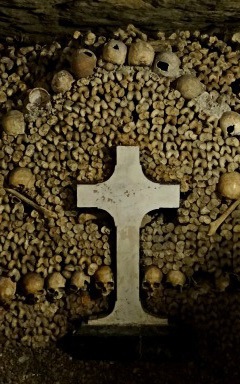
The Paris Catacomb’s - a link to the past and future
A brief history of the catacombs of Paris.
It may be unsettling to some, but many people are drawn to the macabre. The Victorians were obsessed with death, and we aren’t much different today. Not surprisingly, one of Paris’ top attractions are its infamous catacombs.
The remains of over six million Parisians are to be found here in these old, and largely abandoned stone mines. The catacombs were born out of growth and after the great plague Cemeteries inside of the city were filled to capacity and the city boundaries were constantly growing larger. Something had to been done and following the fires that destroyed large swathes of the city, upon the rebuild death was moved underground.
The city had a vast network of underground tunnels waiting to be used, the earth beneath us is riddled with holes and gaps, ancient rivers and waterways. In 1785, these places were used and the catacombs became a reality, soon the cemeteries within the city were being emptied with their dead taken to the new labyrinth.
At first the organisation was really disorganized, but in 1810, Louis-Étienne Héricart de Thury, director of the Paris Mine Inspection Service, conducted renovations of the catacombs that transformed them to the orderly piles we see today. The men that worked these tunnels were certainly creative with the masses of bones they had to hand and the structures in the tunnels are truly beautiful and breathtaking to behold.
The bones, which had previously been loosely piled, were carefully organized in walls, according to a quarry backfill arrangement. The façade consists of rows of tibiae alternating with skulls, and the remaining bones were piled behind this wall. They were often only small fragments, as a consequence of their being dumped into the quarry. Masonry monuments in the Antique and Egyptian styles were also installed along the circuit, in the shape of Doric columns, altars, steles or tombs. Certain areas were named after religious, Romantic or Antique sources, such as the Lacrymatory Sarcophagus, the Samaritan Fountain or the Sepulchral Lamp. With the aim of adding an educational aspect to the circuit, Héricart de Thury had two cabinets built in the style of traditional cabinets of curiosities; one was dedicated to mineralogy, the other to pathology. The pathology cabinet showed specimens that referred to bone illnesses and deformations, as established by the research of Dr. Michel-Augustin Thouret in 1789. Another pedagogical tool are the plaques featuring religious and poetic texts that are found throughout the galleries.
Of course, Paris is not the only place to house catacombs, London has several smaller examples, but sadly most of these are still closed to public view. Budapest and Rome also house them beneath the ground.
Yes, the Paris catacombs are a creepy tourist attraction. However, it is fascinating. It reminds us how remains were once treated before modern times. They were often removed to ossuaries after the body decayed and put in a box. Sometimes these were mass ossuaries, sometimes family mausoleums. Tombs were leased and not bought. When leases run out and no one was left or willing to pay, the remains were removed to ossuaries as well. Many of the remains in the catacombs were from mass graves. People weren’t buried in mass graves just because of war or genocide, but because their families couldn’t afford the lease for a proper tomb.
The subterranean environment of the Paris Catacombs has been the focus of several studies. Shortly after the catacombs were opened, two researchers from the French Museum of Natural History manifested a special interest. They were Jacques Maheu, a botanist, who studied the flora in this light-free environment, and Armand Viré, a speleologist and naturalist, who discovered the existence of cave-dwelling crustaceans. Héricart de Thury also made an experiment in 1813: he put four goldfish into the basin of the Samaritan Fountain; the fish survived but were unable to reproduce and became blind. In 1861, Félix Tournachon, more widely known as Nadar, experimented during three months with the first shots taken using artificial light. Since the darkness required a very long posing time, the photographer used dummies to represent workers in their environment. Today, pathological research continues when work is undertaken to consolidate the ossuary. Ensuring the preventive conservation of the bones in a very humid underground environment, respecting human remains and promoting the geological, archeological and historical heritage are real challenges for the Paris Catacombs.
In the reign of Louis XVI, the fermiers généraux in charge of collecting taxes suggested to the king that he build a wall around Paris that would be 24 kilometers long and feature 55 entry points to allow levying taxes on merchandiser.
This was the most ambitious architectural and urban project of the Ancien Régime. Architect Claude-Nicolas Ledoux (1743-1794) drew the project layout and elevations. For this barrier, the so-called “Gate of Hell”, he designed in 1785 two symmetrical rectangular pavilions that were located facing each other on both sides of the Route d’Orléans. The architect based his design on the propylaea of Ancient Greece, which were monumental gateways or vestibules placed at the entrance to a sanctuary. This impressive urban landmark recalled the power of the State to everyone who crossed the barrier and paid the entrance fee.
The two pavilions were built on four levels: ground floor, mezzanine, first floor and attic. On the main façade along the Route d’Orléans, a central flight of stairs led to a porch with three arcades on baseless Tuscan columns that alternated cylindrical, plain and cubic drums. These columns were prolonged in the protruding bosses on the ground floor. The central arcade forms a Venetian window (a central bay surmounted by a semi-circular arch and two side arches surmounted by a lintel). The only sculpted frieze, which is the work of Jean-Guillaume Moitte (1746-1810), is elegantly decorated with women dressed in the Antique style and holding medallions with the coats of arms of cities tied to the Barrière d’Enfer. The roof was in slate.
Symbols of royal power and unjust taxes, the barriers were the first targets of the revolutionary uprisings in July 1789. The Barrière d’Enfer was pillaged and burned on July 13. A report dated January 1790 notes that the Barrière d’Enfer, which was given the new name of Barrière Égalité (“Equality Gate”), had been repaired and housed the employees and renewed activity of the octroi. Dating from 1790-1791, these plans are conserved in the Historical Library of the City of Paris.
Taxes at the entrance to cities were suppressed in May 1791 and re-established in October 1798. There were successive transformations. The grillwork that barred the Route d’Orléans was modified, and the pavilions were reassigned. In the 1820s, the east building was converted into a barracks to house detachments of the municipal guard and the departmental police force. Employees of the octroi no longer occupied the west pavilion.
Starting in 1809, the Catacombs were opened to the public by appointment. A register was placed at the end of the circuit, where visitors could write their impressions. It was filled very rapidly because these visits had quickly become a success with both the French and foreigners. As the years passed, the ossuary became the resting place of many illustrious individuals. In 1787, the Count of Artois, the future Charles X, visited the site in the company of a group of court ladies; in 1814, Francis I, the Austrian emperor, took a tour there; and in 1860, Napoleon III descended into the catacombs with his son.
During the nineteenth century, visiting arrangements constantly changed, from total closing to monthly or quarterly openings. The Paris Catacombs are now open to everyone without requiring an authorization and welcome nearly 550,000 visitors yearly.
The catacombs continue to give rise to many a story and a fascination of what death is and what lays beyond. Now practically unmapped in areas these halls hold many a strange secret and continue to mystify and intrigue us. I for one would love to discover some unknown part of these haunted pathways, one day maybe I’ll go and try…
That is the end of The Paris Catacomb’s - a link to the past and future. Thanks for reading.
Get the app for the rest of Germaine Mooney's writing, and everything else on Novellea.
Open in Novellea