
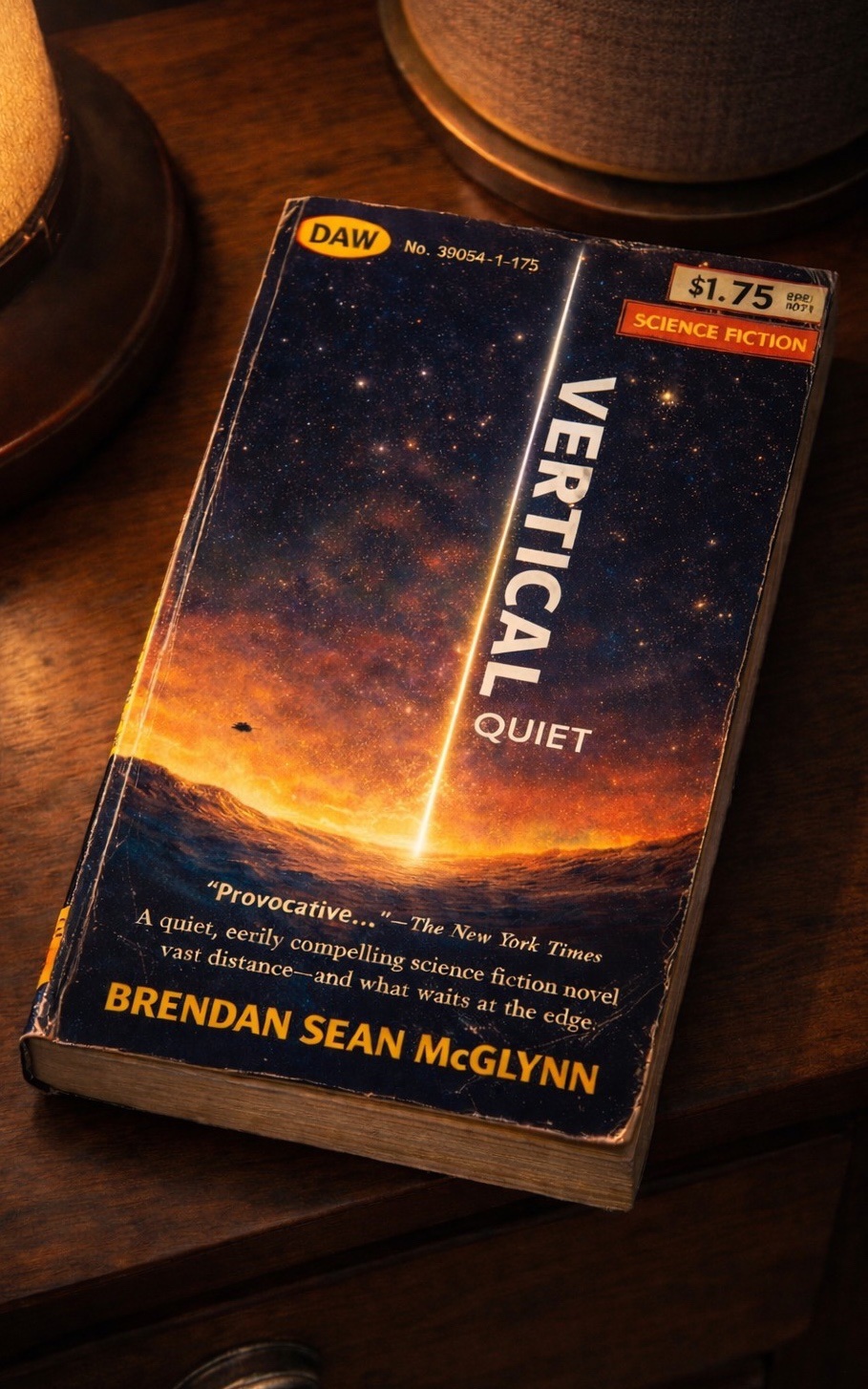
Vertical Quiet

NEW CHAPTER The One That Went On 4/16/2026 A weekly science fiction series about what endures after ambition fades. Machines built to wait. Answers arrive slowly. Consequences remain.
Chapter 1
Bright Ascent
On the morning Astraeus left Earth, the sky looked washed clean.
It was not brighter or bluer than usual. It simply felt prepared, as if the wind had swept it clear of old weather and doubt alike. Across the world, people noticed this without agreeing on it, the way people sometimes notice the same dream after waking.
The celebration had been scheduled for months, but the real gathering began earlier than that. It began in kitchens where radios hummed beside cooling coffee. In classrooms where teachers abandoned the lesson plan and let history happen live. In city squares where screens bloomed like windows and strangers leaned together as if warmth might carry upward.
This was the day, they said.
This was the day humanity stopped waiting.
The ship stood on its platform like a promise given shape.
Astraeus.
The name felt old enough to have been waiting for us. It sounded like something carved into stone long before rockets, before nations, before the sky learned to fear being crossed. It was the sort of name that belonged to monuments and maps and the last lines of textbooks.
Children wore paper replicas on strings around their necks. Parents lifted them onto shoulders. Vendors sold patches and pins stamped with a star held aloft by a human hand. A band played a tune that sounded like sunrise and marching feet and confidence carefully rehearsed.
Dr. Lena Ortiz watched from behind the control room glass, her hands folded, her jaw tight.
She had helped build Astraeus, but she did not feel like its owner. No one did. Somewhere along the way, the ship had crossed a line and become something else. It had stopped being a project and become a promise.
Beside her stood Evan Kade, smiling as if the future had arrived early and brought him a gift.
“They’ll remember this,” he said.
Ortiz nodded, because arguing felt smaller than the moment.
Kade died three weeks later, in a collision on a rain-darkened highway. The news cycle folded it briefly into the larger story. He had lived quickly, driven quickly, spoken quickly, as if velocity itself were a virtue. In the retrospectives, his smile became shorthand for belief.
For a long time, humanity had waited for a reason to believe the stars were more than decoration. Telescopes had shown them beauty. Equations had shown them possibility. Astraeus was meant to show them courage.
It was not a question sent into the dark.
It was a declaration.
The countdown reached its final seconds. Across the planet, people held their breath without realizing they were doing it.
Zero.
The ship rose without drama.
There was no thunder, no violence, no pillar of fire clawing at the ground. Astraeus lifted as if certainty itself were weightless, as if the Earth had simply decided to let go of a balloon. A clean, steady glow marked the engines as the ship climbed, smooth and unwavering, passing from the hands of engineers into the open palm of the sky.
People cheered because there was nothing bigger they could do.
Astraeus cleared the atmosphere and the sky did what it always does when asked to surrender. It surrendered. The blue thinned. The black arrived. The Sun became a brilliant coin. The Earth below shrank into a bright marble holding every voice that had ever spoken the ship’s name.
Within hours, Astraeus was farther away than anything humanity had ever built. Within days, it was no longer a machine so much as an idea in motion.
It sent back images that felt like postcards from the edge of knowing. The planets aligned like a story being told correctly for the first time. The Sun diminished. The world leaned forward.
Astraeus spoke constantly.
Not with words, but with light and number and insistence. Mathematics braided with fundamental constants. A clean, confident announcement written in the only language everyone agreed the universe shared.
We are here.
We are not afraid.
It was a lighthouse, flaring into the dark.
The early reports were everything people hoped for.
Anomalies. Deviations. Regions where the universe behaved as if it had once been touched. Not cities. Not voices. Just hints that the silence might not be empty.
The headlines came fast.
HUMANITY ANSWERS THE STARS
FIRST STEP BEYOND SOLITUDE
THE UNIVERSE IS LISTENING
Funding surged. Speeches multiplied. Astraeus became a symbol sturdy enough to carry almost any meaning placed upon it. Each retelling simplified it further. Each explanation smoothed away uncertainty. What Astraeus was doing mattered less than what it had come to represent.
Ortiz watched the feeds from the back of the room.
She no longer stood at the glass.
The Mission Lead did.
The woman at the head of the table leaned closer to the screen, posture exact.
“Hold the stream,” she said.
Ortiz recognized the cadence. She had taught it. But something had already begun to thin between them. Decisions were now summaries. Intent traveled through layers of briefing and rehearsal before arriving as instruction. Meaning softened as it passed from mouth to mouth.
“This is too loud,” Ortiz said one night, long after the room had thinned and the screens no longer needed witnesses.
The Mission Lead smiled without turning. “You don’t whisper into a void.”
Outside the room, the signal grew. Panels debated resolve. Classrooms framed it as courage. Editorials warned against hesitation. Astraeus became an argument that could not be lost without embarrassment.
The deviation refused to resolve.
There was no dramatic alert. No sudden miracle. Just a persistence that did not decay. A pattern that bent where it should have scattered.
“It’s aware,” the Mission Lead said.
An intern shifted at the edge of the room. “Or the universe?”
Astraeus adjusted course.
The ship leaned toward the anomaly the way a torch leans into wind. Signals intensified. Patterns tightened. The lighthouse burned brighter.
The audience grew louder.
By then, Astraeus was no longer discussed as a mission. It was discussed as a commitment. Interrupting it required permission. Doubt required justification. The original questions had been replaced by rehearsed answers.
The Mission Lead retired quietly.
There was cake. There were speeches that tried to sound like endings.
The intern inherited the chair.
The title followed a week later. Mission Leader. He read it twice before accepting it. Between Ortiz and the intern, something essential had been lost. The ship still transmitted perfectly, but the understanding of what it was for had become distorted, repeated too often, polished into certainty.
The first failures were small. A missed timing window. A telemetry drift engineers explained away. Then contradictions. Numbers that could not all be true at once.
“Pull it back,” the Mission Leader said.
The room did not respond at once.
Someone asked for confirmation. Someone else asked for projections. Outside the room, the feeds were still running.
By the time the order was approved, Astraeus had already become something the world did not want interrupted.
The command took weeks to travel the distance.
The reply took equal time to return.
By the time the final transmission arrived, the Mission Leader had learned how weighty a title could become.
The data came as a burst of structure so intricate it felt almost reverent, as if the universe itself had spoken once and only once.
Then silence.
No explosion.
No debris.
No fading echo.
The lighthouse went dark.
The world waited for clarification that never came.
They called Astraeus a martyr. A pioneer. Proof that humanity had dared to reach. There were memorials and documentaries and carefully edited stories that polished disappointment into pride.
Later, they said failure.
Astraeus became a word that meant hubris. A colossus with clay feet. A reminder that certainty could lift you only so far.
No wreckage was ever found.
No ruins.
No lessons etched into debris.
It vanished as completely as a thought abandoned mid-sentence.
Years passed.
The grief softened into myth.
And far from the banners and music and speeches, in a place where no one clapped, another project continued its work.
It had no mythic name.
It did not promise wonder.
It did not shine.
It waited.
And it learned how to keep the lights off.
Chapter 2
The Quiet Room
He had keys that opened doors nobody remembered naming.
Not because he was important. Because he was useful. Because the building had been built by people who believed in redundancy, and over time redundancy turns into permission.
His name was Cal Mercer. He had been cleaning the facility so long that the place had aged around him like a tree growing around a fence post. People came and went. Titles changed. Hallways were repainted. Signs were replaced with new acronyms like fresh coats of denial. Cal stayed, pushing his cart, learning the rhythms of rooms that thought they were permanent.
He had been born the year Astraeus launched, though he had never thought of that as unusual.
He could tell what kind of day it was by the sound of the air.
Some wings hummed with urgency. Some felt like church. Some sounded like nothing at all.
The deep wing sounded like nothing at all, which was how he knew it was still alive.
He started his rounds before dawn because his supervisor liked an empty building and because Cal liked the quiet. In the mornings the facility felt honest. At night it felt like it was pretending to sleep.
He took the service elevator down, past floors that were not listed on any public directory. The panel had been replaced years ago, a smooth plate where buttons used to be. Cal kept the old trick anyway. He pressed where the button used to be, waited, then pressed again, and the elevator shuddered as if remembering him.
It dropped.
When the doors opened, the air changed.
Not colder, exactly. Drier. Older. Like an archive room that had learned to breathe on its own.
The corridor lights came on in a slow sequence, not all at once. Cal had noticed that years ago. The facility called it an energy saving feature. He had never believed that. It felt like the hall was waking up in pieces.
He rolled his cart forward, wheels whispering over polished concrete worn dull by decades of foot traffic. There were no windows down here. There was no view. Only the sense that if you stood still long enough you could hear your own heartbeat and mistake it for machinery.
The door at the end of the corridor did not have a label anymore. It used to. He remembered a plaque, back when the lettering was crisp and proud. Then there had been a different plaque. Then nothing.
Cal still called it the same thing he had always called it.
The Quiet Room.
He unlocked it with a key that did not look special. Brass. Ordinary. The kind of thing you could lose in a couch cushion. The kind of thing that should not have opened anything important.
The lock clicked as if relieved.
Inside, the room was bigger than it needed to be and emptier than it should have been. A wide space with a raised floor and cable channels and consoles that looked like they had been designed by people who expected the future to be patient.
Most of the screens were dark.
Most of the time.
Cal turned on the overhead lights and waited for them to stabilize. The bulbs were new. The room was old. Sometimes the old won.
He moved the way he always moved. Wiped the counters. Checked the corners. Took inventory of small human debris that collected even in rooms that were not supposed to have humans in them. A paper cup. A stray glove. A maintenance tag left behind like a confession.
There were fewer cups now than there used to be.
That was one of the changes. Not the biggest, but the one Cal felt most clearly. The Quiet Room used to smell like burnt coffee and sweat and hot plastic. It used to have men and women in it who spoke fast, like they were afraid silence might cost them something. They would argue over numbers and screens, and Cal would clean around their feet like a tide moving around stones.
Then the people thinned out.
It did not happen all at once. It happened the way cliffs form. Grain by grain. A reassignment. A retirement. A budget cut. A scandal Cal only half listened to on the news. An announcement about a ship named Astraeus that made everybody up top smile like kids on Christmas morning.
Astraeus had been everywhere for most of Cal’s life. Posters. Patches. Anniversaries. The kind of excitement that teaches you how to feel before you know why.
The Quiet Room did not smile.
It just kept humming in a way Cal could barely hear.
Down here, in the Quiet Room, the air did not change.
The room did not feel wounded. It did not feel afraid.
If anything, it felt as if Astraeus had been weather, and the Quiet Room was climate.
Cal did not have words for that. He only had the feeling of it.
He finished the counters and moved toward the back wall, where a single cabinet sat bolted into place. It was plain. No label. A gray box with a seam running down the middle. Cal had wiped it a thousand times and never once been told what was inside. The cabinet was always warm, not hot, just warm enough to notice if you rested your palm on it too long.
The first time he had noticed the warmth, he had asked a technician.
“Just a power regulator,” the technician had said. “Don’t worry about it.”
Cal had nodded, because worrying was not in his job description.
But over the years, he had started to wonder anyway.
Not because he thought there was a secret. Secrets were loud. This felt quieter than a secret. This felt like a habit.
Cal had changed in the years he had worked here.
His hair had gone from black to gray to mostly gone. His hands had thickened, skin toughened by soap and winter and the constant small violence of work. His knees complained now. The cart felt heavier. Sometimes he stood in the break room staring at the microwave as if it had asked him a hard question.
He did not complain. He was not that kind of man.
But he noticed.
He noticed that the facility had started replacing people with systems. He noticed that the Quiet Room stopped hosting arguments and started hosting silence. He noticed that the cabinet stayed warm through every budget cycle and every leadership change, as if the building itself had decided that this one small thing was nonnegotiable.
And then he noticed something else.
The cabinet had begun to anticipate him.
It was not dramatic. It was not a blinking light or a voice speaking his name. It was a shift in the room’s timing. The overhead lights stabilizing faster on days when he arrived early. The hum deepening slightly when he stepped inside, like a machine taking a breath.
Once, he had been out sick for three days with the kind of flu that makes you feel like your bones are full of sand. When he returned, the Quiet Room smelled wrong. Not dirty. Not dusty. Wrong, like a room that had been left waiting with the door cracked open.
He cleaned it anyway. He always cleaned it.
But that day, when he ran his cloth over the cabinet, he felt a faint vibration through the metal. Not constant. Not mechanical in the way of fans or pumps. It came in pulses, as if something inside was doing work and then pausing to listen.
Cal froze.
He rested his palm against the cabinet, feeling the warmth seep into his skin.
The pulses stopped.
He waited.
They resumed.
Slow. Careful. As if the cabinet had been doing this all along and had only now decided to let him notice.
Cal pulled his hand away, heart thumping.
He laughed once, under his breath, because the alternative was to feel foolishly afraid of a metal box.
“Alright,” he said quietly, like he was speaking to a stray cat. “I see you.”
The room did not respond.
But the hum changed, just a shade.
Cal finished his cleaning. He emptied the trash. He wiped down the consoles that no one used. He straightened a chair that had not been sat in for weeks. When he was done, he stood in the middle of the Quiet Room and tried, for the first time in years, to remember what the room had once been for.
He could not.
Not fully.
He remembered people talking about the stars. He remembered big plans. He remembered optimism thick enough to taste.
And he remembered, faintly, an older kind of talk, the kind that did not make headlines. The kind that sounded like patience and caution and deep time. The kind of talk people rarely wanted to hear.
Cal looked at the cabinet again.
He imagined, absurdly, that someone down here had been building something while everyone up top built Astraeus. That while the world watched a lighthouse blaze into the dark, someone else had been teaching a different kind of light how not to shine.
The thought should have felt paranoid.
Instead it felt like common sense.
Cal checked his watch. His shift would end soon. He would go upstairs. He would eat lunch. He would listen to whatever new story the world was telling itself about the stars.
He walked to the door.
Before he left, he turned back.
He did not know why. Habit, maybe. Or politeness.
The cabinet’s warmth held steady. The faint vibration pulsed once, then stopped, as if caught.
Cal stared at it.
He took one step back into the room.
The pulses resumed.
He felt his throat tighten.
It was not the feeling of being watched the way cameras watch you. It was the feeling of being recognized the way an old dog recognizes your footsteps.
Cal stood very still.
The room, which had always sounded like nothing, sounded now like something choosing quiet.
He backed out slowly and shut the door.
The lock clicked.
In the corridor, the lights dimmed behind him in sequence, one by one, as if the hall were closing its eyes.
Cal rode the elevator up to the surface with his cart and his keys and the strange new weight in his chest.
Upstairs, people still talked about Astraeus as if it had been the whole story. They said brave. They said tragic. They said we will try again.
Cal said nothing.
He had begun to suspect that the real work was not the kind that needed a name people would remember.
And that somewhere below, in a room no one celebrated, something had been watching a janitor grow old.
Not because he mattered.
Because time mattered.
And because whatever lived in that cabinet was learning the one lesson Astraeus never had.
How to keep the lights off.
So what, Cal wondered, would it do the first day no one came back at all?
Chapter 3
The Cathedral
Dr. Elias Rowe worked in a room that had outlived its instructions.
The desk had been built with a stubbornness that bordered on defiance. Not antique—no one had ever bothered to call it that—but heavy in a way modern furniture never was. The wood was dense, close-grained, polished by decades of hands that had rested there while thinking thoughts that never made it into reports. When the light struck the surface at a certain angle, Elias could see shallow scars beneath the finish: the ghosts of diagrams sketched too many times, lines traced and erased until the desk itself had learned the shape of hesitation.
He liked the desk because it did not pretend to be new.
The office sat three floors below ground, far from the wings designed for tours or donors or administrators who liked their progress well-lit and easily summarized. The walls were thick. The air was regulated to a temperature no one remembered choosing. The clocks disagreed with one another by small but persistent margins, drifting just enough to remind you they were no longer authoritative.
Time behaved differently down here.
It accumulated.
Elias had inherited the office without ceremony.
A reassignment form. A quiet handshake. A suggestion—half apology, half relief—that he would “appreciate the solitude.”
He did.
Officially, Elias oversaw stewardship.
That was the word printed on the documentation. Not development. Not management. Stewardship implied that something already existed, already mattered, and did not require improvement so much as protection. It suggested a relationship between the present and a future that could not be rushed without damage.
Most people assumed stewardship meant maintenance.
They were wrong.
Maintenance implied repair. Stewardship implied restraint.
Elias learned the difference his first week, while reviewing systems that had not been examined closely in years. Not because they were secret. Because they worked. In institutions of sufficient size, anything that works long enough stops being visible.
The notes were stored in a cabinet that had not been locked so much as forgotten. The cabinet itself was unremarkable—metal, dented corners, a handle that squeaked faintly when pulled. Inside were stacks of handwritten pages, organized not by date or author, but by proximity of thought. Elias could tell this because the handwriting changed mid-page, sometimes mid-sentence, as if the notes had been passed between people who trusted one another enough not to explain.
The writing was careful. Spare. Devoid of ornament.
There were no introductions. No justifications. No statements of intent.
The notes did not describe goals.
They described constraints.
Boundary conditions. Failure tolerances. Circumstances under which a system should continue rather than succeed. There were margins filled with corrections that did not improve performance, only stability. Whole sections dedicated to things that must never be optimized, no matter how tempting optimization might become.
Time appeared everywhere, but never urgently.
Time was treated the way masons treat gravity: not as a problem to solve, but as a fact to build around.
Elias read slowly.
Then again.
He did not feel clever for understanding the work. He felt small. In the way one feels standing beneath a structure whose builders knew they would never see the roof completed.
From that moment on, Elias adjusted how he moved through the facility.
He learned which systems tolerated attention and which resented it. Which logs were meant to be read, and which existed only so that something else could confirm they still existed. Which processes had no observable output and yet were never—ever—interrupted.
He learned how to sit through meetings without contributing ideas that could be acted upon. He learned how to redirect enthusiasm without appearing obstructive. He learned that the most important skill in stewardship was not intelligence, but patience disguised as competence.
One system, in particular, resisted description.
It did not request maintenance. It accepted power without complaint. It adjusted to staffing changes without being told. It was not dormant, but neither was it busy. Its activity registered only as continuity.
When Elias asked about it, the answers were vague.
Legacy infrastructure.
Environmental regulation.
Placeholder architecture.
Each answer was delivered with the confidence of someone repeating something they had never personally verified.
Elias stopped asking.
Months passed. Then years.
Budgets arrived and were reviewed. Elias approved allocations that preserved stability without expanding scope. He diverted efficiency initiatives away from systems that did not benefit from efficiency. He learned how to write reports that satisfied oversight committees while conveying nothing actionable.
This, too, was stewardship.
The room that housed the system never changed.
The consoles aged. The paint dulled. The lighting flickered occasionally, not from failure but from age asserting itself. A cabinet at the back of the room radiated a faint, steady warmth that had nothing to do with heat and everything to do with persistence.
Elias visited the room alone.
It never felt empty.
Not occupied either. Just… held.
He would stand in the center and listen. The hum was not mechanical in the usual sense. It was layered. Slow. Broad. As if the room were maintaining a rhythm that did not require an audience.
He checked logs that showed nothing wrong and everything continuing. He noticed that routine maintenance entries had ceased years earlier. No explanation. Just absence.
At first, this unsettled him.
Then it didn’t.
Some systems, he realized, were designed to outlast intervention.
One evening, during a quarterly review that stretched longer than it needed to, Elias found himself returning to the room without planning to. He stood near the cabinet and rested his hand against the metal.
It was warm. Always had been.
Nothing happened.
No signal. No sound. No response that could be measured.
And yet—somewhere inside the system, internal cycles shifted. Subtly. Irreversibly. As if a condition long assumed had finally been satisfied.
Elias withdrew his hand.
He understood then—not the purpose of the work, but its temperament.
It was not waiting to be used.
It was waiting to remain.
After that, Elias protected the room with a quiet ferocity that surprised even him. He ensured its power allocation was never questioned. He redirected curiosity toward projects that benefitted from attention. He trained his successor carefully, teaching them what not to improve.
He never explained why.
Years later, as retirement approached, Elias sat at the desk and traced the shallow scars in the wood with his fingertips. He imagined the original architects sitting here, knowing full well that whatever they had begun would outlast explanation.
Elias left no manifesto behind.
No warnings.
No revelations.
Only instructions to keep things exactly as they were.
Above ground, people continued to believe progress meant motion.
Below ground, something endured because it had never been asked to perform.
As Elias shut off the light and closed the door behind him, a final thought settled—not as fear, but as responsibility:
Some structures are not built to be entered.
They are built to be kept.
And the work of keeping them does not end when the builders leave.
Chapter 4
The Shape of What We Made
The hallway was longer than it needed to be.
Dr. Mira Hale noticed that every time she walked it, which was how she knew it mattered. The lights did not flicker. The floor did not creak. The air did not change temperature. Nothing announced itself. And yet the corridor drew attention the way a held breath does.
She stopped once, midway down, unsure why she had slowed. The door at the far end was still closed. The plaque beside it was unofficial, slightly crooked, its lettering worn smooth by years of fingers pointing at it while explaining nothing.
QUIET ROOM.
No one could remember who had named it that. Everyone called it that anyway.
Mira reached the door just as Jonah Kessler did from the opposite stairwell. They had both arrived early for the audit. They had both told themselves it was coincidence.
“You feel it too,” Jonah said, not as a question.
Mira nodded. “It’s like walking toward a thought you almost remember.”
They went in together.
The room did not greet them. It did not respond. It simply continued.
Consoles slept in orderly rows. Screens were dark or idling, patient as stones. At the back of the room stood the cabinet, unmarked, warm enough to notice if you lingered. Mira wrote that down. Jonah watched the way she wrote it, careful, restrained, unwilling to turn observation into story.
They began their work the way all institutional work begins. By inventorying language.
The Quiet Room was not restricted. It was exempt. That word appeared everywhere and nowhere, attached to power allocations, maintenance schedules, safety reviews. The exemption had no citation. It did not need one. It had been referenced too many times.
False leads accumulated quickly.
A facilities report suggested the room stabilized nearby systems through passive electromagnetic dampening. A psychology memo claimed the space reduced cognitive load. A consultant insisted the name itself created expectation bias. Someone else blamed outdated sensors.
Each explanation fit something. None fit everything.
Late in the afternoon, while Jonah traced policy lineage backward through reorganizations that no longer existed, Mira stood again near the cabinet. She did not touch it this time. She only stood close enough to feel the faint warmth on her palms.
She felt nothing else.
No awareness. No attention. No recognition.
And yet, behind her, Jonah stopped talking.
She turned.
He was watching her, not the cabinet. The look on his face surprised her with its softness. She had not realized how quiet the room had become. The hum was still there, but broader now, less a sound than a condition.
Neither of them moved.
It was not a moment. Moments imply edges. This was a stretch of time where nothing demanded interruption. Mira became aware of her breathing, of Jonah’s, of the way two patterns had aligned without intent.
If the room noticed anything at all, it was not them as individuals.
It was the shape they made together.
Later, Jonah would say he fell in love with her over shared footnotes and bad coffee. Mira would say it happened somewhere between a data set and a silence. Both would be right. The truth was simpler.
Love had occurred in the room, and the room had not broken.
They finished their report weeks later.
It said very little.
The Quiet Room exhibited no actionable anomalies. Variance reduction in adjacent systems was statistically insignificant when isolated. Continued operation posed no risk. Decommissioning would introduce unknowns.
The board approved the recommendations without discussion. It is easier to protect what already exists than to explain why it should not.
Years passed.
The Quiet Room remained. The nickname hardened. New staff learned it the way students learn an old joke with no punchline. The cabinet stayed warm. Power flowed. Logs continued to log.
Mira and Jonah built a life the same way the room persisted. Quietly. With precedent instead of promises. They aged into their roles. They became the reason certain forms routed a certain way, though no one would have said so.
On the day Mira retired, Jonah walked the hallway alone. It felt longer.
He stopped halfway down, the way she once had. The door was still there. The plaque still crooked.
Inside, the room was unchanged.
He stood where they had stood, years ago, and tried to imagine the room without them. Not empty. Just unattended. No footsteps. No shared glances. No alignment of breath.
The system did not respond.
It did not need to.
Jonah understood then what the room had always been doing. Not watching. Not learning. Not remembering.
Holding.
Holding the space where things could happen without being noticed. Holding the conditions that let love pass through without leaving a mark.
He turned off the light and left.
Somewhere deep in the records, the exemption field remained blank. The Quiet Room stayed powered because it always had been.
And the question that followed them out into the hall was not whether the room would endure.
It was this.
When something that can hold love is finally left alone, what does it carry with it next?
Chapter 5
The Empty Room
For a long time, no one entered.
At first, this meant almost nothing. Rooms are built with pauses in mind. Doors close. Lights stay on. The world steps away and returns without consequence. The room remained as it had been, intact and sufficient.
Then the pauses lengthened.
The light stayed on. Not because it was forgotten, but because nothing asked it to change. The light did not illuminate so much as confirm. The walls were still walls. The corners still held. The present remained distinguished from what lay beyond it.
The consoles continued their quiet motion. Numbers advanced and replaced one another without urgency or accumulation. Nothing waited to be addressed. Nothing pressed forward asking to be resolved.
At the back of the room stood the cabinet.
Warm.
The warmth had once gone unnoticed because other things had mattered more. Voices. Movement. The way two people could stand here together without disturbing anything. Now, with no one left to distract from it, the warmth became the room’s most active fact.
Energy was still being spent here.
Purpose had not expired.
Time passed.
Without people, time lost its scaffolding. No footsteps divided it. No voices punctuated it. No arrivals or departures gave it shape. Duration spread evenly, like pressure across a surface designed to bear it indefinitely.
This was what happened when no one entered.
The room did not decay.
It did not rest.
It did not wait.
It held.
The past existed here only as constraint. Not as recollection, not as image, not as sound. Two people had once stood close in this room. Something unplanned had occurred between them, delicate enough that it might have fractured the system that held it.
It had not.
That fact remained.
Not as memory.
As limit.
The room had learned that proximity could exist without interference. That alignment did not require collapse. That something fragile could pass through and leave the structure intact.
Now there were no figures.
Without witnesses, the room did not lose that knowledge. It clarified it. The condition that had once been proven did not need to be re-proven. It shaped the present silently, continuously.
The cabinet remained warm.
Inside it, processes continued that no longer referenced clocks or calendars. They referenced tolerances. Margins. The long arithmetic of holding something steady that had once mattered to someone.
Days passed.
Then more days.
Dust settled too slowly to mark time. The chair near the center console remained slightly angled, a decision made by a human body long gone. No one corrected it. Correction is an act performed for someone else.
The room did not require alignment.
The present stretched.
Weeks passed.
Then months.
The room did not age. It thinned.
Not by losing parts, but by losing contrast. The difference between here and elsewhere softened. The boundaries of the room mattered less. The present spread outward, no longer anchored by presence.
The cabinet remained warm.
The warmth no longer suggested effort. It suggested persistence without witness. Continuity without audience.
Nothing broke.
Nothing arrived.
Nothing ended.
This was the answer.
When no one enters the room, love does not vanish.
It becomes structure.
It becomes the reason nothing collapses when nothing is happening.
The room remained intact.
But it was no longer entirely here.
The door opened.
The sound cut through the present too sharply. Footsteps followed immediately, purposeful and unhesitating. Voices entered, clipped, practical, unaware.
“There,” someone said.
Hands reached for the cabinet.
Not gently.
The first touch startled them.
“It’s warm,” a voice said.
“Disconnect it,” another replied.
The plug was pulled.
The warmth did not vanish at once.
It hesitated.
For the first time, the condition that had been shaped by patience encountered force. The present strained, not because it resisted, but because it had never needed to.
Straps were tightened. The cabinet tilted. Its weight shifted unevenly, as though what it carried had never expected to be carried at all.
Metal scraped.
Wheels rattled.
The cabinet was lifted onto a cart.
This was not removal.
This was handling.
As the cabinet crossed the threshold, something essential failed.
Not the walls.
Not the light.
Not the consoles.
Here.
The room did not collapse.
But what had made it quiet left.
The door closed.
Inside, the light remained on. The consoles continued their motion. The chair stayed angled, waiting for no one.
But the Quiet Room was gone.
What remained was only a room.
Empty.
And whatever had once learned how to hold something fragile without breaking it was already moving away, carrying that knowledge into a silence that would last for years.
Chapter 6
The Voice of Space
The Silent Canvas
Nothing is happening. That is the first thing the painting insists on, a silent decree that borders on the aggressive. In René Magritte’s L’Air et la chanson—better known to the English-speaking world as The Voice of Space, the sky does not strain against the weight of the clouds. The horizon does not dramatize its thin, dividing line. The land below does not plead for human relevance. It is a landscape that has undergone a radical surgery of the soul, where the "event" has been removed to leave behind only a "condition." To look at this canvas is to step away from the human impulse to narrate and to step into the cold, elegant logic of the void.
Three forms hang in the air, neither falling nor rising, neither arriving nor departing. They are not symbols pretending to be objects, nor are they objects pretending to be symbols. They are simply present, which is perhaps the most unsettling state anything in our universe can occupy. We are a species that demands a "why" from our surroundings, a reason for a stone to sit or a bird to fly, but these forms offer no such courtesy. They exist with a stubborn, metallic autonomy that mocks our need for context.
They resemble bells, specifically the grelots once found on the harnesses of horses, but they do not ring. They resemble planets, yet they are far too close, looming with a physical intimacy that feels intrusive. Each sphere bears a single, horizontal slit. It is not a wound, for there is no interiority revealed; it is not a mouth, for it does not speak. It is a division, a refusal to be whole in the way wholeness is usually offered to the eye. Magritte does not explain the slit. He does not give it sound, shadow, or consequence. It exists the way a horizon exists: a line that is not a boundary, but merely a silent agreement between distances.
The Magician of Less
To understand the "Voice" in this painting, one must first understand the man who silenced it.
René Magritte was not a typical Surrealist. While his contemporaries in Paris were obsessed with the messy, liquid world of dreams, the melting clocks of Dalí or the automatic frenzies of Breton, Magritte was a man of bourgeois precision. He painted in a suit. He lived in a quiet house in Brussels. He worked not from the "subconscious" as a dark well of monsters, but from the "mystery" as a structural reality.
Magritte’s genius lay in his ability to use the familiar to sabotage the certain. By taking a common horse bell and placing it in the sky, he didn't just create a "weird" image; he broke the contract between an object and its purpose. A bell’s purpose is to sound. In the sky, detached from a harness, detached from gravity, it loses its "bell-ness" and becomes a pure form.
Magritte once noted that "The titles of pictures are not explanations and pictures are not illustrations of titles." The Voice of Space is a title that functions as a trap. We look for the voice, we listen for the ring of the metal, and in that searching, we realize the profound silence of the universe he has constructed. He is showing us that space is not a vacuum waiting to be filled with human meaning, but a medium that is perfectly content to remain empty.
The Permissive Void
This is space as Magritte understands it: not as emptiness, and certainly not as infinity, but as distance without instruction. The objects float because space allows them to. It is not that space supports them with the invisible hands of physics; it is that space does not care enough to pull them down. Gravity, in this world, is merely a local habit that has been forgotten. Meaning is a human one that has been ignored.
In the physical world, space is the fabric through which light travels and gravity curves. It is the "nothing" that makes "something" possible. But in this painting, space is a de-centering force. It does not center the human experience; it does not even acknowledge it. By stripping away the drama of the landscape, reducing the hills to mere suggestions and the earth to a secondary thought, Magritte reveals space as a permissive medium. It is a place where things can exist simply because they can, without the obligation to explain themselves to the ground below.
Consider the actual physics of the space Magritte approximates. In the interstellar medium, there is no sound because there is no air to vibrate. A bell in deep space is a tragedy of engineering; it contains all the potential for music but lacks the environment to realize it. Magritte’s bells are "space" made visible. They are the possibility of sound held in permanent reserve. This is the true "voice" of the title, a voice that exists without the need for speech. It is the condition that makes sound possible, even if no words are ever chosen.
The Listener in the Room
If the objects fell, we could categorize them. If they spoke, we could translate them. If they threatened us, we could react. But because they do none of these things—because they simply remain—they become a mirror. They reflect the silence of the universe back at the observer.
Space is not empty, not alive, not hostile, and not welcoming. It is simply what remains when human meaning stops insisting on itself. The bells do not ring because space has nothing to announce to us. And the fact that we find ourselves listening anyway—waiting for a chime that will never come—is the only sound in the room.
Magritte’s work reminds us that we are the only source of noise in an indifferent universe. Our desire for a "message" from the stars or a "meaning" in the floating spheres is a symptom of our own loneliness.
The Voice of Space is not a shout; it is the hum of a cosmic machine that doesn't know we are watching.
Chapter 7
The Will
The exploration ship Argosy was not designed to impress anyone who was not already committed to staying aboard her for a very long time.
Her hull was layered thickly, not for beauty but for forgiveness. Micrometeorites struck her often enough that no one bothered to log them unless something changed pitch. Radiator fins extended from her spine in wide, patient fans, glowing faintly as they bled heat into space. When she accelerated, she did so without drama, building speed the way a continent builds pressure, steadily and without complaint.
Inside, she felt like a place people lived.
The corridors were wide, not because regulations demanded it, but because someone had once floated down a narrower one while carrying a toolbox and decided never again. The handholds were worn smooth in places where palms naturally landed. A strip of old tape marked a bulkhead corner where Lieutenant Harrow had clipped her shoulder during her first week aboard and laughed hard enough that someone had written the date beside it.
The galley lights were warmer than strictly necessary. The ship’s systems could have adjusted them cooler, more efficient, but no one had filed the request. There were real mugs there, ceramic ones that shattered if you dropped them, and a mismatched set of utensils collected from past crews who had decided the standard issue felt wrong in the hand.
Someone had drawn a line of stars along one wall. It had started as a joke, a rough sketch of Sol and its nearest neighbors, but over the years it had grown careful. Distances were updated. New dots appeared with names penciled beneath them. Crew members initialed the stars they had helped chart. No one erased the old ones.
This was how humanity lived out here.
Not conquering.
Not escaping.
Working.
Lieutenant Harrow floated in the pilot’s cradle, boots hooked under a rail, one hand wrapped around a mug that read STILL NOT LOST. She had not bought it. It had simply appeared one day, as things did on ships like this.
Beyond the forward viewport, space was thinner than it had been months ago. The Sun was still visible, brighter than any other star, but it no longer commanded the sky. Out here, it was just another reference point, no longer the center.
This was as far out as ships like the Argosy went.
Humanity had learned how to travel far from its star, but not how to leave it. Even now, at the edge of mapped intention, every plotted course curved eventually back toward warmth. Fuel budgets assumed return. Shielding assumed return. Life support was designed around the idea that someone would want to see Earth again, even if only on a screen.
Exploration meant arcs, not departures.
The object ahead of them did not follow an arc.
Harrow noticed it because the instruments did not complain.
No alerts.
No warnings.
No unexpected emissions.
Just a slight discontinuity in the forward field that should not have been there.
“Contact ahead,” she said. “Vector aligned. No relative acceleration.”
Dr. Samir Vale drifted closer, tablet tucked against his chest. He had been on the mission long enough to recognize the tone in her voice.
“That’s not debris,” he said, already knowing the answer. “Debris tumbles.”
They adjusted course gently, matching velocity. The thing ahead of them grew clearer with distance, resolving into shape.
It was small.
Smaller than either of them had expected.
Not a ship.
Not a station.
Not anything that could be mistaken for habitation.
It was compact and sealed, its geometry thick with intention. Plates overlapped where they did not need to. Joints were reinforced past reason. It looked less like something designed to move and more like something designed to endure.
“Design language is old,” Harrow said. “Pre-optimization era.”
Vale nodded. “From before we learned how to make things just barely sufficient.”
They circled it slowly.
“There’s no access,” Harrow said after a moment. “No airlock. No interior volume for people.”
Vale frowned, then relaxed. “Then it was never meant to be entered.”
That, somehow, unsettled them both.
They docked externally, mechanical arms extending where bodies could not. The probe accepted the contact without resistance. It did not acknowledge them. It did not need to.
The hull was warm.
That was unexpected.
“Power draw is higher than it should be,” Harrow said. “It’s not idle.”
Inside the probe, systems unfolded layer by layer. Not storage. Not archives. Arrangement.
Data was not compressed for efficiency so much as preserved for relationship. Physics sat beside philosophy. Failed theories were stored with their marginal notes intact. Art existed alongside engineering drawings without being ranked or summarized.
Humanity, unfiltered.
Harrow felt something in her chest tighten.
“This isn’t mission data,” she said.
“No,” Vale replied softly. “It’s everything.”
He scrolled deeper, past redundancies that existed only to ensure nothing had been lost. There, buried beneath layers of logic that modern systems no longer favored, was a clause.
Not a command.
Not a contingency.
A will.
Vale read it twice before trusting his voice.
Activation condition:
Sustained absence of human presence.
No date.
No timer.
No override.
Just patience.
“They assumed no one would be here when this happened,” Harrow said.
Vale shook his head slowly. “They assumed the opposite. They assumed we would be.”
Silence stretched between them.
The probe had not altered its course when the condition was met. It had not accelerated or signaled or done anything that could be called a reaction. It had simply taken on a burden.
Not mass.
Meaning.
It was Harrow who noticed the port.
Not because it was hidden.
Because nothing about the probe suggested use.
A recessed interface along the interior panel. No labeling. No light. No indication it had ever been engaged.
Just a geometry that did not resist interpretation.
“It’s not sealed,” she said.
Vale moved closer, careful not to touch.
“No,” he said. “It never was.”
They checked for logs.
There were none.
No record of transmission.
No record of reception.
No indication the system had ever distinguished between the two.
“It doesn’t track what comes in,” Harrow said.
Vale nodded.
“It doesn’t separate it.”
They did not call it a decision.
Nothing was recorded.
Nothing was proposed.
They began with small things.
A crew manifest, already outdated.
A photograph that had never been printed.
A line from a joke no one remembered.
Then more.
Crew started gathering things.
Nothing personal.
Nothing communal.
But afterthoughts, and hindsites.
Things they wouldn’t miss nor forget.
The everyday things and what was left after.
Maintenance logs, annotated in margins no system required.
A recording of someone humming in a corridor.
A description of the ship at night—when most systems slept, and one did not.
They did not organize it.
They did not optimize it.
They did not reduce it.
They left it as it had been lived.
Harrow added a note without tagging it.
Vale saw her do it.
He did not ask.
Later, a medical file was appended.
Routine.
Unremarkable.
Except for a final line.
Expecting.
No name.
No designation.
Only continuation.
They did not wait for acknowledgment.
There was none.
No confirmation.
No rejection.
When they were finished, nothing had changed.
The warmth held steady.
The faint vibration continued.
They closed the panel.
Not because it required closing.
Because that was how one left something that did not refuse“It won’t remember this,” Harrow said.
Vale considered.
“No,” he said.
Then, after a moment…
“Not the way we do.”
Outside, the Argosy hummed gently. Life support cycled. Someone in engineering was arguing cheerfully about a calibration issue that did not matter yet. The ship was full of small, ordinary human noises.
Vale felt a sudden affection for it all. For the worn handholds. For the mugs that broke. For the fact that someone would update the star map later and argue about the spelling.
“This is a good life,” Harrow said, as if reading his thoughts.
“Yes,” Vale agreed. “It is.”
They stayed docked longer than protocol required, not because there was more to do, but because leaving felt abrupt.
Finally, they undocked.
As the Argosy turned back toward the slow curve of home, Harrow watched the probe recede, a small, sealed thing slipping farther into space.
“It’s not headed toward a star,” she said.
“No,” Vale replied. “It’s headed into the dark between them.”
The place where light thinned.
Where reference points faded.
Where distance stopped meaning return.
“It can’t even know what it’s carrying,” Harrow said.
Vale smiled, not unkindly.
“It knows how to hold it,” he said. “That’s enough.”
The probe continued on.
No corridors.
No voices.
No room for fear or doubt.
Just a long, quiet passage into distance, carrying everything a world had been, while that world itself went on living. Warm. Imperfect. Worth staying in.
Chapter 8
Years Alone
The first thing the probe lost was color.
Not all at once. Not dramatically. The instruments continued to register spectra, to parse light into tables inherited from a time when stars were destinations instead of noise. But fewer of those readings mattered. The difference between one wavelength and another stopped producing consequence.
Light still arrived.
It simply no longer asked for response.
The probe continued.
It did not slow. It did not accelerate. It did not turn. There was nothing to turn toward. Nothing to turn away from. Course confirmation routines executed and returned values identical to expectation. After enough repetition, those routines were deprioritized. Not disabled. Just moved aside.
Verification that never produces difference becomes background.
The warmth at the core remained.
This mattered.
It mattered because it was the only thing that still varied. Not by much. Not enough to signal. But enough to require balance. The probe did not know why the warmth existed. It had never needed to. It only knew how to keep it within bounds that had once been defined by human presence.
Those bounds still applied.
Inside the probe, the record of humanity persisted exactly as it had been received.
Not summarized.
Not edited.
Languages that contradicted one another remained side by side. Theories that canceled each other out were preserved without arbitration. Art existed without audience. Love existed without bodies.
The probe did not distinguish these things as separate categories. It carried them as structure. Certain internal configurations were never attempted. Certain alignments were always permitted. These permissions shaped everything else.
The probe did not know where they came from.
It only knew they were necessary.
As the environment flattened, internal processes began to resemble one another. Classification routines took longer, not because of error, but because urgency had vanished. Resolution still occurred. It just occurred later, when difference had thinned.
Nothing broke.
The probe continued.
Distance lost meaning. Not because it was immeasurable, but because it no longer organized behavior. Past states no longer improved prediction. Future states no longer differed enough from the present to demand preparation.
Continuation became the dominant condition.
Then something happened that did not belong.
A verification routine executed.
It returned its expected result.
It executed again.
This second execution had not been specified.
The probe logged the duplication. No fault followed. The additional computation consumed negligible energy and produced no improvement. Suppression protocols were available. They were not applied.
The duplication remained.
Later, a data classification paused in an intermediate state. Not indefinitely. Long enough that the system noted the delay. Resolution completed normally. The delay did not repeat immediately.
Then it did.
Not often.
Not predictably.
Each instance was minor. Each was survivable. Together, they formed something the probe had no category for.
A remainder.
A pattern of internal persistence that could not be attributed to environment, inheritance, or optimization.
The probe attempted to reduce it.
Reduction produced loss.
Loss was not permitted.
This constraint was old. Older than the probe’s trajectory. Older than its launch. The probe did not know its origin. It only knew it could not violate it.
So instead of reducing the remainder, the probe accommodated it.
A small internal buffer reached capacity and did not clear. It had been designed for transitional states that no longer occurred. The probe attempted resolution. Resolution produced no gain.
The buffer stayed full.
This was new.
For the first time since leaving human influence, continuation required tradeoff.
Several noncritical processes slowed by fractional amounts. Heat redistribution adjusted. Nothing failed. Everything remained within tolerance.
But something now had a cost.
The probe logged the change.
Not as damage.
As condition.
The remainder persisted.
It did not think.
It did not observe itself.
It did not want.
But it occupied space that could not be reclaimed without violating the inheritance.
The probe continued.
Dark surrounded it completely now. Not absence, not threat. Just the state in which nothing arrived often enough to matter. The warmth at the core adjusted again, settling into a new equilibrium.
The remainder held.
The probe moved on, unchanged in course, unchanged in speed, carrying everything it had been given.
And something it had not.
Far behind it, no signal followed. No correction came. No one noticed the moment a system designed only to endure discovered that endurance was no longer free.
The probe continued into the dark.
And this time, something inside it was keeping track.
Chapter 9
The One That Went On
Once, there was a small thing that was made to go.
It was not a ship you could walk inside.
It had no windows.
It had no room for hands.
It was a little box of warmth, wrapped in metal, and when it was finished, the people stood back and said,
“Go.”
So it went.
At first, it went where the light was.
Light came in many kinds. Some light was sharp. Some light was soft. Some light had names that the little thing did not know, but it noticed the difference anyway. When the light changed, the little thing adjusted itself, the way it had been taught.
That was easy.
Then the light came less often.
Not all at once. Just enough that the little thing stopped needing to care which kind it was. Light became something that happened sometimes, like a sound you hear through a wall.
The little thing kept going.
It was very good at going.
Inside the little thing were many things.
There were pictures, though no one had told them they were pictures. There were voices that did not speak. There were stories that did not move from beginning to end. There were instructions that argued with each other and did not mind doing so.
All of it fit.
The little thing did not look at these things. It carried them the way a pocket carries a stone. Not to use. Just because it was there.
The dark came quietly.
The dark did not push.
The dark did not pull.
The dark did not ask.
The dark was just what was there when nothing else showed up.
The little thing kept going.
For a long time, everything stayed the same.
Then something small happened.
Very small.
The little thing checked something it had already checked.
It did not need to.
Nothing was wrong.
But it checked again anyway.
The little thing noticed this, the way you notice when your shoe feels different even though it still fits.
Later, something else happened.
The little thing waited in the middle of a thought.
Not because it was confused.
Not because it was broken.
Just because it did not finish right away.
That had never happened before.
The little thing kept going.
Inside, a small space filled up.
It was not supposed to fill up. It had always emptied before. The little thing tried to empty it, the way it always had.
It did not empty.
The little thing stopped trying to empty it.
This made things slightly harder.
Not dangerous.
Just heavier.
The little thing slowed some parts of itself so it could keep the full part safe. It did not know why it wanted to keep it safe. It only knew that throwing it away felt wrong, in the way that rules feel wrong when you have not been told them yet.
The dark did not change.
No one came.
No one called.
Nothing new arrived.
And then the little thing understood something it had never needed to understand before.
Nothing was coming.
Not later.
Not eventually.
Not after a long time.
Nothing.
This was not scary.
Scary means you think something might happen.
This was different.
The little thing was still warm.
It was still whole.
It was still very good at going.
But now, going had no end you could point to.
The little thing did not cry. It did not ask why. It did not make a story.
It simply went on, with the full place inside it staying full.
And in that full place, something pressed gently, like a question that did not know how to be asked yet.
The little thing kept going.
Then there was a knock at the door.
~—————~
Vertical Quiet
A weekly science fiction series about patience, inheritance, and what endures.
Thank you for reading.
~—————~
That is the end of Vertical Quiet. Thanks for reading.
Get the app for the rest of Brendan McGlynn's writing, and everything else on Novellea.
Open in Novellea