
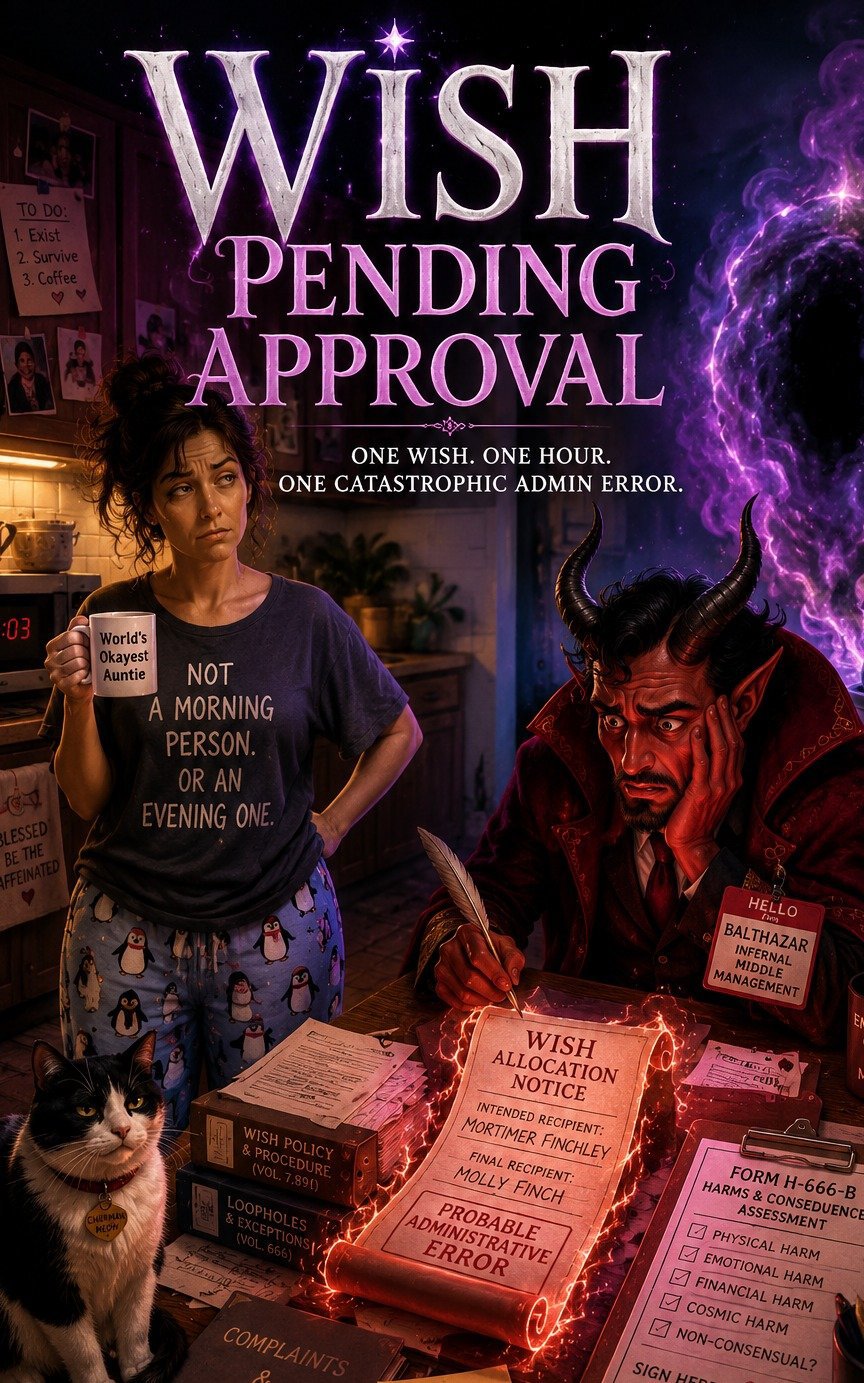
Wish Pending Approval

A demon offers Molly one wish by mistake. Refuse, and a billionaire becomes immortal. Use it, and Hell may discover paperwork.
Wish Pending Approval
She was given one wish, and one hour to decide.
This would have been overwhelming under normal circumstances.
Unfortunately, it happened at 7:03 p.m. on a Tuesday, while Molly Finch was wearing pyjamas with penguins on them, holding a fork in one hand, and trying to decide whether the smell coming from her microwave was soup, plastic, or a legal matter.
The kitchen lights flickered.
The microwave beeped.
The air split open above the bin.
A tall, horned figure in a burgundy cloak stepped through a column of black smoke and landed with both hooves directly in the cat’s water bowl.
The demon looked down.
Molly looked at him.
Her cat, Chairman Meow, looked at both of them with deep professional disappointment.
The demon lifted one dripping hoof and said, in a voice like thunder arguing with a cathedral, “Mortal woman, tremble before—”
“Shoes off,” Molly said.
The demon blinked. “Pardon?”
“Hooves. Whatever. You’re on laminate.”
“I am Balthazar Grivens, Third Infernal Officer of Desires, Bargains and Miscellaneous Temptations.”
“Lovely. Mat’s by the door.”
Balthazar stared at her as if, in all his centuries of corrupting souls, no one had ever made him feel underdressed.
Then he sighed, stepped carefully out of the cat bowl, and wiped each hoof on the mat.
“Thank you,” Molly said. “Now, why are you in my kitchen?”
Balthazar raised one clawed hand. A scroll appeared in a burst of flame. It unrolled dramatically until it touched the floor, then kept going across the tiles, under the table, and into a pile beside the recycling.
“Molly Finch,” he intoned, “you have been chosen by powers older than language, darker than the grave, and considerably more senior than me, to receive one wish.”
Molly looked at the microwave. The soup had overflowed and was now making a noise like a swamp learning to breathe.
“One wish,” Balthazar continued, “bounded only by the ancient restrictions of cosmic balance, infernal liability, and clause seventeen, subsection b, concerning requests involving time travel, resurrection, or members of boy bands.”
Molly took a slow breath.
“I’ve got work tomorrow.”
“Yes.”
“I have soup exploding.”
“Yes.”
“And there is a demon in my kitchen offering me a wish.”
“That is correct.”
“Is this because I clicked ‘accept all cookies’?”
“No,” Balthazar said. “Though that does not help.”
Molly put the fork down.
“Right. What’s the catch?”
Balthazar smiled. It was not a friendly smile. It had too many teeth and not enough dentist.
“You have one hour to decide. At 8:03 p.m., your wish expires. If you do not make a wish, the allocation passes to the original candidate.”
Molly narrowed her eyes.
“The original candidate?”
Balthazar’s smile twitched.
“Yes.”
“So I wasn’t meant to get this?”
The kitchen went very quiet.
Even the soup seemed interested.
Balthazar glanced at the scroll. Then at Molly. Then at the scroll again.
“Technically,” he said, “all recipients are exactly where destiny intends them to be.”
“That sounds like something someone says after sending an email to the wrong person.”
“Destiny has a very robust filing system.”
“Who was supposed to get it?”
“I am not at liberty to disclose—”
Molly reached past him, picked up the scroll, and turned it around.
At the top, written in scorched gold letters, was:
WISH ALLOCATION NOTICE
INTENDED RECIPIENT: MORTIMER FINCHLEY
FINAL RECIPIENT: MOLLY FINCH
Below that, in angry red ink, someone had stamped:
PROBABLE ADMINISTRATIVE ERROR
Balthazar snatched the scroll back.
“That is internal correspondence.”
“That is my kitchen.”
“That does not give you authority over infernal documents.”
“It does when they’re touching my recycling.”
Balthazar rolled the scroll up quickly.
Molly folded her arms.
“Who is Mortimer Finchley?”
The demon hesitated.
Molly waited.
Chairman Meow began drinking from the other side of the water bowl with the cold courage of a creature that had seen worse men than demons.
“Mortimer Finchley,” Balthazar said carefully, “is a businessman.”
“That’s never good.”
“He owns several companies.”
“Worse.”
“He has donated to many causes.”
“What causes?”
“Mainly himself.”
Molly leaned against the counter.
“What was he going to wish for?”
Balthazar looked toward the ceiling as if hoping for a helpful bat to fall out of it.
“I must stress that I cannot disclose another client’s private desires.”
“Fine. Guess I’ll wish for all demons to speak only in limericks.”
Balthazar’s horns drooped.
“You wouldn’t.”
“There once was a demon called Baz—”
“Immortality,” he said quickly.
Molly stopped.
“Oh.”
“Immortality, invulnerability, and legal immunity,” Balthazar added. “Packaged as one wish due to a loophole he spent eleven years researching.”
Molly stared at him.
“So if I don’t make a wish, some rich lunatic gets to live forever and never face consequences?”
“Not forever,” said Balthazar. “Until the heat death of the universe.”
“That’s forever with better branding.”
Balthazar gave a small, helpless shrug.
“It is not my department.”
Molly looked at the clock on the oven.
7:09 p.m.
Fifty-four minutes.
She had planned to spend the evening eating soup, watching a murder documentary, and pretending not to notice the laundry mountain in the corner of her bedroom.
Now she had to save the world from a billionaire with immortality issues.
Typical Tuesday.
“Right,” she said. “What are the rules?”
Balthazar brightened slightly. He liked rules. Rules made suffering measurable.
“Excellent question. You may make one wish. The wish must be spoken clearly. It cannot directly destroy the universe, reverse creation, abolish death, compel genuine love, or make people enjoy jazz against their will.”
“That last one feels specific.”
“We had an incident.”
“Can I wish Mortimer Finchley dead?”
Balthazar winced.
“That would involve several departments, two ethics committees, and one very angry horseman. I would advise against it.”
“Can I wish he becomes poor?”
“Define poor.”
“Has to check his bank before ordering chips.”
Balthazar considered this.
“Possible, but he may recover.”
“Can I wish for everyone he’s hurt to get justice?”
“Justice is complicated.”
“No, it isn’t. People who do bad things face consequences.”
Balthazar gave her a look of almost tender pity.
“That is not justice. That is optimism.”
Molly hated that he had a point.
She opened the microwave. A cloud of steam rolled out. The soup had escaped its bowl and spread across the plate like it was trying to reach international waters.
She shut the door again.
“Can I think?”
“You have until 8:03.”
“And you’re just going to stand there?”
“I am required to supervise.”
“Fine. Sit down.”
Balthazar looked at one of the kitchen chairs.
“It has cushions.”
“Yes.”
“They have ducks on them.”
“Yes.”
“I am an infernal officer.”
“And yet here we are.”
Balthazar sat.
The chair made a noise like it had seen its entire life flash before its eyes.
Molly paced.
A wish.
A real wish.
Not a birthday wish blown over cheap candles. Not a 2 a.m. wish whispered into a pillow when life got too heavy. Not the kind people made when the bus arrived late or a text went unanswered or their card declined at Tesco.
A proper wish.
She could fix things.
Her first thought was money, obviously. Anyone who said otherwise was either lying or had never received a gas bill in winter.
She could wish off the debt.
Wish for a house.
Wish for her mother’s knees to stop hurting. Wish for her brother to call more. Wish for the damp patch in the ceiling to stop expanding like a haunted continent.
She could wish for the ache in her chest to disappear whenever she thought about Daniel.
That one made her pause.
Balthazar noticed.
“Ah,” he said softly. “There it is.”
Molly turned.
“What?”
“The personal wound. There is always one.”
“I don’t have a personal wound.”
“You named your cat Chairman Meow.”
“That’s politics, not trauma.”
Balthazar tapped the scroll against the table.
“You could wish him back.”
Molly’s face changed before she could stop it.
Daniel had been gone three years. Sudden, stupid, ordinary death. A wet road. A tired driver. A phone call at midnight.
There had been no final speech. No meaningful goodbye. Just a policeman on the doorstep and her own hands going numb around a mug of tea she could not remember making.
For one dangerous second, the kitchen vanished.
There was only Daniel laughing with toothpaste on his chin. Daniel stealing chips from her plate. Daniel saying, “I’ll be back in ten,” and not knowing the universe was a cruel editor.
Molly swallowed.
“You said resurrection was restricted.”
“Restricted, not impossible.”
“What’s the catch?”
Balthazar’s silence was answer enough.
“What’s the catch?” she repeated.
“A life returned must be balanced by a life redirected.”
“Meaning?”
“Someone else dies.”
Molly laughed once. It came out sharp.
“Of course. Of course that’s how it works. Heaven forbid the universe does anything without charging postage.”
“I don’t design the system.”
“No. You just deliver it.”
Balthazar looked wounded.
“I also process forms.”
Molly looked at the clock.
7:21 p.m.
Forty-two minutes.
Her phone buzzed on the counter.
A message from her friend Leanne:
You alive?
Molly typed:
Demon in kitchen. One wish. Might have to stop billionaire becoming immortal. Soup ruined.
Leanne replied immediately:
Wish for thinner thighs.
Then:
No wait. Wish for his money.
Then:
Actually wish for Pedro Pascal.
Molly sighed.
Balthazar peered at the phone upside down.
“Who is Pedro Pascal?”
“A clause seventeen subsection b waiting to happen.”
Balthazar nodded gravely, as if this made sense.
Molly opened a notes app and typed possible wishes.
1. Money.
Selfish, but useful.
2. Mum healthy.
Good, but what about everyone else’s mum?
3. Daniel back.
No. Not like that.
4. Stop Mortimer Finchley.
Too narrow?
5. World peace.
Suspicious. Too many moving parts.
6. Everyone gets what they deserve.
Dangerous. Some people deserve a parking fine. Some deserve prison. Some deserve a cuddle and therapy. Who decides?
She looked at Balthazar.
“Can I wish for world peace?”
He inhaled through his teeth.
“You can.”
“But?”
“Last person who tried it removed free will.”
“Oh.”
“For twelve minutes, Earth was very peaceful. Then everyone regained consciousness and started three new wars over whose fault it was.”
Molly deleted number five.
“Can I wish for no one to be evil?”
“Define evil.”
“People who hurt others because they can.”
“Do you mean intent, action, outcome, ideology, negligence, greed, apathy, cowardice, bureaucracy—”
“Fine, stop.”
“As you can see, evil is administratively dense.”
“You must love it.”
“We have a newsletter.”
Molly sat opposite him.
“You’re scared.”
Balthazar stiffened.
“I am incapable of fear.”
“Your left horn sweats.”
He touched it quickly.
“It does not.”
“It’s glistening.”
“That is atmospheric condensation.”
“In July?”
“I am from a warm region.”
Molly leaned forward.
“What happens to you if I use the wish?”
“That depends on the wish.”
“What happens if I refuse?”
“Mortimer Finchley receives the wish. I return to my department. A mistake is quietly corrected.”
“And if he becomes immortal?”
“That is above my pay grade.”
“What is your pay?”
Balthazar looked offended.
“Pain.”
“So nothing useful.”
“There is a pension scheme.”
“In Hell?”
“It is mostly symbolic.”
Molly almost smiled despite herself.
“What happens if I make a wish that exposes the admin error?”
Balthazar’s expression collapsed.
“There would be an inquiry.”
“Good.”
“No,” he said, suddenly serious. “Not good. Infernal inquiries are not like human inquiries. Humans ask questions, take notes, blame someone junior, and move on. Hell takes notes forever.”
“Sounds deserved.”
“You don’t understand. I could be reassigned.”
“To what?”
Balthazar looked away.
“Children’s recorder practice.”
Molly gasped.
“You monsters.”
“We are very thorough.”
For the first time, Molly felt something dangerously close to sympathy.
Then she remembered Mortimer Finchley wanting to live forever without consequences and sympathy returned to its cage.
7:34 p.m.
Twenty-nine minutes.
Molly stood and made tea because Britain had trained her for emergencies with boiling water.
“Do demons drink tea?”
“Only if it has been witnessed by despair.”
“I’ve got oat milk.”
“That will do.”
She made two mugs. Balthazar held his with both claws, suspicious but grateful.
The sight of a demon hunched at her kitchen table, sipping tea from a mug that said World’s Okayest Auntie, should have been absurd.
It was absurd.
But the hour was shrinking, and beneath the absurdity was a weight pressing at Molly’s ribs.
One wish.
One hour.
Every option seemed either too small or too dangerous.
Wish for money, and Mortimer lost. That helped her. It did not help the people like her who would still be crushed by men like him.
Wish for her mother’s health, and she would do it in a heartbeat if the world were smaller. But the world was not smaller. That was the problem. It had too many people in it. Too many needs. Too many griefs. Too many versions of Daniel who did not come home.
Wish for Mortimer to fail, and another Mortimer would rise.
Wish for justice, and the universe might misunderstand.
The universe had a history of misunderstanding.
Molly turned to Balthazar.
“How many wishes get granted?”
He stirred his tea with one claw.
“I cannot disclose exact figures.”
“Roughly.”
“No.”
“I’ll wish for you to have knees.”
Balthazar’s eyes widened.
“Seven hundred and twelve last financial century.”
Molly stared.
“Financial century?”
“We budget differently.”
“And who gets them?”
“Kings. Tyrants. Inventors. Witches. Occasionally someone who finds a lamp in a charity shop and says something stupid while polishing it.”
“Normal people?”
“Rarely.”
“Why?”
“Normal people waste them.”
“On what?”
“Rent. Teeth. Their children. A dog that died when they were nine.”
Molly’s throat tightened.
“That’s not wasting.”
“No,” Balthazar said, looking into his tea. “But it does not reshape empires. Upper management likes scale.”
“Upper management sounds awful.”
“It is Hell.”
“Fair.”
Her phone buzzed again.
Leanne:
Serious answer: wish that no one cruel can have power.
Molly typed:
Define cruel. Demon says evil is administratively dense.
Leanne:
Why does your demon sound like he works for the council?
Molly glanced at Balthazar.
He was now reading the ingredients on the oat milk carton with scholarly horror.
“He sort of does,” she muttered.
7:45 p.m.
Eighteen minutes.
The lights flickered again.
Balthazar sat up sharply.
“What?”
He checked the scroll. New red letters burned themselves onto the parchment.
TRANSFER PREPARATION INITIATED. ORIGINAL RECIPIENT AWAITING ALLOCATION.
Balthazar swallowed.
Molly saw the fear in him then. Not just for himself. For what was coming.
“Tell me about Mortimer.”
“I cannot—”
“Balthazar.”
The demon looked at her.
For all the smoke and horns and theatrical nonsense, he suddenly looked tired. Not human, exactly, but close enough to recognise the shape of it.
“He believes consequences are a design flaw,” Balthazar said. “He has spent his life purchasing distance between action and result. When workers suffer, it is market pressure. When rivers are poisoned, it is operational leakage. When families lose homes, it is asset optimisation.”
Molly was quiet.
“He wants to become untouchable,” Balthazar continued. “Not because he fears death. Because death is the last thing in existence that does not respect his lawyers.”
The kitchen seemed colder.
Molly looked at her list again.
Nothing on it was enough.
That was the trick, wasn’t it?
People like Mortimer always wanted one giant thing. Immortality. Immunity. Control. A throne so high they never had to see the floor.
Normal people wanted a hundred little things. A fixed boiler. A safe street. A phone call. A body that didn’t hurt. A person back at the table. A month without panic.
One wish could not hold all of that.
Unless the wish was not for an outcome.
Unless it was for a rule.
Molly slowly put the phone down.
“Balthazar.”
“I dislike your tone.”
“Can a wish change the process of wishes?”
“No.”
Molly waited.
Balthazar looked away.
“Probably not.”
She waited harder.
He muttered something in a language that made the fridge magnet fall off.
“Technically, process alteration is possible if the wisher has standing.”
“What standing?”
“You are the active recipient of an allocated wish.”
“So I have standing.”
“Unfortunately.”
Molly smiled.
Balthazar gripped his mug.
“No.”
“I haven’t said anything.”
“You are about to wish for paperwork. I can feel it.”
“Is paperwork powerful?”
“In the wrong hands, more than fire.”
“Brilliant.”
Balthazar stood so quickly the chair toppled backwards.
“You must not.”
“Why?”
“Because systems are delicate.”
Molly laughed.
“Systems are delicate? People are delicate. Systems are what people hide inside when they don’t want to feel bad.”
“That is a very emotional interpretation of governance.”
“I work in customer service.”
“Ah,” Balthazar said. “Frontline trauma.”
7:54 p.m.
Nine minutes.
The scroll began to smoke.
Balthazar’s voice dropped.
“Molly. Listen to me. If you tamper with infernal allocation procedure, Hell will not thank you.”
“I wasn’t expecting a hamper.”
“You could make everything worse.”
“Could I?”
“Yes.”
“Worse than immortal billionaires?”
“There are degrees.”
“Then help me word it.”
Balthazar froze.
“No.”
“Yes.”
“I am forbidden from advising a mortal toward a wish.”
“But are you forbidden from preventing poorly drafted policy?”
His mouth opened.
Closed.
Opened again.
Molly could almost see the bureaucrat wrestling the demon inside him.
“The wording,” he said slowly, “would need to be precise.”
“Obviously.”
“It must not create infinite review loops.”
“Fine.”
“It must define affected parties.”
“Good.”
“It must include curses, blessings and bargains, otherwise departments will route around it.”
“Add that.”
“And miracles,” he said bitterly. “Those smug upper-realm idiots love a loophole.”
Molly grabbed a pen and the back of an electricity bill.
“Talk.”
Balthazar paced now, cloak swishing, tea forgotten.
“You cannot wish for goodness. Too subjective. You cannot wish for fairness. Too broad. You need procedure, harm assessment, appeal rights, and enforcement.”
“This is the least sexy demon deal in history.”
“Be grateful. Sexy demon deals end in frogs.”
“Noted.”
7:58 p.m.
Five minutes.
The lights dimmed until the kitchen was lit only by the microwave clock and the red glow of the scroll.
The air above the bin began to open again.
Through it, Molly glimpsed another room.
A huge office. Glass walls. A man in a perfect suit standing beside a desk bigger than her entire kitchen. He was smiling.
Mortimer Finchley.
He looked exactly like she expected: polished, thin-lipped, and rich enough to think empathy was an optional app.
He could not see her yet.
But he was waiting.
Balthazar’s scroll screamed.
TRANSFER IMMINENT.
Molly read the sentence she had written.
It was ugly.
It was long.
It contained the phrase “non-consenting third-party harm,” which was never going to look good on a greeting card.
But it was the best she had.
Balthazar looked at her.
“You understand,” he said, “this will count as your wish.”
Molly thought of money.
Her mother’s knees.
Daniel.
The damp patch on the ceiling.
Her tired life, with all its small humiliations and unpaid miracles.
Then she looked through the tear in the air at Mortimer Finchley, checking his watch as if even eternity should hurry up for him.
“Yes,” she said. “I understand.”
At 8:02 p.m., Molly Finch stood in her penguin pyjamas, in a kitchen that smelled of burnt soup, and made her wish.
“I wish,” she said clearly, “that from this moment until the end of everything, every wish, miracle, curse, blessing, bargain, loophole, divine favour, infernal favour, supernatural allocation, and cosmic exception must pass an independent harm review before taking effect; that anything causing serious harm to people who did not freely consent is automatically refused; that all affected parties receive the right to appeal; and that no one, living, dead, divine, infernal, wealthy, royal, elected, unelected, or spiritually annoying, can exempt themselves from the process.”
The universe went silent.
Balthazar whispered, “Spiritually annoying?”
“It felt necessary.”
Then reality sneezed.
Every cupboard in the kitchen flew open.
Chairman Meow levitated three inches, decided he hated it, and returned to the floor by force of personality.
The scroll burst into flames, folded itself into a paper crane, screamed in Latin, and vanished up the extractor fan.
Through the tear in the air, Mortimer Finchley opened his mouth.
Molly heard him say, “I wish to be immortal, invulnerable, and immune from—”
A bright white form appeared in front of his face.
It made a polite ding.
Mortimer stopped.
A calm voice announced:
“Your request has been refused under Regulation One: Catastrophic Non-Consensual Consequence. You may appeal within fourteen working eternities.”
Mortimer stared.
“What?”
The voice continued.
“Additionally, your pending contracts have been referred to the Office of Moral Fraud, the Bureau of Poisoned Rivers, and three mothers from Wolverhampton.”
Mortimer screamed.
The tear snapped shut.
Molly’s kitchen lights came back on.
The microwave beeped again, although no one had touched it.
For a moment, nobody moved.
Then Balthazar sat down very slowly.
“You did it,” Molly said.
“I did not do it. I was coerced by policy anxiety.”
“You helped.”
“I advised on wording to prevent catastrophic ambiguity.”
“That’s helping.”
“That is compliance.”
Molly smiled.
Balthazar put his head in his hands.
“They will create a department.”
“Good.”
“They will need managers.”
“Probably.”
“They will need training.”
“Definitely.”
“They will need someone who understands both infernal procedure and customer complaints.”
Molly said nothing.
Balthazar looked up.
“No.”
The air behind him opened.
A small grey envelope dropped onto the table.
On the front, in neat gold letters, it said:
BALTHAZAR GRIVENS
TEMPORARY ACTING DEPUTY OMBUDSMAN FOR SUPERNATURAL HARM REVIEW
Balthazar made a noise that no human alphabet could survive.
Molly picked up the envelope and read the second line.
“Oh, look. Comes with paid leave.”
He snatched it from her.
“Hell does not have paid leave.”
“It does now.”
His claws trembled as he opened the letter.
His eyes moved across the page.
“There is… a pension adjustment.”
“Nice.”
“And hybrid working.”
“Even better.”
“And mandatory empathy training.”
Molly winced.
“Sorry.”
Balthazar looked genuinely haunted.
“I have to attend a listening circle with angels.”
“That does sound awful.”
“They bring harps.”
“Thoughts and prayers.”
“Do not mock me with upper-realm language.”
Molly laughed.
It surprised her. The laugh came from somewhere rusty but real.
Balthazar folded the letter.
The kitchen was normal again, almost.
There was still soup on the microwave plate. The cat bowl had hoof water in it. A faint smell of brimstone clung to the curtains.
But the world had shifted.
Not fixed.
Not saved in the clean, shining way stories liked to promise.
But altered.
Somewhere, a cruel man had been told no by a form.
That was something.
Balthazar stood.
“I must go.”
“Big first day tomorrow?”
He gave her a look.
“I have to draft a complaints pathway for genies.”
“Take biscuits.”
“I am an officer of Hell.”
“You are a deputy ombudsman. Take biscuits.”
Molly opened a cupboard, found a slightly crushed packet of chocolate digestives, and handed them to him.
Balthazar accepted them with solemn embarrassment.
At the portal, he paused.
“Molly Finch.”
She looked up.
“What?”
“You could have had anything.”
“No,” she said. “I could have had one thing.”
He considered this.
Then he nodded once.
It was not warm. It was not exactly respectful.
But it was something near enough.
The portal opened. Smoke curled around him.
Before stepping through, he looked back.
“For what it is worth,” he said, “your Daniel would have found the phrase ‘spiritually annoying’ very funny.”
Molly’s breath caught.
The portal closed before she could answer.
The kitchen was quiet.
Chairman Meow jumped onto the table, sniffed the place where the demon had been, and sat directly on the electricity bill.
Molly wiped the microwave. Heated what remained of the soup. Made fresh tea.
Then she sat at the table and cried for five minutes.
Not because she regretted it.
Because she did not.
That was the strange part.
She had not brought Daniel back. She had not fixed her bank account. She had not healed her mother’s knees or repaired the ceiling or made life gentle.
Tomorrow would still be tomorrow.
Work would still be work.
The world would still be run by people who mistook profit for intelligence and cruelty for strength.
But somewhere in the machinery of existence, a new rule existed.
No more wishes without review.
No more miracles for monsters without paperwork.
No more cosmic blank cheques for men who thought consequences were for other people.
At 8:37 p.m., her phone buzzed.
Leanne:
So what did you wish for?
Molly looked at the damp ceiling. The laundry mountain. The cat licking soup off his paw.
She typed:
Regulation.
Leanne replied:
You absolute freak.
Then:
Proud of you though.
Molly smiled.
Outside, rain began tapping against the windows.
In a glass tower across the city, Mortimer Finchley received his seventh refusal notice and threw a chair at a printer. The printer, newly protected under supernatural workplace dignity rules, filed a grievance.
In Hell, Balthazar Grivens sat in a meeting room beside an angel called Timothy, who had brought gluten-free muffins and a harp “just in case the mood needed softening.”
And in Molly Finch’s kitchen, where nothing looked miraculous at all, the universe quietly updated its terms and conditions.
For the first time in history, almost no one clicked accept.
That is the end of Wish Pending Approval. Thanks for reading.
Get the app for the rest of David Mozdzen's writing, and everything else on Novellea.
Open in Novellea