
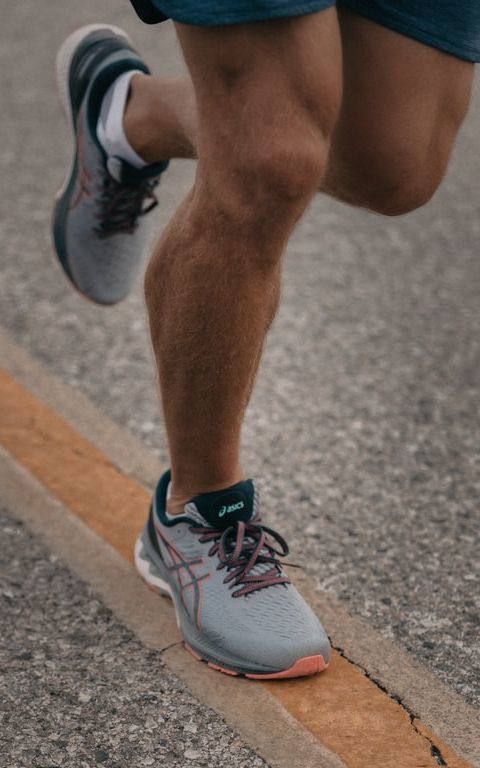
My Left Leg, Just Above the Knee
A person with body integrity dysphoria reflects on his condition. (Photo by Jakob Owens on Unsplash)
It started when I was eight or nine.
I’m sitting in the back of my parents’ car. Seconds blend into minutes into hours. Rain washes across the window: streaks of grey water staining my blurred vision. I wriggle the toes in my right foot. I feel the elasticity of my socks and the hard barrier of the shoe. I stretch out my right leg, straighten my foot parallel to my fibula, allow the tensed muscles to massage the long journey’s aches.
But I keep my left leg perfectly still. I pretend that it’s paralysed.
I’ve always thought that it should’ve been.
I’m eleven, lying in bed and staring up at the ceiling. It’s summer. The sun hasn’t wholly fallen. Soft palettes of light entice me, buzzing through me, stirring me. I am still, trying to conjure something like sleep. My mind fixates upon my left leg. Its shape presses into the mattress, feeling like something between pins and needles and an itch, something between an electric current and a lumpen, dead weight. I hate that I feel anything. It is something alien to me, something stitched onto me, a graft that doesn’t belong.
I’m fourteen, borrowing Joshua’s crutches, feigning disability. My leg hangs limply. I feel relief for the first time in years. But the limb’s still there, hanging, unatrophied, blood pumping, bones intact, muscles ready. That evening, I beg mom for crutches I don’t need. She gets angry. She says I’m ungrateful. She says that I don’t know how lucky I am.
She doesn’t understand.
I don’t understand.
I’m sixteen, standing on the edge of a bridge, trying to calculate the damage of a fall. Left leg extended, offered to some careless god, offered for the rest of me, the weight of my fall. I don’t hear the kindly woman running towards me, not until she drags me back from the edge and tackles me to the ground. ‘No, child,’ she keeps saying, hugging me to her breast. ‘No, child. There’s another way.’
I’m not suicidal.
I’m talking to a psychiatrist, mom pacing outside, tears streaming down her face. I tell the doctor that my left leg was meant to be paralysed. I ask if he’d make a surgeon cut it off above the knee. It’s like the opposite of being made whole, I say. It’s like removing a parasite, a tapeworm, a cancerous growth. I can tell from the doctor’s face that he doesn’t know what kind of crazy I am.
It’s a different time.
Mom makes me promise. I’m not to try this again. I’m not to try this again. Do I understand?
The doctor gives me anti-depressants. He doesn’t speak to a surgeon.
I’m twenty, skiing down the snow-lain slopes of the Caberfae Peaks. I’m in the varsity team. They say I’m fearless, but they don’t know the truth. I’m just waiting for a fall bad enough to cripple me. The mangled leg, the popped-out knee, the broken bone. It never comes. Animal impulse holds my balance, bestial instinct lessens each twist and tumble.
We win bronze in the Division II.
I’m twenty-four, researching self-amputation. One Hand Jason. Doctor Robert Smith. Arteries and clean instruments. Tourniquets and preparations. Words and data compressing on my left calf, prodding it, measuring it, scratching it. I hear mom’s voice in my head. I’m not to try this again. I’m not to try this.
I’m twenty-seven, wondering if I should tell Vanessa. I’ve already told her that I love her. She’s said it back. But I can’t tell her about this. Butterflies throw up in my stomach. Lies upon lies have compounded into betrayals. A cane for a skiing injury in my left leg. A limp that I’ve practiced and perfected and twisted my back into dull aches. A story of how it was almost amputated, an ideation, a fantasy, a hope.
I don’t tell her.
I don’t want to be alone.
I’m thirty-two. Yesterday. Mom’s funeral has come and gone, folding back into the laundered weeks of creased thoughts and crumpled time. I’m in a bathtub with a wooden block, a roll of bandages and an electrical saw.
It doesn’t hurt. It was never supposed to be attached in the first place. Just the sting of a pimple being popped. A tumour carved away. The endless, buzzing tingling, the discomfort – that maddening, hateful discomfort – it’s gone.
I sigh a sigh that’s been waiting for me my entire life, and call an ambulance.
I wake in a hospital bed. Vanessa holds my hand, her face grief-stricken with dried, uncomprehending tears. Serious-faced doctors tell me they couldn’t reattach my lower left leg. Vanessa bursts into sobs when she sees me smile.
A psychiatrist comes to speak to me. I tell her everything I’ve always wanted to tell Vanessa. She nods. She doesn’t seem to judge. I explain that I don’t regret what I’ve done. I’m finally free of it: that alien, unbelonging appendage, that awful, empowering weight. She nods. She takes notes.
Vanessa doesn’t understand. She tells me that we’ll get help. That we’ll get through this.
There’s so much to say and I’m scared that it’s too late to say it. I don’t know how I’ll formulate the words, clumsy and disordered. I don’t know how I can organise my life into something she’ll understand. Something that sounds like me, or, at least, the me she thinks she knows.
They all think I’m crazy. Maybe I was, before. I don’t think I care. If I was crazy, I’ve cured it.
It’s over. The feeling is gone, forever.
I’m free of it.
That is the end of My Left Leg, Just Above the Knee. Thanks for reading.
Get the app for the rest of Stephen Duxbury's writing, and everything else on Novellea.
Open in Novellea