
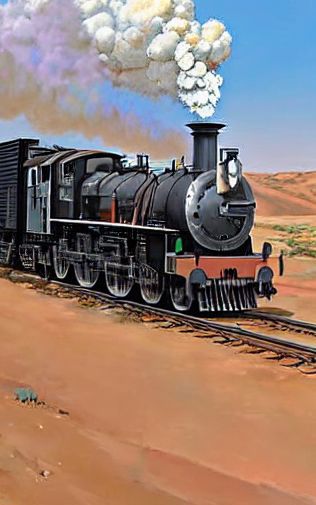
The Iron Horse

A young photographer hears about a train cemetery, and decides to pay a visit by himself.
In Brazil, in the far northern part of the state of Paraíba, where the land is mostly dry and cracked, there lay a train cemetery. Even though there were no gravestones, it felt like any other cemetery: it was silent and somber, and Arthur could feel the atmosphere of sadness that so often surrounds real graveyards.
The enormous machines formed a labyrinth. Arthur couldn't understand how there could be so many of them. Click. A photo. Click, click. Two more photos of a rusty, pinkish train dating back to 1892. It must have been red at some point in its coal-propelled life, but, little by little, time had sapped its colour.
Arthur was fascinated. He had not even known that places like that existed. He was surrounded by ancient machines, cacti, and miles of desert. His pictures were astonishing, especially with the golden light of the sun on its way to the horizon. Click. A photo of a train that, with a bit of imagination, he swore had a melancholic face, as if it were nostalgic for the days when it spewed smoke into the air and carried passengers to all parts of the state. Click.
He liked going to places like this by himself. When the clerk at the hostel mentioned the cemetery, he did not hesitate to ask for a map. He imagined a place centuries old, home of reliquaries of an age forgotten or ignored by most people. He wasn't disappointed. As he walked among the abandoned and forgotten trains, he tried to imagine the stories behind those machines. How many people had they carried? How many urgent situations had they helped resolve? How many couples met during the long trips? How many people died while laying down the tracks?
In the end, he concluded, cemeteries were about memories, not the dead. People do not go to a cemetery to visit the deceased, but, rather, to relive memories of those they once loved. From behind his camera lens, Arthur tried to imagine the heyday of one of the train cars he singled out, rotted and covered with dust. He smiled as he pictured a scene from the Far West, where the hero, mounted on a galloping stallion, caught up to the train and leapt onto it. He knew that such a scene would have never taken place in Brazil, but it fit the mood.
His smile vanished, however, when he heard something move behind a cactus. A vulture that had been perched on one of the train cars rose and flew over his head. The sudden beating of wings gave him a start, making him jump back. His foot stumbled on a stone and he staggered backwards until he came up against another car. The sound of the hollow metal of the old locomotive startled dozens of other vultures, which took flight in unison. The huge black creatures darkened the skies for a while. With his heart racing, Arthur watched them above, but it was not until the sound of their wings faded in the distance that he managed to laugh at the situation.
He decided that he had spent enough time there. The whole place had a macabre air to it. The sun threw shadows that grew ever longer. Arthur took a few last photos, then stuffed the camera in his backpack. It was time to go.
That was when he realized that he did not know where he was.
The decades had made all those machines look the same to him: old and discoloured. To get there, he had taken a bus from the small city of Tucunhas as far as the dirt road that led to the cemetery, then grabbed a ride in a rancher’s cart to his destination. “When you’re ready, just come on back to this road and walk to the end, I’ll pick you up and take you back,” the rancher said. Now Arthur did not know where the road was.
As he searched for the way back, he slipped between one car and another at an angle, coming out on an open plain. The desert stretched as far as the eye could see. A gust of wind caught him by surprise, tossing sand in his face. He could not make out the road he had used when he came. However, he did see some train tracks, which lay no more than ten yards away. They hardly showed any signs of wear, looking like they had been placed there only a few months ago. They seemed to come out of nowhere and went on to nowhere, meeting the sky in the horizon.
The sound of someone grunting behind him gave Arthur the second fright of the day. He took a deep breath and turned around quickly to look. From the space between the two cars he had passed moments earlier came an elderly man, carrying a large bag with scraps of metal in it. He wore a jean apron with suspenders, the kind that Arthur thought no one anywhere had used for decades.
Arthur was at a loss for words. He had not seen this man around, even though he had spent more than three hours ambling through the cemetery. For his part, the scrap metal scavenger caught a glimpse of him while moving from one abandoned train car to another.
“Afternoon,” he said with a grunt.
“Good afternoon,” Arthur replied. He grabbed his camera from the backpack without thinking too much. Instinct moved his hands.
“Are you lost, son?”
“I don't think so... I mean, no.” He paused as he took some more pictures of the scene.
“Oh, photos,” the man said, grunting again. “You young people always come here taking photos.”
Another gust of wind put an end to the conversation, so the old man turned to head towards another train car. Something about him bothered the photographer, but he could not put a finger on it. A few seconds later, the old man grunted again, while Arthur kept on watching him.
“This place is a junk yard that people sometimes treat like a museum. Or, sometimes, a cemetery. So that’s why there’s always some kid like you coming here to take photos. Always taking photos.” He put a few more pieces of rusty steel in his bag before continuing. “So many beautiful places to see, and, still, you all come here to see this lousy dump of old junk, disturbing the peace and quiet.”
“Do you live here, sir?”
“Yes and no, kid. It’s a long story”. The old man spoke without turning around, gesturing with his free hand, as if he felt disdain for every word he said. Arthur put the camera away - didn't feel right to do it any more.
“Are these tracks recent?”
“That depends. Recent is a notion that changes, depending on whether you’re young or old, kid.”
Arthur laughed.
“So is there any train that still goes through here?”
“Oh, yes. It comes twice a day, at six in the morning and six at night.” The old man looked up toward the sky for a few moments, squinting his eyes and shading them with his hand. Then he turned back to his work, saying, “It’s bound to arrive any moment now.”
“A train that’s still operating in this desert, who’d have imagined!” said Arthur, suddenly wishing he had brought some old-fashioned garment in his backpack to meet the occasion. He felt like he was living a moment that happened two hundred years ago. He checked with the elderly scavenger to ask if the train went to Tucunhas and whether it stopped near the cemetery. The old man, who said his name was Eugene, confirmed that it did.
“It stops right here, you just have to flag it down. It chugs along real slow, it’s so old. One good kick and I bet I could derail that big piece of junk. It would make for some great scrap metal,” he said, grunting once more.
No sooner had Eugene finished speaking than he disappeared into the cemetery. The sun was already half-hidden behind the mountains when the train appeared on the horizon, spewing out black smoke from the chimney at the head of the line of cars. It came so slowly that it took more than ten minutes to reach the cemetery. Arthur flagged it down, and the giant machine ground to a stop with a deafening burst of steam. It was a real Iron Horse, a truly majestic machine. Arthur could see that everything Eugene said about it was a lie. Like the tracks, the locomotive was in excellent condition. It was black and shiny, its polished surface glittering in the sunset. It did not even show any sign of rust. When he climbed the steps of the car, he saw the red curtains through the windows, still in pristine shape. He opened the door and entered. Inside, everything looked exactly like something from an earlier century, but preserved as if brand new. Arthur took his camera out again and snapped pictures right and left as the train began moving forward again, heading slowly toward Tucunhas.
He did not notice how much time passed while he took pictures of the train’s old cabins, colonial curtains, antique wood furniture, and even the lovely landscape outside. But he did note that the train, which had come from some distant place and apparently did not pass through many inhabited locations, was utterly empty. He hoped he would run across a tourist, even another photographer like himself, to exchange some ideas. But he got so immersed in taking pictures that he only broke out of his mesmerized enthusiasm when the locomotive began surging ahead. From one moment to the next, the train’s slow, monotonous march forward suddenly picked up speed. The dead trees and cacti were merged in blurs.
The first thing that occurred to him was to ask the engineer what was going on. He also wanted to know how much more time it would take to reach Tucunhas. He had trouble walking, trying to keep his balance as the cars whipped along at high speed. He finally reached the engineer’s cabin and opened the door. There was no engineer. There was not even a control panel.
His heart froze. He looked out at the landscape. He had never seen these surroundings before. The sun was gone. He did not know where he was nor where he was going.
-------------------------------
A few days later, back at the train cemetery, the police were leaving to go back to the city. Eugene watched the red and blue lights of their cars moving along the dirt road, receding farther into the distance. It was always the same story: some kid had come to the cemetery to take photos, then caught the six o’clock train and disappeared. The police would come soon afterwards trying to locate the missing person, but without success.
The old man did not understand why they didn't see the tracks, nor why they never came over to ask him any questions, but it did not bother him. When they visited the cemetery with their blinding lights and search dogs, Eugene would cower in his dilapidated shack and wait for them to leave. Sometimes the dogs even came sniffing inside his shack and looked him in the eye, but apparently the police could see nothing, so they left.
With his shoulder bag jangling with pieces of rusty metal, he set out again for the tracks. In the distance, he could see the train approaching. It was an ugly old thing, much inferior to the fine machines he had been accustomed to driving years ago, around eighteen hundred… and what? He had forgotten. He had been here for so many years that he was not even sure any more.
He waited for the rattletrap to arrive. He thought about his wife. He missed her greatly, wishing he could embrace her once again. He thought the train might carry him to her. But when the machine stopped alongside him, with its wheezy blast of steam, he did not have the strength to climb up into it. Something held him back, something that had always held him back over all those years. He looked up at the door to the train car, its handle beckoning him. Then he turned around and retraced his steps back to his shack, muttering some curse.
Maybe tomorrow he would try again.
That is the end of The Iron Horse. Thanks for reading.
Get the app for the rest of Marco Saraiva's writing, and everything else on Novellea.
Open in Novellea