
Traditions
A boy faces death for the first time, and learns to repress his feelings. (Photo by Stephen Ellis on Unsplash)
I was fourteen years old when I saw my first human corpse.
Grandma had lived a long life. ‘Too long,’ she used to say. Grandpa died before I was born, killed by prostate cancer that riddled his guts, robbed him of a dignified death. All I knew was grainy photographs, with his deep-framed glasses and a beard that covered his round face. When I first saw it, I asked my grandma if she’d married a gorilla. She laughed so hard that she cried.
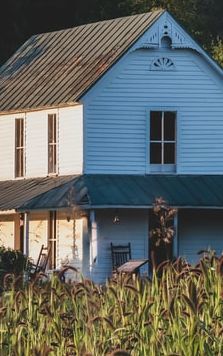
We were isolated, on the farm. Traditions grew up like roots around us, undermining the foundations. It was just how things were. I didn’t get much schooling. As soon as I was old enough, I helped on the farm: mucking out, changing bales, collecting eggs from the chickens, milking the suckler cows, and, when I was twelve, slaughtering the beef. I hated that at first. I had known those animals my entire life, and they trusted me, with their brown bovine eyes reflecting mine. Dad told me to stop being a sissy. He kept making me slaughter them until I could do it without crying.
I don’t know what grandma died of. She just shrank away, her skin ravelling into a walnut, her eyes retreating into her skull. Sometimes I thought Death was slinking out of her: that it had taken root in her since grandpa died, and was finally taking off its mask. When I thought of that, I was scared, but I didn’t tell anyone. I knew that dad would make me visit her more often if he knew.
I was glad when she finally died.
It was a mild, winter day. I remember that it was cloudy. Mom served up the eggs and told me that grandma had died. I just nodded.
Thomas, my little brother, wept. I told him not to cry, otherwise dad would call him a sissy. I gripped his head in my hands and used my thumbs to wipe away his tears. Mom told us both to ‘hush, now.’ I told Thomas to be quiet. He whimpered into his toast. He was only seven. Dad hadn’t shown him death, yet. It was still a stranger to him, something unknown and terrifying, stalking on us all.
We started work late that day. Dad spoke with Father Hebley to put things in order. Dad was always different with Father Hebley. He would smile, and stroke his chin, which he’d never do normally, unless he had to wipe the sweat or muck from his beard. I knew that dad respected Father Hebley, though I didn’t understand why. Dad was bigger than Father Hebley, and Father Hebley knew nothing about raising cattle and sheep and chickens, and he was always sneering when he thought we weren’t looking. Once, Father Hebley told me that I’d go to hell if I didn’t pay attention in Sunday School. I told him that I wasn’t learning anything important in his class, and he dragged me to the front of the room and whipped my knuckles with a ruler. I could’ve stopped him if I’d wanted to. I could’ve wrenched back his arm and pinned him to the ground and beat him with that ruler, and I would have, too, if not for what dad might have done.
That was when I realised that Father Hebley was weak, and that I hated him, and that I wasn’t scared of him, either.
But dad respected him, so I had to pay attention in Sunday School, and keep my thoughts to myself. I’d scowl secret, inward scowls, and match Father Hebley’s eyes with a defiant stare, and I knew that he knew, and I knew that he’d never try to hurt me again.
I never really saw the big deal about God. I never understood the idea of Jesus as a shepherd. People were nothing like sheep. People didn’t have wool, they weren’t good to eat, and they didn’t eat grass. And then Father Hebley would talk about Joseph’s multi-coloured coat, or Moses parting the sea, and I didn’t understand what that had to do with the likes of me. I’d never seen the sea, and all my coats were one colour, and I didn’t understand what would be so great about a multi-coloured one, anyway. Once I grew older, I started to understand a bit better, to understand the lessons behind the stories. But even those lessons left me cold.
I went to church every Sunday until dad died. His funeral was the last time I stepped inside a place of worship.
When dad finished speaking to Father Hebley, he saw me skulking round the car and gestured me over. He asked if I was sad about grandma and I said no, and he cuffed me round the ear, and then ruffled my hair, so I didn’t know if he was angry or pleased with me. He said that mom would get the body dolled up, and that then we’d go and say goodbye. Once enough time had passed, we’d bury grandma in the earth by the church.
I nodded, and asked about feeding the chickens. He told me I was a good boy, and told me to get to it.
The chickens didn’t care that grandma was dead. They didn’t know. I did know, and I did care, but still, I was glad. It was obvious to me that she’d been dying for some time. I’d felt uneasy with anticipation, the rot of it. I’d wanted it to end. Every time I was forced to visit, I had to hold her hand, even though she was always sleeping, or seemed so confused that her life must’ve just been a waking dream. Her skin was calcifying into bone. Her knuckles were sharp against my palm. When she did speak, it was in murmurs, and I just said ‘yes’ and ‘hush’, like mom did, and then she’d fall quiet again.
For the chickens, it was just another day. They waddled out of the coop and swarmed about me, clucks bouncing about my skull. I scattered the feed in the dirt, and they pecked at the hard ground with determined, little beaks. I watched them for a while, figuring how long I could get away with just standing there. I tried to work out if they were happy, or anxious, or just mindless, pecking away at the earth, pressed together in company or in competition, clucking away. I imagined what it’d be like to be a chicken, so close to other chickens, clucking whenever I felt like it, but then I remembered I would be a girl, and I didn’t want to think about being a chicken any longer.
The sun broke through the clouds. A single ray of light shone down on grandma’s house, and I thought that it must be her soul, travelling up to heaven. I had liked grandma. I thought she deserved to go there. She always wore a crucifix around her neck, a cross that seemed to get bigger and bigger as she shrunk smaller and smaller, pinning her to her bed. But souls can’t be weighed down by crucifixes.
I wondered what version of grandma would go to heaven, and whether she’d find grandpa there, and whether they’d both be old, and wearing the face of Death, or if God would make them new. And then I worried that I wouldn’t recognise them if I went to heaven, because I’d only known grandpa through a grainy picture and grandma as an old lady. That made me anxious, and I kicked a stone down the path, seeing how far I could boot it along.
When I got back to the house, dad was getting ready for work. The dog sat next to him, released from his kennel, his mouth opened in a patient smile as his tail wagged behind him. Then we got to work, and it was like any other day. The sun soon disappeared beneath another curtain of clouds, and it rained a little, but that didn’t bother us. Dad took the dog to herd the sheep, and I went to milk the cows, and I mucked out the cow shit, rubbing some of it on my hands to keep them warm.
Mom was done getting grandma ready by the time the day was finished, so we ate a quick supper before making our way to her cottage. Grandma lived on the farm, but she had a house to herself that dad built after grandpa died. It was a little smaller than our house, and it felt even smaller inside. Grandma had filled it with knickknacks and memories: photographs and trinkets and shells from the sea, that played the sound of the ocean when you brought them to your ear. There was one shell that was big enough to cover the whole ear, so there was nothing but the ocean if you stuck your finger in the other ear. That was the only thing I wanted from grandma’s house, but I never told anyone.
I think mom ended up throwing it away.
Grandma was lying on the dinner table, surrounded by wildflowers that mom picked out for her: purple prairie clover, white avens, pink quinine weed. The body was dressed in her Sunday best. She was wearing red lipstick and her eyelashes were curled upwards. I didn’t like it at all. It looked wrong: not because she was dead, but because she never wore makeup when she was alive, and so the lipstick just made her look more dead, more unnatural. And there was a horrible contrast between the vitality of the red and the white of her skin, shrunken back into her skull, reminding me of a clown. I was afraid of clowns for a long time after that.
Because dad was there, I went up to the table and stared at the body. She didn’t look much different, apart from the makeup and her Sunday dress. Death had crept up on her inch by inch, and I watched it creep, so it wasn’t that bad, really. But Thomas started to cry, and that made dad angry, so I took my brother outside and slapped him round the face. I told him not to cry, otherwise he’d make dad even madder. Then I hugged him, and wiped the tears from his face, and told him it’d be alright.
‘How do you know?’ he asked me, and I didn’t know what to say, so I just repeated that it’d be alright, and pretended I hadn’t heard him. It was starting to rain, so I told Thomas to pretend that his tears were just raindrops, and that we should go back inside. Fat droplets of rain exploded on our cheeks, dribbling grey lines off our chin.
It smelled in grandma’s house. Mom had sprayed her perfume, but there was so much that it cloyed and itched at my nose. I cleared my throat so I wouldn’t splutter, and resumed my place beside the table. Grandma was holding her crucifix, its chains still leaving little indents, or wrinkles, on her neck. She wasn’t smiling, but she didn’t seem sad, either. I asked dad if she was in heaven already.
‘Yes, son,’ dad said.
I asked what the body was, if grandma was in heaven already. Dad narrowed his eyes, trying to work out if I was taking the cheek or not.
‘This is just a body,’ he said, finally. ‘This is just the flesh she used to reside in.’
‘Dust to dust,’ I said, trying to be dutiful.
‘Don’t get smart with me, boy,’ dad replied, and that was that.
It was our way to make sure a body had company for a full week, even though it was just a body, even though the soul was gone. So, we took it in turns to keep vigil, and sometimes Father Hebley did that for us, but mostly it was mom. After a couple of days, grandma began to rot, and all the perfume in the world couldn’t get rid of the smell. It stank like defecation and diseased flesh. One time, Thomas ran all the way back to the house, screaming about maggots, and dad gave him a hiding for leaving the body on its own. I hated keeping vigil, but I wasn’t scared. I’d seen dead vermin and birds rotting in the sun, and it was just like that, really. I would’ve been fine if not for the smell, which followed me about the whole week, like the shadow of Death itself, stinking on me. I watched as grandma swelled a bit, and then shrank down again, like a leaking balloon, and then start to dissolve into the grains of wood she lay upon. And, all the time, she stank.
I don’t truly know why we did that, as a family, as a community. It mustn’t have just been us, because I’m sure Father Hebley helped us with the vigil, but I don’t think if he kept coming once grandma got really bad. I don’t know why we did it. I know it wasn’t for grandma’s sake, because dad had told me that she was already gone, and there was no dignity in what we let happen to her, just watching as she disintegrated into fleshy parts. Decomposing in the most literal sense: all those elements that comprised her, separating and unbinding.
If I had to guess, I think it was for us. So we could look Death in the eye. That it was kind of a rite of passage, or a harsh reminder that we would all rot, one day. But if that was the lesson, it was a strange kind of teaching, because there didn’t seem to be any imperative, any call to action, any prompt other than just the truth that one day you will die and you will rot and you will stink.
So I don’t know.
We buried her in the earth near the church on the seventh day. I don’t know how mom got the remains in the casket, but I know that we burned the table afterwards, and kept the windows open in that house for a full month. Dad and I dug out the hole the casket would go in, while Father Hebley watched from the doorway of his church, doing nothing useful. When the time came, though, when the casket was nearby and ready to be lowered, Father Hebley wanted to say some words. He talked about God and about dust, and about heaven and how Jesus died so that our sins would go away, and that didn’t make much sense to me, but I said nothing.
I helped lower grandma’s casket into the ground, and helped cover her with the pile of earth we’d made when digging the hole in the first place. It was raining, so the earth had lumped together in clumps of mud, heavy on the end of the spade. My arms hurt. By the time we were done, we were covered in dirt and sweat, and Father Hebley had gone back inside his church. Thomas was crying against mom’s legs, but dad didn’t seem cross: he didn’t seem to notice my brother at all.
We went back to the house, and mom served up dinner. She’d slaughtered a chicken, so we had roast chicken with greens and gravy made from hot water and chicken bones. We ate in silence.
I studied dad’s face. There was gravy in his beard. His eyes seemed focused on the next forkful of food. Nothing else.
My dad did sometimes laugh, from time to time. It always came from nowhere. He had a spluttering, choking laugh that surprised everyone, even him, escaping from his windpipe in a sputter of sound. But I couldn’t tell you what made him laugh.
He didn’t laugh that day.
As mom cleared the table and dad drank whiskey, Thomas and I went for a walk. We kicked rocks down the beaten path. The sheep were restless, bleating on.
‘Is grandma in heaven?’ Thomas asked me.
‘Yes,’ I said, shrugging. I remember very clearly that I shrugged, but I couldn’t explain why I did. Thomas pursed his lips.
‘Am I going to die?’ he asked.
‘Yes.’
My little brother frowned, and I knew that he was scared. I sighed. ‘Not for a long time, though.’
‘And you and dad and mom?’
‘Everyone.’
He was silent for a few moments. ‘What’s it like when you kill a cow?’
I thought of those big, brown eyes, looking back at me, trusting me, as I placed the bolt gun to the back of his head. The shudder of his death as the bolt slid from the gun and through his brain, corpse held aloft by metal harness. How easily he went from living to dead. ‘What do you mean?’ I asked.
‘Is it scary?’
I shook my head. ‘You get used to it.’
‘Is it sad?’
I felt myself bristle with anger, but I hid it with a shrug. ‘I dunno.’
Thomas fell quiet, realising he was annoying me. A minute passed before he spoke up again. ‘Do you miss grandma?’
I shrugged again.
‘I miss grandma,’ Thomas said, his voice quiet. He looked up at the sky. The rain had emptied the clouds. The sun turned a burnished orange as it slipped and fell. The horizon brimmed with red fire and a bitter wind rustled our clothes.
We walked along in silence, and kicked stones along the path.
That is the end of Traditions. Thanks for reading.
Get the app for the rest of Stephen Duxbury's writing, and everything else on Novellea.
Open in Novellea